EIOPA proposal for Regulatory Technical Standards (RTS) on management of sustainability risks including sustainability risk plans – Part 2

Our recent article presented EIOPA’s RTS proposal regarding the requirements of sustainability risk management with respect to ORSA, governance and key functions within the future, significantly broadened Solvency II framework.

This article will focus on materiality and financial assessment of sustainability risks as well as on proposed metrics, targets, and actions described by the RTS draft.

Materiality assessment

The definition of materiality under Solvency II and the European Sustainability Reporting Standards (ESRS) are aligned in their focus on the potential impact of information on decision-making.

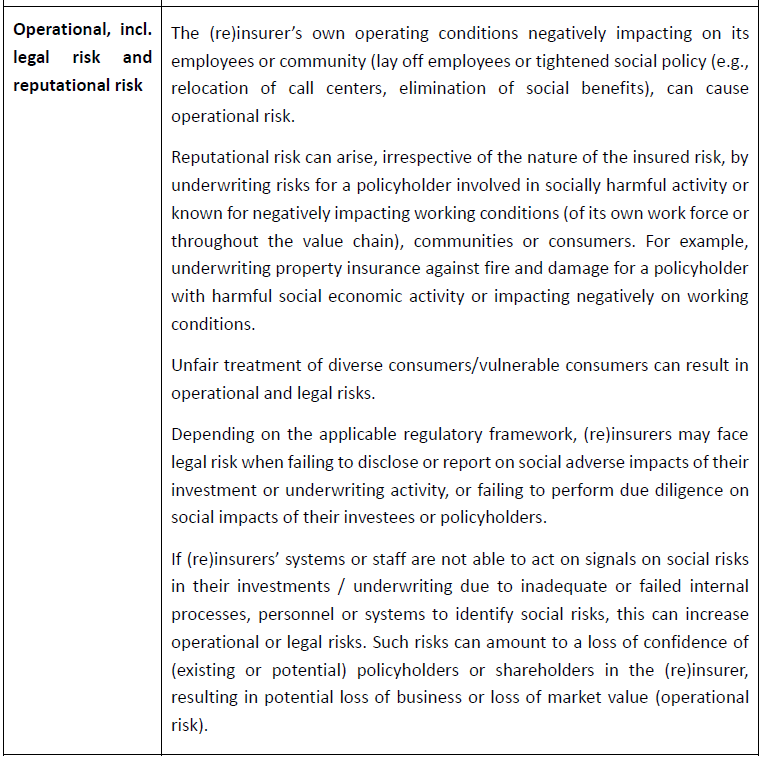
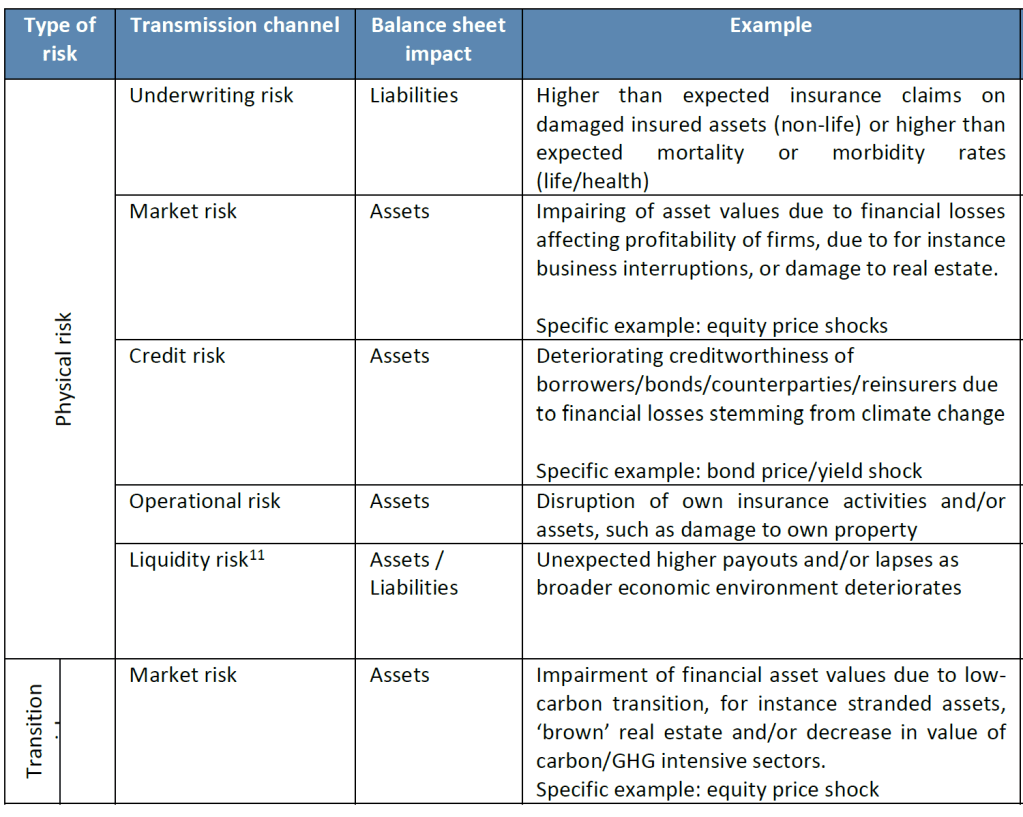
  • Under Solvency II, for public disclosure purposes, materiality means that if an issue is omitted or misstated, it could influence the decision-making or judgment of users of the information, including supervisory authorities. As to financial materiality, sustainability risks can translate in a financial impact on the (re)insurer’s assets and liabilities through existing risk categories, such as underwriting, market, counterparty default or operational risk as well as reputational risk or strategic risk. In other words, they are ‘drivers’ to existing risk categories.
  • Similarly, the ESRS defines materiality as the potential for sustainability-related information to influence decisions that users make on the basis of the undertaking’s reporting. In the context of financial materiality, which is relevant for Solvency II purposes, the ESRS specifies that a sustainability matter is considered material if it could trigger or reasonably be expected to trigger material financial effects on the undertaking. This includes material influence on the undertaking’s development, financial position, financial performance, cash flows, access to finance or cost of capital over the short-, medium- or long-term. The materiality of risks is based on a combination of the likelihood of occurrence and the potential magnitude of the financial effects.

The two frameworks are aligned as material financial effects, as defined by the ESRS, would likely influence the decision-making or judgment of users of the information, including supervisory authorities. This alignment enables undertakings to apply a consistent materiality assessment approach across both Solvency II and ESRS reporting requirements.

Both Solvency II and ESRS do not set a quantitative threshold for defining materiality. The RTS do not specify a threshold for materiality either, considering this should be entity-specific. The undertakings should however define and document clear and quantifiable materiality thresholds, taking into account the above and provide an explanation on the assumptions made for the categorisation into non-material and on how the conclusion on the materiality has been reached. The classification of an exposure or risk as material has bearing on its prudential treatment, as it is a factor that determines whether the risk should be further subject to scenario analysis in the undertaking’s ORSA. The RTS require the undertaking to explain its materiality threshold in the plan: the assumptions for classifying risks as (non-) material in light of the undertaking’s risk appetite and strategy.

The materiality assessment should consider that:

  • Sustainability risks are potential drivers of prudential risk on both sides of the (re)insurers’ balance sheet.
  • Sustainability risks can lead to potential secondary effects or indirect impacts.
  • The exposure of undertakings to sustainability risks can vary across regions, sectors, and lines of business.
  • Sustainability risks can materialise well beyond the one-year time horizon as well as have sudden and immediate impact. Therefore, the materiality assessment necessitates a forwardlooking perspective, including short, medium, and long term. For example, certain geographical locations may not be subject to flood risk today but may be so in the future due to sea level rise. The risk assessment should be performed gross and net of reinsurance, to measure the risk of reliance on reinsurance.

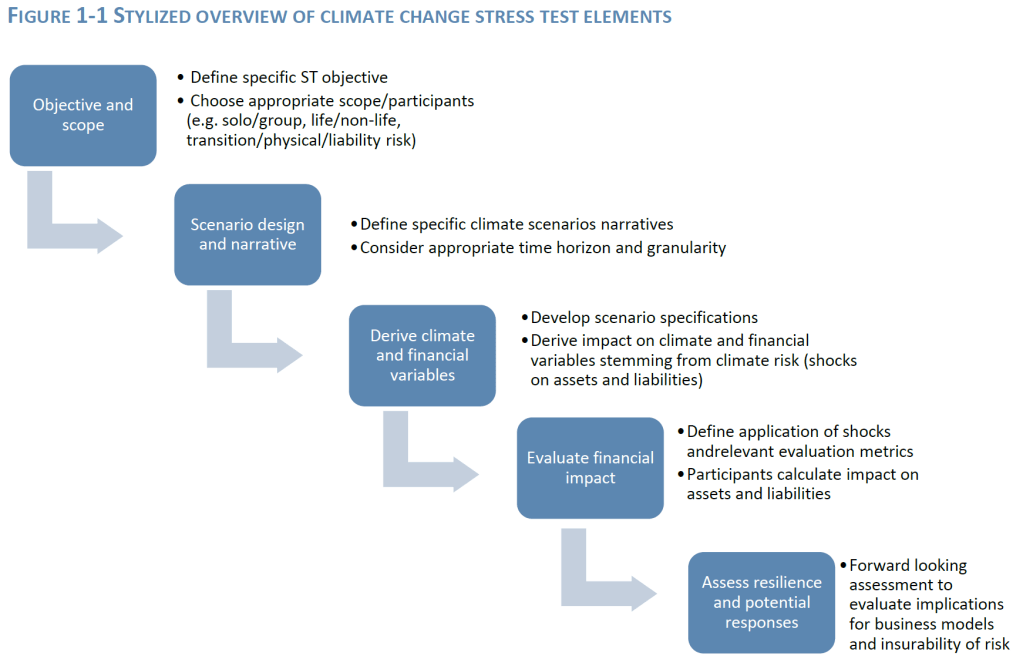
The materiality assessment would consist of a high-level description of the business context of the undertaking considering sustainability risks (‘narrative’) and the assessment of the exposure of the business strategy and model to sustainability risk (‘exposure assessment’), to decide whether a risk could be potentially material. Following this, based on the identification of a potentially material risk, the undertaking would perform an assessment of the potential financial impact (i.e., financial risk assessment, as part of ORSA).

The narrative should describe the business context of the undertaking regarding sustainability risks, and the current strategy of the undertaking. It also describes the long-term outcome, the pathway to that outcome, and the related actions to achieve that outcome (e.g., emissions pathways, technology developments, policy changes and socio-economic impacts).

The narrative would include a view on the broader impact of national or European transition targets on the economy, or the effect of a transition risk throughout the value chain. The narrative should include other relevant sustainability risks than climate, such as risks related to loss of biodiversity, or social and governance risks, as well as interlinkages between sustainability risks (e.g., between climate and biodiversity or climate and social) and spill-over and compounding effects looking beyond specific sustainability risk drivers on particular lines of business.

Sustainability narratives, indicators, and interlinkages

  • Narrative: For example, for climate change undertakings may refer to publicly available climate change pathways (i.e., the Representative Concentration Pathways (RCPs) developed by the Intergovernmental Panel on Climate Change (IPCC); Network for Greening the Financial System (NGFS)) or develop their own climate change pathway.
  • Indicators: Macro-prudential risk indicators or conduct indicators may provide additional insights and help the undertaking form its view on the future development of sustainability risks. Especially over a longer horizon, sustainability risk could have a wider and compounding impact on the economy and interactions between the financial and the real economy would need to be considered. For example, indirect impacts of climate change could lead to increase in food prices, migration, repricing of assets and rising social inequalities. All these indirect drivers will, in turn, impact the real economy as well as the financial sector, even more so as they could also trigger political instability. Macroprudential concerns could include, for example, plausible unfavourable forward-looking scenarios and risks related to the credit cycle and economic downturn, adverse investments behaviours or excessive exposure concentrations at the sectoral and/or country level. For example, EIOPA financial stability and conduct ESG risk indicators can be used to assess the external environment and business context in which climate change-related risks/opportunities can arise for the undertakings, the risk indicators will give an indication of macro-prudential risk in the insurance sector, and potential ESG related developments at sector level to the detriment of consumer protection.
  • Interlinkages: For example, increasing temperatures leading to increased mortality risk affecting health business can potentially create underwriting as well as legal transition risk if the conditions for triggering a liability insurance have been met (e.g. a company failing to mitigate/adapt the risk). But also, a sharp increase in physical risks can lead to public policies focusing on a faster economy transition, leading in turn to higher transition risks. Physical and transition risks can impact economic activities, which in turn can impact the financial system. At the same time, the interconnectedness of the financial sector, and more generally of the economy, can create secondary effects: physical risk reducing the value of property, reducing in turn the value of collateral for lending purposes or increasing the cost of credit insurance, leading to economic slowdown; or physical damage caused by extreme weather events to critical infrastructure increasing the potential for operational/IT risks, amplifying supply chain disruption and disruption to global production of goods.

Based on the narrative, through qualitative and quantitative analyses, undertakings should arrive at an assessment of the materiality of their exposure to sustainability risks. A qualitative analysis could provide insight in the relevance of the main drivers in terms of traditional prudential risks. A quantitative analysis could assess the exposure of assets and underwriting portfolios to sustainability risk.

Exposure assessment

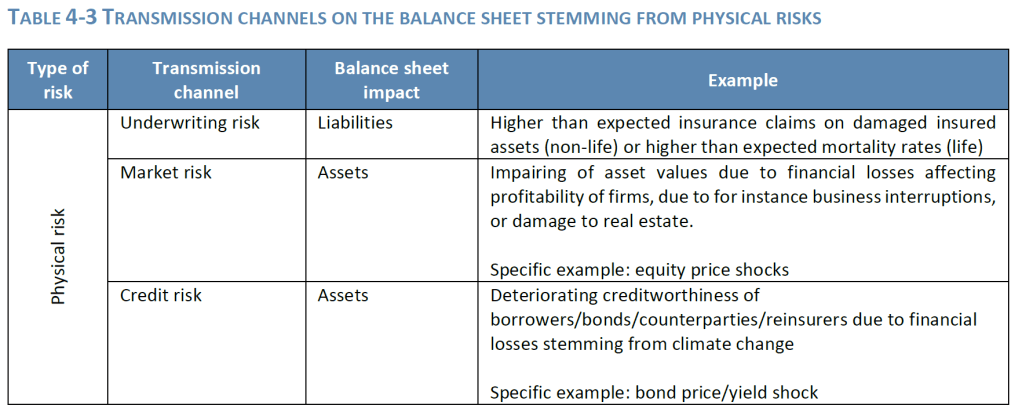
The aim is to identify sustainability risk drivers and their transmission channels to traditional prudential risks (i.e. market risk, counterparty risk, underwriting risk, operational risk, reputational risk and strategic
risk). Additionally, the assessment should provide insight into (direct) legal, reputational or operational risks or potential (indirect) market or underwriting risks, which could arise from investing in or underwriting activities with negative sustainability impacts, or from the undertaking misrepresenting its sustainability profile in public disclosure.

  • Qualitative analysis to help identifying the main drivers of climate change risks:
    • Transition risk drivers include changes in policies, technologies, and market preferences as well as the business activities of investees and commercial policyholders and policyholder preferences. At macro level, it may include consideration of failure of national governments to meet transition targets.
    • Physical risk drivers include level of both acute and chronic physical events associated with different transition pathways and climate scenarios. This involves assessing the impact of physical risks to counterparties (investees, policyholders, reinsurers) as well the insurer’s own operations (e.g.to insurer’s business continuity, also for outsourced services). For climate change-related risks, the assessment should consider the evolution of extreme weather-related events for insurers underwriting natural catastrophe risks (incl. in property and health insurance).
  • Geographical exposure: Identify potential exposure of assets or insured objects to sustainability risk based on, for example, the location of operations, assets or insured objects or supply chain dependencies of investee companies in geographical areas, regions or jurisdictions prone to (physical) climate, other environmental or social risks.
    • Natural catastrophe and environmental risk datahubs such as the Copernicus datasets on land (use) or biodiversity can give an indication of relevant environmental risks across regions.
    • Social risk indicators identify countries or regions that are vulnerable to social risk, measure social inequality or development. These can give an indication on potential social risk exposure of assets or liabilities located in those regions.
  • Economic activity/sector-based exposure: Identify potential exposure of assets or lines of business or insured risks to potential sustainability risks based on the impact of the investee (or supply chain dependencies of the investee) or the policyholder’s economic activity, or their dependency on environmental or social factors. Such assessment should however not only focus on for example, exposures to climate related sectors, but also to other sectors which may be indirectly affected by (transition) risks.
    • Alignment of the economic activity with the climate and environmental objectives and screening criteria set out in the Taxonomy Regulation and Climate, Environmental Delegated Regulations, as supported by the taxonomyrelated disclosures.
    • Biodiversity loss, a high-level exposure assessment of could be carried out using the level of premiums written in economic sectors with a high dependence on ecosystem services and/or a high biodiversity footprint (economic exposure) and the probability of occurrence of the associated nature-related risk factors.
    • Social risks, exposure of assets or liabilities to economic activities in ‘high risk social sectors’, can be identified by referring to the Business and Human Rights Navigator (UN Global Compact), which can help mapping exposure to sectors at high risk of relying on child labour, forced labour, or sectors negatively impacting on equal treatment (incl. restrictions to freedom of association) or on working conditions (inadequate occupational safety and health, living wage, working time, gender equality, heavy reliance on migrant workers) or have negative impacts on indigenous people.

Financial risk assessment

Where the exposure is deemed material, based on the thresholds set by the undertaking, a more detailed evaluation of the financial risks combining quantitative and/or qualitative approaches should inform the financial impact on the undertaking’s balance sheet. Here the assessment should aim to identify the key financial risk metrics and provide a view of the expected impact of such risks under different scenarios and time horizons at various levels of granularity.

Scenarios

When assessing the potential financial impact of material sustainability risks, the RTS sets out that undertakings should specify at a minimum two scenarios that reflect the materiality of the exposure and the size and complexity of the business. One of the scenarios should be based on the narrative
underpinning the materiality assessment. Where relevant, the scenarios should consider prolonged,
clustered, or repeated events
, and reflect these in the overall strategy and business model including
potential stresses linked to the

  • availability and pricing of reinsurance,
  • dividend restrictions,
  • premium increases/exclusions,
  • new business restrictions,
  • or redundancies.

For climate change risks, the Solvency II Directive requires undertakings with a material exposure to climate change risks to specify at least two long term climate change scenarios:

(a) a long-term climate change scenario where the global temperature increase remains below two degrees Celsius;

(b) a longterm climate change scenario where the global temperature increase is significantly higher than two degrees Celsius.

Experience to date shows that the most used scenarios are those designed by NGFS43, IPCC Shared Socioeconomic Pathways (SSPs) or tailor-made scenarios (set by regulators, e.g. for nature-related scenarios or for stress testing purposes.

Time horizons

The time horizon should ensure that the time horizon for analysing sustainability risks is consistent with the undertaking’s long-term commitments. The time horizon should allow to capture risks which may affect the business planning over a short-to-medium term and the strategic planning over a longer term.

The time horizon chosen for the materiality assessment in sustainability risk plan should also enable the integration of the risk assessment process with time horizons applied for the purposes of the ORSA for risk assessment purposes.

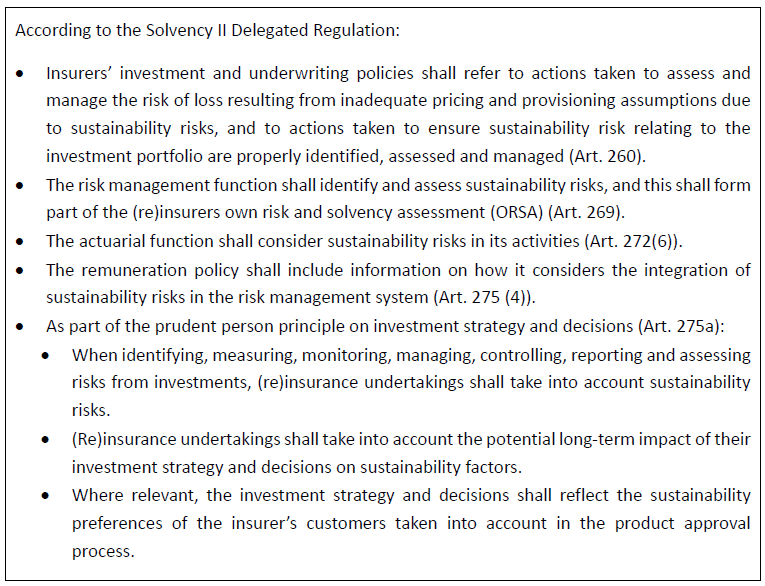
Taking the example of the impact of climate change: its impact can materialise over a longer time horizon than the typical 3-5 years (re)insurers’ strategic and business planning time horizons considered in the ORSA. It is argued that ORSA time horizons are too short to integrate the results of such longer-term climate change scenarios. Nevertheless, the ORSA should allow for the monitoring of the materialisation of risks over a longer term. At the same time, climate change-related risks and opportunities can affect the business planning over a short term and the strategic planning over a longer term.

The RTS specify the time horizons for sustainability risk assessment, to promote supervisory convergence and increase the consistency of risk assessment across undertakings and with decisionmaking. For this purpose, the RTS stipulates that the following time horizons for the sustainability risk assessment apply:

  • Short term projection: 1-5 years
  • Medium term projection: 5-15 years
  • Long term projection: min. 15 years

Documentation and data requirements

The sustainability risk assessment should be properly documented. This would include documenting the methodologies, tools, uncertainties, assumptions, and thresholds used, inputs and factors considered, and main results and conclusions reached.

Undertakings’ internal procedures should provide for the implementation of sound systems to collect and aggregate sustainability risks-related data across the institution as part of the overall data governance and IT infrastructure, including to assess and improve sustainability data quality.

Undertakings would need to build on available sustainability data, including by regularly reviewing and
making use of sustainability information disclosed by their counterparties, in particular in accordance with the CSRD or made available by public bodies.

Additional data can be sourced from interaction with investees and policyholders at the time of the
investment or underwriting of the risk
, or estimates obtained from own analysis and external sources.
Undertakings should, where data from counterparties and public sources is not available or has shortcomings for risk management needs, assess these gaps and their potential impacts. Undertakings
should document remediating actions, including at least the following: using estimates or (sectoral) proxies as an intermediate step – the use of such estimates should be clearly indicated – , and seeking to reduce their use over time as sustainability data availability and quality improve; or assessing the need to use services of third-party providers to gain access to sustainability data, while ensuring sufficient understanding of the sources, data and methodologies used by data providers and performing regular quality assurance.

Frequency

The RTS aim to align the frequency of performance of the materiality and financial risk assessments
with, on the one hand, the cycle of the submission of the regular supervisory report to the supervisor ‘at least every three years’, if not stipulated differently by the supervisor, and the requirement for undertakings to assess material risks as part of their ORSA ‘regularly and without any delay following any significant change in their risk profile’.

Significant changes to the undertaking’s risk profile can include material change to its business environment including in relation to sustainability factors, such as significant new public policies or shifts in the institution’s business model, portfolios, and operations.

In addition, for the frequency of the financial risk assessment, the RTS need to consider that undertakings (except for SNCUs) are required to conduct at regular intervals, at a minimum every three years, the analysis of the impact of at least two long-term climate change scenarios for material climate change risks on the undertaking’s business.

Based on these considerations, the RTS set out that the materiality and financial risk assessment should be conducted at least every three years, and regularly and without any delay following any significant change in their risk profile.

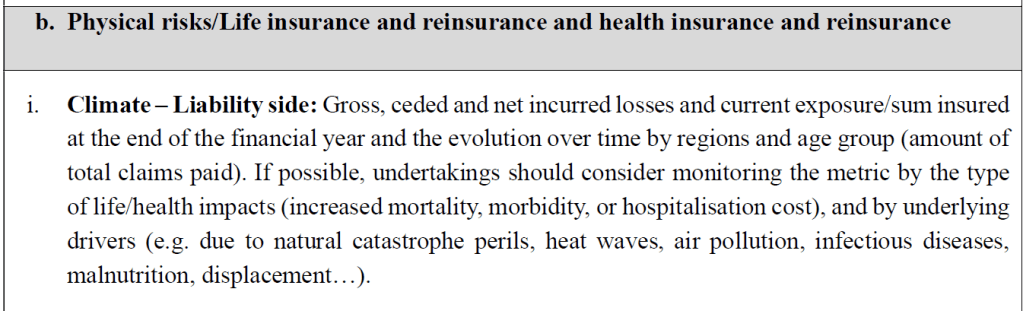
Building on the requirements , the RTS specifies that key metrics and the results of the sustainability risk
plan should be disclosed at least every year
or, for smaller and non-complex undertakings, at least every two years or more frequently in case of a material change to their business environment in relation to sustainability factors.

Metrics

Prescribing a list of metrics in sustainability risk plans can help

  • in promoting risk assessment,
  • improve comparability of risks across undertakings,
  • promote supervisory convergence in the monitoring of the risks and
  • enable relevant disclosures.

At the same time, it is important to allow undertakings flexibility in defining their metrics to avoid missing useful undertaking-specific information. Therefore, the RTS describes the key characteristics of the metrics and provides a minimum list of relevant metrics to compute.

Backward-looking (current view) and forward-looking, can be tailored to the undertaking’s business model and complexity, while following key characteristics apply. Metrics should

  • provide a fair representation of the undertakings’ risks and financial position using the most up-to-date information.
  • be appropriate for the identification, measurement, and monitoring of the actions to achieve the risk management targets.
  • be calculated with sufficient granularity (absolute and relative) to evaluate eventual concentration issues per relevant business lines, geographies, economic sectors, activities, and products to quantify and reflect the nature, scale, and complexity of specific risks.
  • allow supervisors to compare and benchmark exposure and risks of different undertakings over different time horizons.
  • be documented to a sufficient level to provide relevant and reliable information to the undertaking’s management and at the same time be used as part of supervisory reporting and, where relevant for public disclosure, ensuring sufficient transparency on the data (e.g. source, limitations, proxies, assumptions) and methodology (e.g. scope, formula) used.

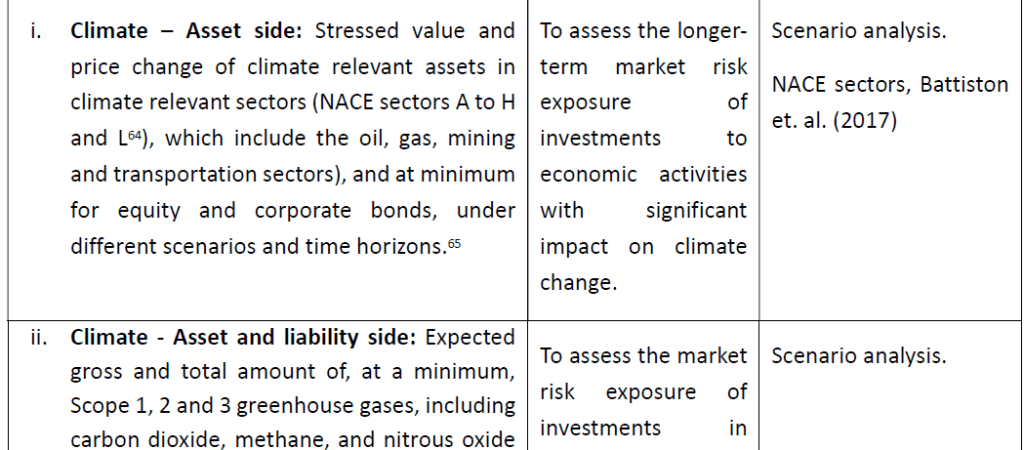
The RTS requires the following minimum current view metrics:

The following list includes optional metrics which could be considered by the undertaking on a voluntary basis to report on the results of scenarios analysis (financial risk assessment) for material sustainability risks.

Targets

Based on the results of the sustainability risk assessment, the undertaking’s risk appetite and long-term
strategy
, the undertaking should set quantifiable targets to reduce or manage material sustainabilityrelated exposure/risks or limits sustainability-related exposure/risks to monitoring prudential risks over the short, medium, and long term.

The undertaking should, based on its risk appetite, specify the type and extent of the material sustainability risks the undertaking is willing to assume in relation to all relevant lines of business, geographies, economic sectors, activities and products (considering its concentration and diversification objectives) and set its risk management targets accordingly.

Undertakings shall explain the way the target will be achieved or what is their approach to achieve the
target. Intermediate targets or milestones should allow for the monitoring of progress of the undertaking in addressing the risks. The undertakings should specify the percentage of portfolio covered by targets.

The targets should be consistent with any (transition) targets used in the undertaking’s transition plans and disclosed where applicable. The targets and measures to address the sustainability risks will consider the latest reports and measures prescribed by the European Scientific Advisory Board on climate change, in particular in relation to the achievement of the climate targets of the Union.

Relation between targets, metrics, and actions across transition plans, sustainability risk plans and ORSA, applied to an example for transition risk assessment for climate risk-related investments
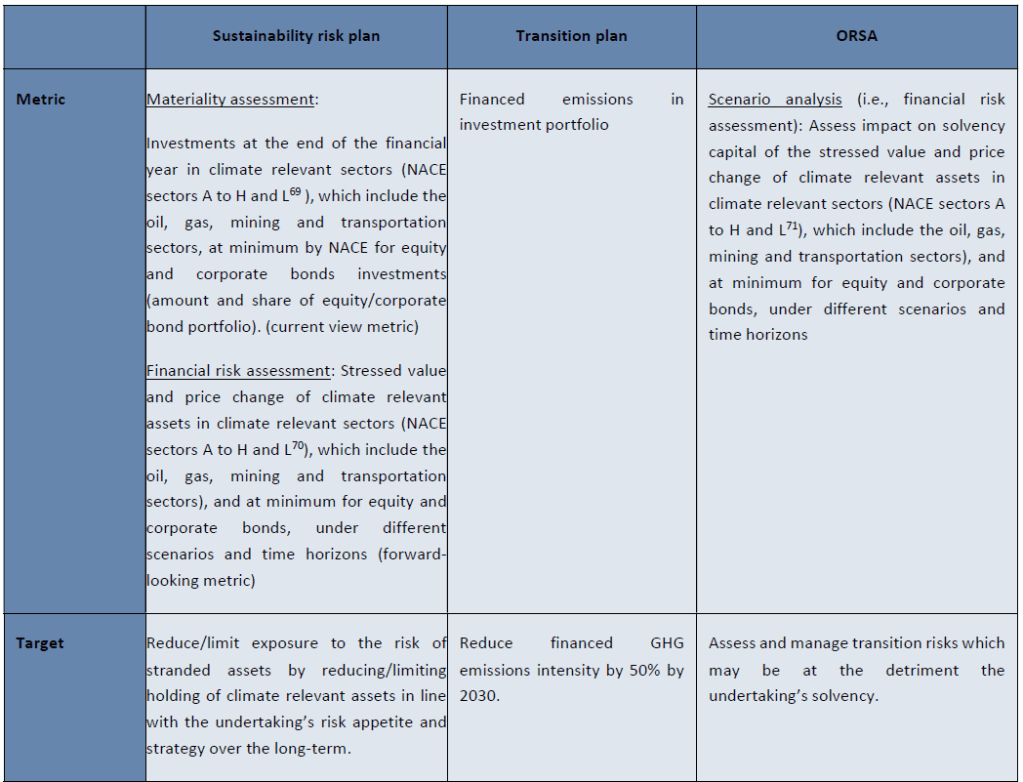
Actions

Actions to manage risks should be risk-based and entity-specific.

  • Actions set out in undertakings’ transition plans, for example under CSDDD can inform the sustainability (transition) risk to the undertaking’s business, investment, and underwriting. Such transition plan actions typically involve:
  • Limiting investment in non-sustainable activities/companies Introduction of sustainability criteria in the investment decision.
  • Re-pricing of risks.
  • Integrating sustainability into the investment guidelines.
  • Stewardship, impact investing, impact underwriting.
  • Integrating ESG into the underwriting standards and guidelines of the undertaking.
  • Product development considering the impact on climate change.

The measures in the transition plan and actions to address financial risks arising from the transition need to be integrated into the investment, underwriting and business strategy of the undertaking. They need to be measurable and where actions fail to meet their expressed target, these should be monitored and, where necessary, adjusted.

Towards a European system for natural catastrophe risk management

EIOPA / ECB December 2024

Executive Summary

Increased economic exposure and the growing frequency and severity of natural catastrophes linked to climate change have been driving up the cost of natural catastrophes in Europe. Between 1981 and 2023, natural catastrophes caused around €900 billion in direct economic losses within the EU, with one-fifth of these losses having occurred in the last three years alone. However, over the same period, only about a quarter of the losses incurred from extreme weather and climate-related events in the EU were insured – and this share is declining.

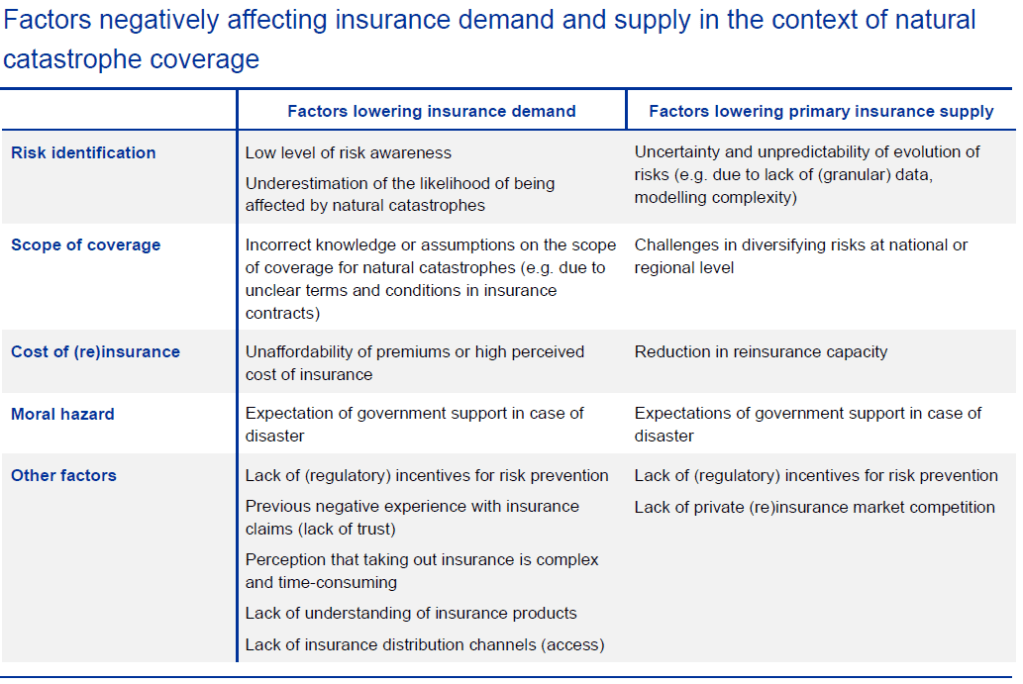
This “insurance protection gap” is expected to widen further due to the increasing risk posed by climate change. Europe is the fastest-warming continent in the world and increasing climate risk is likely to have implications for both the supply of and demand for insurance if no relevant measures are in place. As the frequency and severity of climate-related events grow, (re)insurance premiums are expected to rise. This will make insurance less affordable, particularly for low-income households. Climate change also increases the unpredictability of these events, which may prompt insurers to stop offering catastrophe insurance in high-risk areas. At the same time, low risk awareness and reliance on government disaster aid further dampen insurance uptake by households and firms.

Recent events, such as the 2024 flooding in central and eastern Europe and in Spain, have further illustrated the challenges that extreme weather events can pose for the EU and its Member States. These events highlight the importance of emergency preparedness, risk mitigation, and adaptation efforts to prevent and/or minimise the losses from natural disasters, as well as the relevance of national insurance schemes in reducing the economic impact of natural catastrophes. They also bring to the fore the importance of addressing the insurance protection gap and the associated burden on public finances.

National schemes aim to broaden insurance coverage and encourage risk prevention. Typically, they do so by setting up risk-based (re)insurance structures involving public-private sector coordination for multiple perils (e.g. floods, drought, fires and windstorms). Some of the schemes further support the availability of insurance through mandatory insurance coverage and improve the affordability of insurance through national solidarity mechanisms. At the same time, there are fewer risk diversification opportunities at national than at EU level and reliance on both national and EU public sector outlays has been growing. Therefore, it is beneficial to discuss at EU level how adaptation measures can help in proactively reducing disaster losses and how the sharing of losses between the public and private sectors can help in raising risk awareness and improving risk management before disasters occur.

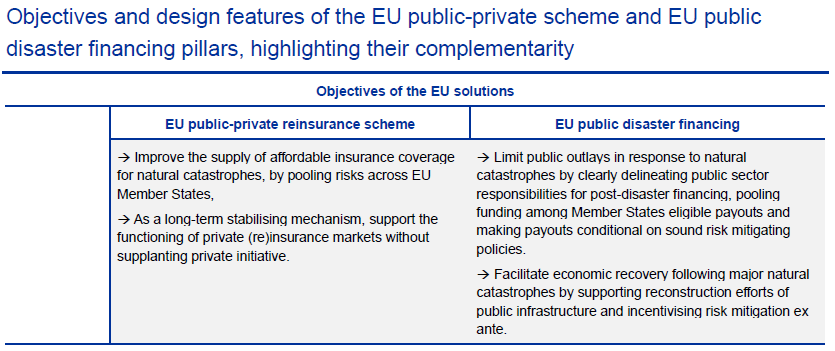
Building on existing national and EU structures, the EIOPA and BCE spell out a possible EU-level solution composed of two pillars, firmly anchored in a multi-layered approach:

  • An EU public private reinsurance scheme: this first pillar would aim to increase the insurance coverage for natural catastrophe risk where insurance coverage is low . The scheme would pool private risks across the EU and across perils, with the aim of further increasing diversification benefits at EU level, while incentivising and safeguarding solutions at national level. It could bef unded by risk based premiums from (re)insurers or national schemes , while taking into account potential implications of risk based pricing for market segmentation . Access to the scheme would be voluntary. The scheme would act as a stabilising mechanism over time to achieve economies of scale and diversification for the coverage of high risks at the EU level, similar to an EU public private partnership.
  • An EU fund for public disaster financing: this second pillar would aim at improving public disaster risk management among Member States . Payouts from the fund would target reconstruction efforts following high loss natural disasters, subject to prudent risk mitigation policies, including risk adaptation and climate change mitigation measures. The EU fund would be financed by Member State contributions adjusted to reflect their respective risk profiles. Fund payouts would be condition al on the implementation of concrete risk mitigation measures preagreed under national adaptation and resilience plans. This would incentivise more ambitious risk mitigation at Member State level before and after disasters. Membership would be mandatory for all EU Member States.

Rising economic losses and climate change

Economic losses from extreme weather and climate events are increasing and are expected to rise further due to the growing frequency and severity of catastrophes caused by global warming. Between 1981 and 2023, natural catastrophe-related extreme events caused around €900 billion in direct economic losses in the EU, with more than a fifth of the losses occurring in the last three years (2021: €65 billion; 2022: €57 billion; 2023: €45 billion).

Europe is the fastest-warming continent in the world and the number of climate-related catastrophe events in the EU has been rising, hitting a new record in 2023. Moreover, climate change is already now affecting many weather and climate extremes in every region across the globe and its adverse impacts will continue to intensify. In the EU, all Member States face a certain degree of natural catastrophe risk and the welfare losses are estimated to increase in the absence of relevant measures to improve risk awareness, insurance coverage and adaptation to the rising risks.

Over the last ten years, the reinsurance premiums for property losses stemming from catastrophes have increased across all major insurance markets. In Europe, property catastrophe reinsurance rates have risen by around 75% since 2017. While there may be various factors affecting reinsurance prices, the increasing frequency and severity of events is likely to trigger further repricing of reinsurance contracts, which can in turn increase prices offered by primary insurers. The rising risks may even prompt insurers to retreat from certain areas or types of risk coverage. Moreover, since insurance policies are typically written for one year only, such repricing or insurance retreat may be abrupt. Reduced insurance offer is justified where risks become excessively high or unpredictable. In particular, insurance cannot palliate for inadequate climate adaptation, spatial planning and (re)building conventions.

At the same time, take-up of natural catastrophe insurance in the EU is declining among low-income households, thus increasing the pressure on governments to provide support in the event of a natural catastrophe. For instance, the share of low-income consumers with insurance for property damage caused by natural catastrophes has declined from around 14% to 8% since 2022. Affordability and budgetary constraints are the main reason why 19% of European consumers do not buy or renew insurance. Low-income households may also be disproportionately vulnerable to financial stress and are more likely to live in areas with increased exposure to environmental stress or natural catastrophes, due to the affordability of land and housing or limited resources to relocate to safer areas or invest in disaster-resistant housing. Insurance affordability stress might eventually also contribute to housing affordability issues, because if a larger portion of income is spent on insurance, a smaller portion is available for other expenses (e.g. rent). Therefore, solutions should consider vulnerability and consumer protection aspects.

Lessons from national insurance schemes

National schemes to supplement private insurance cover for natural catastrophes, such as PPPs, help improve insurance coverage and reduce the insurance protection gap. Looking at the European Economic Area (EEA), the share of insured losses tends to be higher in countries with such national schemes: the average share across countries with a national scheme is around 47%, while it is below 18% for those without a national scheme. Currently, eight EEA Member States have established a national scheme:

The schemes share the same objective: they all aim to enhance societal resilience against disasters. They typically do so by improving risk awareness and prevention, while increasing insurance capacity through more affordable (re)insurance.

While the design features vary by scheme, some of them are recurring:

  1. Scope: most national insurance schemes have a broad scope of coverage, which allows them to pool risks across multiple perils and assets. The majority also incorporate a mandatory element, requiring either mandatory offer or mandatory take up of insurance by law .
  2. Structure: the prevalent structure of national schemes is that of a public (re)insurance scheme. Most schemes offer complementary direct (re)insurance and are of a permanent nature.
  3. Payouts and premiums: national schemes are typically indemnity based (i.e. payouts are based on actual losses rather than quantitative/parametric catastrophe thresholds). Premiums are mostly risk based.
  4. Risk transfer and financing: the use of reinsurance by the schemes depends on the availabil ity and the cost of reinsurance, with national schemes increasingly facing issues over affordability. Public financing of the scheme is not an essential design feature.
  5. Risk mitigation and adaptation measures: initiatives to ensure proper coordination between the public and private sectors on risk identification and prevention are now emerging in response to climate change. Private and public sector responsibilities are typically divided, with the private market contributing its insurance expertise and modelling capacity, while the public sector provides the legal basis and operating conditions.

Lesson 1: an EU solution could cover a wider range of perils and assets across several Member States, thus allowing for greater risk pooling and risk diversification benefits than at a national level. This can be particularly relevant for small countries where a single catastrophe can affect the whole country and for countries without a national insurance scheme. By pooling catastrophe risk across different exposures, regions and uncorrelated perils within a single EU scheme, it may be possible to reap larger risk diversification benefits than could be achieved at national level. This would, in turn, reduce the required capital needed to back the risks and lower the cost of reinsuring them. Mandatory elements to boost the demand for or offer of insurance could further increase the risk diversification benefits and limit adverse selection. However, this would also require a certain degree of harmonisation of existing national practices.

Lesson 2: an EU-wide solution could include a permanent public-private reinsurance scheme to complement private sector or national initiatives. Setting up a public-private reinsurance scheme, as opposed to a private structure, would have the advantage that it could be accessed by a large range of entities: primary insurers, reinsurers and various national schemes. Therefore, such a scheme would require no harmonisation of existing national practices. Participation in such a scheme would be voluntary, so that the scheme supplements, rather than crowds out, private sector or national initiatives. Making the scheme permanent would allow for pooling risk over time, thus reaping even greater diversification benefits than if risks were pooled only across perils, asset types and Member States.

Lesson 3: an EU-wide solution could further support affordable risk-based premium setting, owing to the potentially sizeable risk diversification benefits that could be achieved across Member States. Given the significant heterogeneity in the risks faced by policyholders across Member States, flat premiums or premiums capped by law could imply a relatively high level of cross-subsidisation and solidarity, which might be difficult to agree upon at EU level. A risk-based approach at EU level could support additional risk diversification benefits achieved from risk pooling across Member States, time horizons, perils and asset types.

Lesson 4: since public funding mechanisms for disaster recovery are stretched and reinsurance prices have been rising, an EU solution could aim to finance itself through risk-based premiums and could explore tapping capital markets. In addition to collecting risk-based premiums (see Lesson 3), the scheme could explore tapping the capital markets by issuing catastrophe bonds or other insurance-linked securities. The catastrophe bonds could be indemnity-based or parametric (or both), depending on the further design features of the solution (e.g. whether it would provide indemnity-based or index-based payouts). The extensive risk pooling enabled by the EU solution could also allow for the issuance of catastrophe bonds that could be less risky and more transparent than many other catastrophe bonds, thus attracting a relatively wide set of investors. Ultimately, the EU solution could in principle be set up with no public financing or backstop.

Lesson 5: an EU solution could support both insurance and public sector initiatives geared towards risk mitigation and adaptation as part of a public-private concerted action. For instance, an EU solution could improve the availability, quality and comparability of data on insured losses across EU countries. It could also support the modelling of risk prevention and the integration of climate scenario analysis into estimates of future losses (both insured and uninsured) from natural disasters. The analysis of EU solutions might further promote the use and development of open-source tools, models and data to enhance the assessment of risks. In this context, care should be taken to prevent further market segmentation or demutualisation based on granular risk analysis, which could widen the insurance protection gap in the medium term.

A possible EU approach

An EU-level system could rest on two pillars, building on existing national and EU structures:

  1. Pillar 1: EU public private reinsurance scheme. Establishing an EU public private reinsurance scheme would serve to increase the insurance coverage for natural catastrophe risk. The scheme would pool private risks across the EU, perils and over time to achieve economies of scale and diversification at the EU level.
  2. Pillar 2: EU public disaster financing. The second pillar would look to improve public disaster risk management in Member States through EU contributions to public reconstruction efforts following natural disasters, subject to prudent risk mitigation policies, including adaptation and climate change mitigation measures

The EU public-private reinsurance scheme could help to provide households and businesses with affordable insurance protection against natural catastrophe risks, while also providing incentives for risk prevention. Embedded in the ladder of intervention, the design features of the scheme build on the five lessons learned from the analysis of the national schemes. The scheme seeks to (i) ensure coverage of a broad range of natural catastrophe risks, (ii) fulfil a complementary role to national and private market solutions, (iii) rely on risk-based pricing, (iv) reduce dependence on public financing in the long term, and (v) support concerted action on risk mitigation and adaptation.

The EU reinsurance scheme could seek to transfer part of the risks to capital markets via instruments such as catastrophe bonds. The market for these products is less developed in the EU than in North America. Part of the reason is the smaller scale of the issuances. The EU scheme could explore the feasibility of a pan-European catastrophe bond covering more perils than the bonds currently issued. This would serve the dual purpose of expanding the catastrophe bond market and bringing more niche risks directly to capital markets investors. The investors, in return, could benefit from the additional diversification offered by exposure to these risks relative to the risks currently covered.

Risk pooling is a fundamental concept in insurance, grounded in the law of large numbers. As independent risks are added to an insurer’s portfolio, the results become less volatile. For example, in a pool of insured vehicles, the actual number of accidents each year converges with the expected number as the size of the pool increases. In terms of capital, reduced volatility means lower capital needs and costs for the same level of protection. More diversified insurers can therefore offer cover at a lower price and given the level of capital, provide a higher level of protection.

The underlying risk (annual expected loss) remains unchanged when pooling risks together. However, the cost of covering or transferring the risk (cost of capital), along with the cost of information and operating costs, decreases with diversification and risk pooling. Operational costs are lower due to economies of scale, as they are shared among all participants in the pool. The cost of information is also lower , as the time and money required to obtain information can be shared among participants.

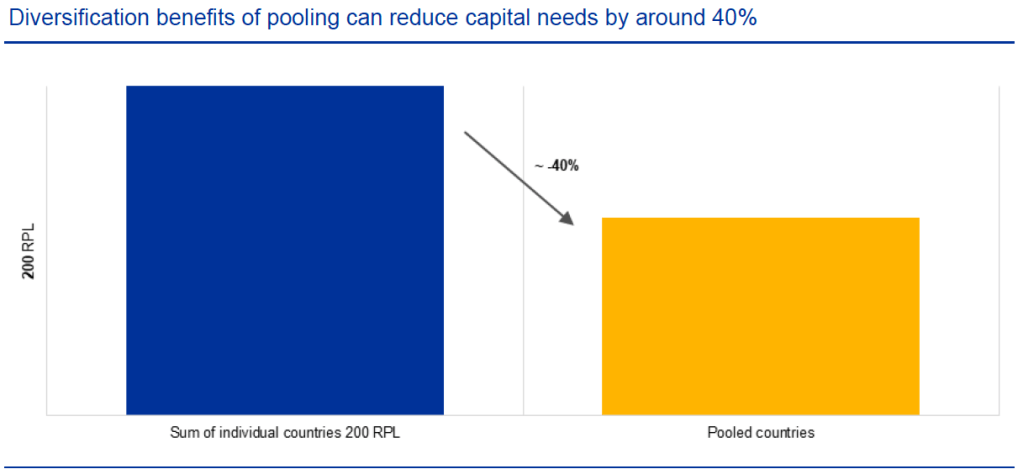
Solvency II requires insurers to hold sufficient capital to withstand a loss occurring with a
probability of 1 in 200 years.
In an example, using the Moody’s RMS Europe NatCat Climate HD
model, and based on the current insured landscape, the pooled portfolio shows a reduction of
around 40% in the 1 in 200 year return period losses (RPL) compared to the sum of individual
values for countries
. This reduction might be even larger if penetration of flood insurance increases. A similar analysis conducted by the World Bank, provid ing a framework for estimating the impact of pooling risks on policyholder premiums , supports these conclusions.

The EU disaster financing component would provide a complementary mechanism that governments could tap when managing natural catastrophe losses. Natural catastrophes can lead to significant costs for governments, including damage to key public infrastructure. The EU disaster financing component would help governments to manage a share of these expenses following a major disaster, thus supplementing their national budgetary expenditure. The component would cover damages caused to key public infrastructure that is inefficient or too costly to insure privately, with a view to supporting resilient reconstruction efforts and public space adaptation. Clear rules on contributions and conditions on the disbursement of the funds should encourage ex ante risk prevention by governments, to minimise the emergency relief and residual private risks that the government may need to cover following a major event.

Greenwashing in Insurance – How Regulators Design a Framework

In 2023, EIOPA has published several recommandations and progress reports, the most insightful being:

  • Advice to the European Commission on Greenwashing – EIOPA-BoS-23/157 – 01 June 2023
  • Consultation Paper on the Opinion on sustainability claims and greenwashing in the insurance and pensions sectors – EIOPA-BoS-23/450 – 17 November 2023

Both documents contain highly important information and guidelines towards a future framework for the industry, a framework probably to be applicable no later than 2025.

As outlined in both papers, EIOPA addresses these guidelines in close cooperation with the two other ESA in charge of financial services supervision, EBA and ESMA. It’s advice summarizes this interconnectedness with a « Sustainable Finance Investment Value Chain » chart:

The Advice to the EC defines the meaning of « Sustainibility Claims« , the critical item to be addressed to analyse any kind of greenwashing activity within this value chain.

‘Sustainability claims’ are claims that state or imply that an entity or product ‘benefits’ the environment or society. The type of ‘benefit’ is varied and includes:

  • positively impacting sustainability factors;
  • not impacting sustainability factors;
  • minimizing negative impacts on sustainability factors;
  • minimizing the impact of climate change on society (this includes climate adaptation measures).

This understanding of ‘sustainability claims’ is consistent with the definition of “environmental claims” as defined in the EC proposed Directive as regards empowering consumers for the green transition which would amend the Unfair Commercial Practices Directive (UCPD): “‘environmental claim’ means any message or representation […], which states or implies that a product or trader has a positive or no impact on the environment or is less damaging to the environment than other products or traders, respectively, or has improved their impact over time”. ‘Sustainability claims’ as understood by EIOPA extends it to also cover social aspects.

Misleading sustainability claims can deceive consumers into buying products that are not aligned with their preferences, or into buying products from a pension or insurance provider that misleadingly portrays itself an entity with sustainability credentials. In such cases, consumers’ investments or premiums are re-routed away from sustainability factors.

Further, greenwashing occurrences erode consumers’ trust in providers’ ability to positively impact environmental or social factors. While EIOPA has not identified to date any major greenwashing cases in the insurance and pension sectors, because cases emerged in other sectors there may be already a general mistrust from consumers in relation to sustainability claims which can be made by providers. The EU-wide Eurobarometer survey carried out by EIOPA in June 2022 shows that 62% of EU consumers do not trust the sustainability claims made by insurance undertakings or distributors, while a similar percentage (63%) says that sustainability claims about insurance products are often misleading. Consumer representatives in their response to the ESA Joint CfE in January 2023 also reported limited trust in insurers and pension providers sustainability claims.

Additionally, misleading sustainability claims do not allow consumers as well as broader society to hold providers accountable for their environmental and social impact. This unaccountability might embolden providers to make misleading sustainability claims to gain a competitive advantage over other providers, after which these other providers might follow suit to close the competitive advantage, leading to more greenwashing occurrences.

Where and How Greenwashing Occurs in the Insurance and Pension Sectors

EIOPA differentiates seven major fields (three specific stages for insurers, three for IORPs and one common stage for both types of organizations) within the insurance and pensions lifecycle chart:

The major difference among insurers and IORPs are the reference to « products » and « schemes », taking into account the still highly heterogenous pension market and pension scheme providers within the EU.

In relation to the stages of the insurance and pensions lifecycle, respondents to the ESA Joint CfE provided views on the likelihood of the occurrence of greenwashing:

Declared likelihood shows that Marketing and Sales a clearly fingerpointed as they are considered « highly likely » to be subject to greenwashing. Without neglecting the other stages and especially the entity model and management clearly in the drivers’ seat of the other stages’ behaviour, let’s focus on the product delivery issues:

  • Marketing: main fields of potential greenwashing have their origins in the risks related to terminology and non-textual imagery.
  • Sales: information asymmetry or misleading information/disclosure as well as risks related to unsuitable product due to poor advice, incentives and distributors’ training are cited as potentially important and critical

Tackling Greenwashing

EIOPA regularly conducts surveys with the NCA to evaluate maturity and action plans as long as the framework is not in place.

Results are for the time being relatively mitigated as the large majority of NCA (21) didn’t identify greenwashing issues yet due to missing criteria to be applied and inexisting client related investigations. However, NCA reporting first actions are using several techniques EIOPA will probably evaluate and adopt for the future framework:

Very interesting also the survey results on the potential use of Suptech to deal with the enormous need to analyze data on products, sales and marketing practices:

Next Steps

Based on additional analyses, discussions and evidence that emerges by the delivery of the final report (May 2024), EIOPA will further refine its view on the definition of greenwashing, its impacts and risks (particularly on potential financial stability risk implications), as well as on how greenwashing can occur in the insurance and pensions lifecycle. To further exemplify the latter, EIOPA might develop case studies showing how greenwashing can emerge in practice.

EIOPA will also provide further considerations on the supervision of greenwashing, particularly in relation to any new greenwashing-related supervisory experiences and practices, as well as in relation to greenwashing-related supervisory and enforcement measures, if any.

Finally, EIOPA will further develop the list of issues it has already identified in the regulatory framework and based on those issues it will propose improvements – by way of recommendations – to the regulatory framework relevant to the insurance and pension sectors, including to Level 1 legislation. However as requested by the CfA, EIOPA will not make any proposals that would imply modifications of the Corporate Sustainability Reporting Directive (CSRD).

Prudential Treatment of Sustainability Risks

December 13, 2023, EIOPA has published a Consultation Paper regarding potential amendments of the prudential treatment of sustainibility risks (EIOPA-BoS-23-460). The expected Article 304a of the Solvency II Directive mandates EIOPA to assess the potential for a dedicated prudential treatment of assets or activities associated substantially with environmental or social objectives, or harm to such objectives, and to assess the impact of proposed amendments on insurance and reinsurance undertakings in the European Union. EIOPA is required to submit a corresponding report to the Commission.

A discussion paper outlining the scope, methodologies, and data sources for the analysis has been published in 2022 as the first outcome of EIOPA’s work under this mandate. This consultation paper is the second outcome, based on the discussion paper’s public feedback received, together with the feedback received from the Platform on Sustainable Finance and the European Banking Authority (EBA). It will form the basis of the report envisaged to be submitted to the Commission after consulting the European Systemic Risk Board (ESRB).

EIOPA decided to focus its analyses on the following three conceptual areas that are considered to be appropriate for a risk-based analysis:

  • The first area of the analysis is dedicated to the potential link between prudential market risks in terms of equity, spread and property risk and transition risks.
  • The second area of the analysis focuses on the potential link between non-life underwriting risks and climate-related risk prevention measures, since the prudential treatment of assets or activities as referred to in the mandate includes insurance undertakings’ underwriting activities.
  • The third area of the analysis is related to the potential link between social risks and prudential risks, including market and underwriting risks.

As a kind of « disclaimer » EIOPA states that « since sustainable finance is an area characterized by an ongoing progress regarding data availability and risk modelling, certain natural limitations of the analysis exist at this stage« :

  • Firstly, the sample size of certain asset portfolios for the analysis is relatively small due to general data constraints that can hardly be overcome. Further to this, the limited sample size covered in the present analysis might not reflect the overall insurers’ exposure to transition risks, which could also materialize from indirectly held assets.
  • Secondly, since legally binding transition plans of firms, for instance in relation to the Corporate Sustainability Reporting Directive (CSRD), are not yet available, reliable firm-specific characteristics affecting the (long-term) transition risk exposures of firms are difficult to obtain as further input data for the analysis. In this respect, a sectoral classification approach is generally not able to model firm-specific transition risk characteristics, which would require a firm-level approach instead.
  • Thirdly, technical challenges for the analysis exist in isolating transition risks from other risk drivers, such as the impact of the Covid-19 shock on asset prices, which is an important determinant for the backward-looking analysis, but not for the forward-looking analysis.
  • Fourthly, the exact extent to which credit ratings reflect transition risks remains unclear at this stage, making it challenging in the case of the prudential treatment of spread risk in the Standard Formula whether a dedicated treatment would be justified.

By acknowledging the methodological limitations in the context of assessing sustainability risks from a prudential perspective, EIOPA, at this stage, does not recommend policy options in all areas studied in this consultation paper, and does not express a preference between the options proposed as regards equity and spread risk in relation to transition risk exposures.

Potential link between prudential market risks in terms of equity, spread and property risk and transition risks

The challenging question arises as to whether to rely on historic asset price data to conduct an empirical risk analysis (backward-looking) or to use model-based risk assessments, typically in terms of stress scenarios (forward-looking), or a combination of both.

The feedback EIOPA received to its 2022 discussion paper (« Discussion paper on physical climate change risks ») overall support for the methodologies outlined regarding the forward-looking analysis. Some respondents mentioned that the use of a model-based assessment can be subject to technical bias due to the model assumptions taken, and corresponding findings should be treated with caution regarding the conclusion on potential prudential implications. Several respondents suggested focussing only on a forward-looking assessment, since historic time series data might not be able to show a potential materialization of transition risks.

EIOPA considers forward-looking model-based risk assessments to offer valuable insights into the potential impact of transition risks on asset prices, particularly since historical asset price data may not fully reflect the dynamic nature of environmental externalities and the complexities of transitioning to a low-carbon economy. Market sentiment, technological advancements, regulatory changes, and societal awareness of climate issues can significantly influence transition risks in the future. A comprehensive model-based approach can complement historical data analysis and provide a holistic view of how transition risks may materialize in asset prices.

A forward-looking assessment requires models and assumptions regarding the future developments of climate change and the transition to a carbon neutral economy. In particular, uncertainty surrounds the nature and timing of policy actions, technological change and the extent to which financial markets are already reflecting a transition scenario in asset prices. In other words, the results and conclusions obtained can be quite sensitive to the choices adopted for such parameters and assumptions. To capture such uncertainty, researchers make use of scenario analysis to analyse a broad range of future states of the world.

A number of supervisory authorities – both at national and European level – have developed climate change scenarios to assess the exposure of financial institutions to climate risks in terms of transition risks. EIOPA studied several analyses of climate transition scenarios developed by ACPR/Banque de France, DNB, ECB/ESRB as well as EIOPA/2DII to build a conceptual framework for the forward-looking analysis presented in this section. EIOPA’s discussion paper in 2022 briefly summarised these studies21, whereof the main conclusions are:

  • The assessments make use of different scenarios. ECB/ESRB and ACPR/Banque de France use as a basis the climate scenarios developed by the Network for Greening the Financial System (NGFS), DNB developed its own bespoke shock scenario and the EIOPA/2DII sensitivity analysis makes use of transition scenarios developed by the International Energy Agency (IEA);
  • The analyses use two ways to measure the impact of disorderly transition scenarios by either comparing them with the baseline results for an orderly transition or with the current, no policy change pathways;
  • The forward-looking assessments employ several models to translate high-level climate scenarios into pathways for equity and corporate bond prices at sector level using either the NACE breakdown of economic activities or – in case of the EIOPA/2DII sensitivity analysis – fifteen climate-policy relevant activities;
  • The assessments exhibited substantial differences in exposures to transition risk for the various economic activities and technologies. On the one hand, equity exposures to mining and power generation would be fully stranded in the DNB combined policy and technology shock scenario. On the other hand, equity exposures to renewable energy would double in value in the EIOPA/2DII late and sudden policy shock scenario.

A mapping of the Transition Vulnerability Factors (TVFs) developed by the DNB on the NGFS’s transition risk scenarios to assess the potential exposure of economic activities to transition risks from a forward-looking and risk-oriented perspective. The TVFs capture the sensitivity of stock returns to forward-looking scenario-specific excess market returns, for instance in case of a rise in carbon prices or a technological shock. Based on this mapping exercise, the economic activities that seem to be particularly exposed to transition risk from a forward-looking perspective are the following:

  • B05-09 – Mining and quarrying (coal, lignite, crude petroleum, natural gas, etc.);
  • C19 – Petrochemical;
  • C22 – Manufacture of rubber and plastic products;
  • C23 – Manufacture of non-metallic mineral products;
  • C24 – Manufacture of basic metals;
  • D35 – Utilities (electricity, gas, steam and air conditioning supply);
  • H50 – Water transport and
  • H51 – Air transport.

It is important to differentiate economic activities that might be able to follow a transition to a low carbon economy in the future from those which might not. Indeed, in terms of carbon footprint, sectors related to the extraction, production, processing, transportation and reselling of fossil fuels will hardly be able to reduce their carbon emission levels as it is directly linked with their activity. In this regard, the Platform on Sustainable Finance (PSF) states that “the Platform recognizes there are other economic activities for which no technological possibility of improving their environmental performance to avoid significant harm exists across all objectives and which might be thought of as ‘Always Significantly Harmful’ activities”, referring particularly to economic activities B5 (Mining of coal and lignite), B8.92 (Extraction of peat) and D35.11 (Power generation from solid fossil fuels). According to article 19(3) of the taxonomy regulation, power generation activities that use solid fossil fuels do not qualify as environmentally sustainable economic activities.

Three possible types of transition scenarios can be envisaged in the coming decade:

  • An orderly type of transition scenario in which there is no or little impact on the real economy and financial sector. This type of scenarios consists of a timely and predictable path to a carbon-neutral economy with companies gradually adjusting their business models and capital stock to this new reality. An orderly transition is considered to be the baseline scenario in the ACPR and ECB/ESRB transition stress tests.
  • A disorderly type of transition scenario where there is a substantial impact on the real economy and – through their asset exposures to carbon-intensive sectors – the financial sectors. This type of scenarios tends to be characterised by unexpected, sudden and delayed actions to achieve carbon-neutrality. A disorderly scenario is generally considered to be a low probability, but yet plausible event.
  • A type of scenario where there is no transition or an insufficient transition to a carbon-neutral economy. Such a type of scenarios is also bound to have substantial negative impacts on the real economy and financial sector. Not due to transition risk, but as a consequence of a further increase in (acute) physical risks, like floods, fires and storms that may damage production facilities and disrupt supply chains.26 However, such risk differentials will materialise in another dimension, i.e. depending on the geographical location of companies rather than their carbon sensitivity.

Given that a disorderly transition poses the biggest transition risk, a prudential forward-looking VaR-analysis should focus on transition risk differentials relating to a disorderly scenario. Since it is difficult to estimate the probability of such a scenario, it is proposed to assess its impact under various annual probabilities of occurrence, e.g. ranging from 0.5% to 4.5% per year. To put these annual probabilities into a longer-term perspective, assume for example that the probability of an orderly transition amounts to 50% during the coming decade. The annual probabilities of 0.5-4.5% will then translate in a cumulative probability of 5-30% after 10 years, leaving a cumulative probability of no (or insufficient) transition of 20-45%.

Equity Risk: Backward-Looking Results

Results of the Broad Portfolio Allocation Approach

Results of the Narrow Portfolio Allocation Approach : CPRS (Climate Policy Relevant Sectors) – based Portfolio Allocation)

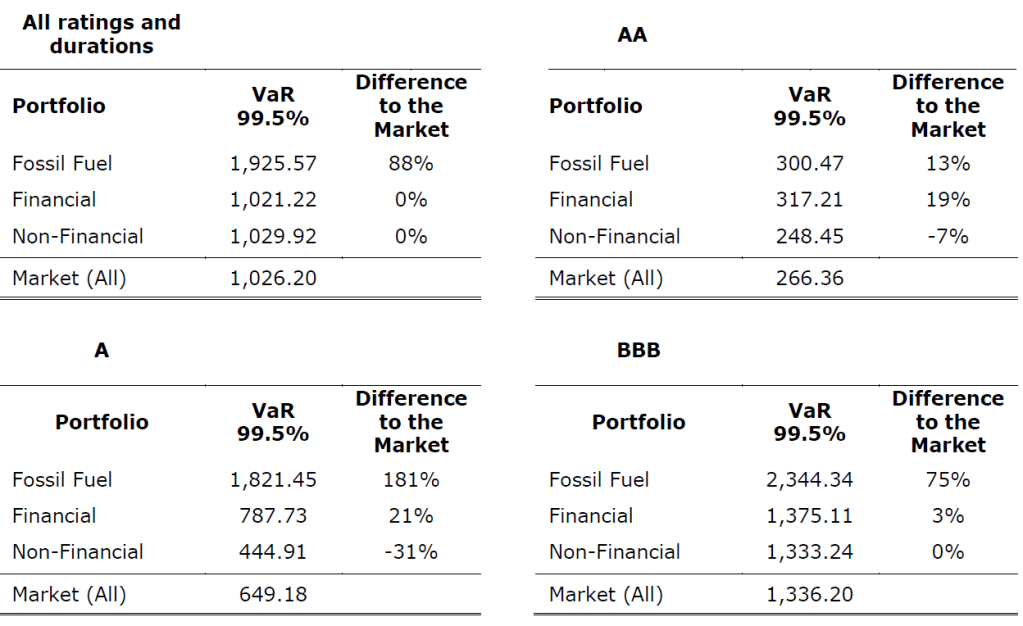
Overall, the fossil fuel sector shows a differentiated risk profile relative to the other sectors in terms of the highest VaR (-56.5%) in the relevant time period from 2010-2021. This sector includes the following NACE codes: B5, B6, B8.92, B9.1, C19, D35.2, H49.5, G46.71, which mainly relate to activities associated with the extraction of crude oil, natural gas and the mining of coal. A large number of studies underline that these activities, due to their inherent carbon intensity and limited potential to transition, tend to be more exposed to transition risks, as European economies gradually converge towards the objectives set out by the 2015 Paris Climate Agreement and the EU Green Deal.

Equity Risk: Forward-Looking Results

The forward-looking analysis uses the projected equity shocks for the different economic sectors being distinguished in:

  • the sudden (1) and delayed (2) transition scenarios of ACPR;
  • the policy shock (3), technology shock (4) and double (or combined) shock (5) scenarios of DNB;
  • the delayed transition (6) scenario of ESRB/ECB;
  • the disorderly transition (7) and ‘too little, too late’ (8) scenarios of IAIS.

In the Monte Carlo simulations, if a disorderly transition scenario materialises, a probability of 1/8 is attached to each of these eight specific scenarios occurring.

Equity Risk Differentials (Monte Carlo)

Spread Risk: Backward-Looking Results

Since the aggregation of various different economic activities into high-level portfolios as regards transition risk exposures appears suboptimal for assessing the potential for a risk differential, the assessment focuses on the narrow portfolio approach, in particular regarding fossil fuel-related bonds.

Spread Risk: Forward-Looking Analysis

In line with the forward-looking analysis for equity risk, the transition return shocks for corporate bonds for the different economic activities are derived from the disorderly transition scenarios of ACPR (sudden and delayed transition scenarios), DNB (policy, technology and double shock scenarios), ESRB/ECB (delayed transition scenario) and IAIS (disorderly and ‘too little, too late’ scenarios). In the Monte Carlo simulations, if a disorderly transition scenario materialises, a probability of 1/8 is attached to each of these eight specific scenarios occurring.

Spread Risk Differentials (Monte Carlo)

Stocks and Bonds: EIOPA’s Potential Policy Options

Based on the detailed analysis, EIOPA describes and evaluates three potential options for both asset classes:

Equity Risk (options and EIOPA’s evaluation)

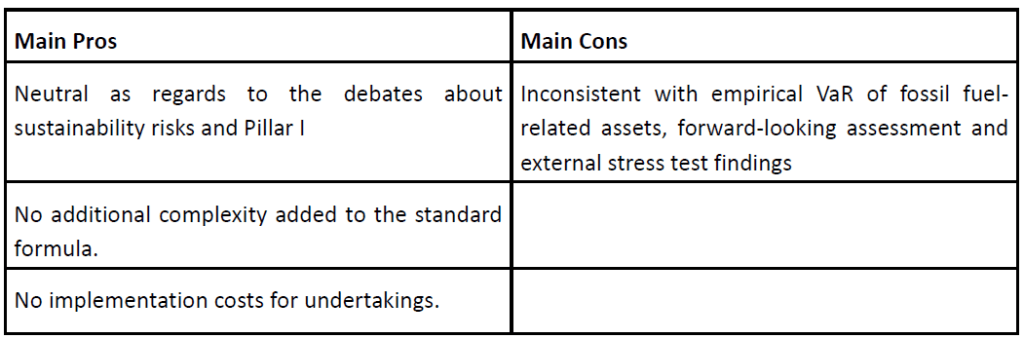
  • Option 1: “no change”-option
  • Option 2: treating fossil fuel-related stocks as Type II (stocks listed outside EEA and OCDE markets) equity, i.e., a capital charge of 49% rather than 39% for Type I equities;
  • Option 3: a dedicated supplementary capital requirement to the current equity risk calibration with supplementary capital charge to the current Standard Formula’s risk charge of 39%, in case of Type I equities, could lie in the range up to 17% in additive terms, i.e., 39%+17%=56%. Regarding the role of participations or long-term equity, exclusion criteria for fossil fuel-related activities or a potentially higher capital requirement may be needed to limit incentives to re-classify Type I/II stocks as participations for the sake of SCR reduction.

Spread Risk (options and EIOPA’s evaluation)

  • Option 1: no change option.
  • Option 2: a rating downgrade of bonds related to fossil fuel activities,
  • Option 3: a dedicated supplementary capital requirement to the current spread risk calibration, up to 5% in additive terms, which corresponds to an increase in the capital requirements of up to 40% relative to the bond portfolio’s current capital requirement.

An impact assessment conducted by EIOPA shows a very low impact of the proposed policy options on the solvency ratio of the undertakings (cumulated range equity and spread on Germany’s and France’s solvency ratios from -0.21 to -1.71%p) mainly due to the undertakings’ limited exposure to directly held fossil fuel-related assets. The low impact on the undertakings’ solvency ratio thereby suggests a limited impact on the asset allocations of undertakings in terms of potentially triggering fire-sales of fossil fuel-related assets that could contribute to systemic risks in the financial system. Moreover, it is important to note that besides capital charges, insurers take further criteria for their investment decisions into account, such as objectives in terms of duration and cash flow matching between assets and liabilities, further limiting the potential of the proposed policy options to trigger material re-allocations in the undertakings’ asset portfolios. It is therefore concluded that the proposed policy options would not materially contribute to systemic risks in the financial system.

Property Risk and Energy Efficiency

Regarding property risk, the Standard Formula in Solvency II currently foresees a shock to the market value of buildings of 25%. The shock has been calibrated as the annual 99.5%-Value-at-Risk (VaR) of monthly total return real estate indices and does not distinguish between commercial or residential real estate.

To study the potential effect of energy efficiency on property risk, EIOPA proposed in its discussion paper to construct property price indices based on samples of buildings with the same energy performance level, while controlling for major property characteristics typically driving the market value of a building. The energy performance-related price indices track the average price series of a specified reference building over time, and allow to calculate the corresponding annual returns. From a prudential perspective on property risk, a comparison of the annual Value-at-Risk values at the 99.5% confidence level across the energy performance-related price indices can provide evidence on a potential energy performance-related risk differential for property risk.

The two main variables of interest for the analysis are the building’s energy performance and its market value. EIOPA suggested in its discussion paper to use the building’s energy performance certificate (EPC) as a categorical measure of its level of energy efficiency. In this regard, the energy performance of a building is defined as the amount of energy needed to meet the building’s energy demand associated with a typical use of the building in terms of heating, cooling, ventilation, hot water and lighting. The EPCs typically range from A+ (most efficient) to H (least efficient), and using EPCs as a determinant for transition risk exposures was broadly supported in the public consultation. Moreover, energy performance certificates are also used as measure for the energy performance of buildings under the corresponding technical screening criteria of the EU Taxonomy.

The building’s market value, measured for the analysis as a building’s advertised sales price, is scaled by the building’s size (typically the square meter of living area for residential buildings) to reduce selection bias and to raise comparability of prices across buildings. Due to the impact of inflation on the market value of buildings, the building’s sales price in a given year is deflated for the analysis.

A range of factors can typically influence a building’s market value, such as location and age, and should be controlled for when grouping comparable buildings together to construct the house price indices. Generally, grouping data in relation to multiple house characteristics to reach homogeneous groups for comparison can materially limit the number of available price observations to construct respective price indices. In particular, residential buildings are typically infrequently sold during their lifetime, constraining materially the scope of building-specific time series data that could be used to track pricing effects. Therefore, a general tradeoff between complexity (granularity) in terms of building characteristics to construct homogeneous groups of buildings and the sample size arises, and a sufficient balance needs to be found.

To study the effect of a building’s level of energy efficiency on property risk from a backward-looking perspective, energy performance-specific property price indices based on the German residential housing market and advertisement data have been constructed.

The findings of EIOPA’s backward and forward-looking analysis together with a risk differentials based sensitivity study show an inconsistent effect of the level of energy efficiency on property risk in terms of the 99.5% Value-at-Risk of annual property returns. In contrast, the forward-looking analysis finds an increase in the riskiness of properties with energy labels F and G, i.e. the two least energy-efficient classes of property.

Since the quantitative findings from a backward- and forward-looking perspective show mixed evidence, EIOPA cannot conclude whether a dedicated prudential treatment of energy efficiency under the property risk sub-module in Solvency II’s Standard Formula could be justified.

As the analysis is subject to various data limitations that could not have been overcome by means of the public consultation of EIOPA’s discussion paper in 2022, EIOPA suggests a repetition of the analysis, particularly in context of the developments of the Energy Performance of Buildings Directive (EPBD), which aims for a consistent assessment of the energy efficiency of buildings in the EU and for improving corresponding data availability. It can therefore be expected that more data suitable for a property risk analysis as regards energy efficiency will be available in future.

Non-Life Underwriting and Climate Change Adaptation

The expected growth in physical risk exposures and insurance claims due to climate change will increase risk-based premium levels over time, potentially impairing the mid- to long-term affordability and availability of insurance products with coverage against climate-related hazards. Moreover, the increased frequency and severity of natural disasters and extreme weather events associated with climate change can make it more difficult for insurers to predict the likelihood of future losses accurately and to price insurance products appropriately.

Climate-related adaptation measures are defined as structural and non-structural measures and
services that are implemented by (re)insurance undertakings or policyholders ex-ante to a loss event, which reduce the policyholder’s physical risk exposure to climate-related hazards through

  • lowering the frequency of climate-related losses or
  • lowering the intensity of climate-related losses in an underwriting pool.

Climate-related adaptation measures can differ substantially regarding their form and ability to protect against climate-related hazards. Specific examples of climate-related adaptation measures discussed in the insurance context comprise:

  • measures related to a building’s structure like water-resistive walls, windows and doors or non-return valves on main sewer pipes against flood risk,
  • external building measures such as sandbags against flood risk,
  • heat- and fire-resistive construction materials for buildings against exterior fire exposures,
  • the irrigation of crop fields against drought risk and heat waves and
  • non-structural measures such as forecasting and warning systems (e.g., SMS) to enable policyholders to protect their goods in advance of severe weather events.

From a risk-based perspective, a clear link between climate-related adaptation measures and insurance premiums is given, as adaptation measures aim to reduce the policyholders’ physical risk exposures and insured losses associated with climate change, and thereby contribute directly to reducing the actuarial fair premium of an insurance contract. In contrast, climate-related mitigation measures focus on actions to reduce greenhouse gas emissions, for which a direct risk-based link to the actuarial fair premium does not necessarily exist. For instance, while motor insurance products focusing on electric vehicles contribute to reducing the emission levels associated with an underwriting pool, the lower emission levels do not directly affect the loss profile of the underwriting pool in terms of the frequency and intensity of claims. Therefore, climate-related mitigation measures are excluded from the scope of this analysis.

The prudential requirements for non-life underwriting risks in Solvency II’s Standard Formula comprise three main modules:

  • the premium – refers to future claims arising during and after the period of the solvency assessment (covered but not incurred, e.g., in relation to the provision for unearned premiums) – and reserve – refers to past risks and claims that have already materialized (provision for outstanding claims) – risk module,
  • the catastrophe module – potential losses from extreme and rare tail events, which are expected to happen more frequently and becoming more intense due to climate change – and
  • the lapse – instantaneous loss of 40% of the in-force business – risk module.

As per EIOPA, Particularly the first two modules can be considered materially sensitive to climate change and its impact on the frequency and intensity of severe weather- and natural catastrophe events. This statement can be challenged as we believe that increasing non affordability of insurance might well have an impact on lapse risk and feed-back on the consultation paper might well add it as being material.

Premium Risk

Premium risk in the Standard Formula is treated by means of a factor-based approach. In particular, the standard deviation of the underwriting pool’s loss ratio, which basically relates to the ratio of claims incurred to premiums earned, is driving the premium risk from a prudential perspective. The capital charge is determined to be consistent with the 99.5% percentile of the loss ratio’s distribution to cover unexpected shocks to the claims and premiums of the insurance undertaking in a given year.

Since climate change and its impact on physical risks materializes dynamically over time, for instance due to the dependance on changes in (global) temperature levels which in turn depend on greenhouse gas emission levels, historic data might not be an appropriate predictor of future trends, making it difficult for insurers to accurately predict the likelihood of future claims.

Climate-related adaptation measures can reduce the frequency and severity of weather- and climate-related losses in an underwriting pool and thereby smooth the claim’s distribution and lower the standard deviation of the loss ratio. In that regard, the risk of mispricing insurance policies due to climate change could be reduced, as the adaptation measures limit the potential for claims realizing in a given year to deviate materially from the expected outcome on which the premium level of the underwriting pool has been set before. The volume measure in terms of the net premiums earned is the second factor in the Standard Formula to determine premium risk from a prudential perspective and can be interpreted as a measure to scale the overall level of premium risk and the corresponding capital charge for the individual insurance undertaking. As the premium level of an underwriting pool is based on the expected volume of claims in a given year, the volume measure covers the expected losses.

Reserve Risk

Reserve risk captures the risk that the absolute level of claims provisions for an underwriting pool could be mis-estimated, i.e., that reserves are not sufficient to settle down the claims that occurred already in the past. As for premium risk, reserve risk is supposed to cover small to medium loss events and not tail events.

The prudential reserve risk is measured by means of a volume measure (net provisions for claims outstanding) and a parameter for standard deviation for the claim payments. Climate-related adaptation measures are expected to reduce the volume measure in terms of the net provisions for claims outstanding. Hence, the expected effect of adaptation measures on insurance reserves will be captured by the volume measure. The variation of costs to settle down claims that have already occurred in the past, however, does not seem to be materially affected by the fact of implementing climate-related adaptation measures in insurance products. Therefore, it is not expected that climate-related adaptation measures will have an impact on the standard deviation parameter driving reserve risk and is therefore studied only qualitatively.

Natural Catastrophe Risk

Under Solvency II, undertakings can take the risk reducing effect of climate-related adaptation measures into account when applying a suitable internal natural catastrophe model for estimating the corresponding capital requirements, but not under the Standard Formula. However, the effects of climate-related adaptation measures on the solvency capital requirements for natural catastrophe risk are difficult to predict, as they depend substantially on the catastrophe model used, the climate-related hazard considered, the risk characteristics of the adaptation measure modelled and the localisation of the risk exposure. Moreover, for example large-scale and expensive adaptation measures like flood-resistant walls might raise materially the value of a building, and thereby raise the sum insured, which in turn will raise the corresponding solvency capital requirement for natural catastrophe risk.

EIOPA focus un Premium Risk

Given the early stage of the EU insurance market regarding the implementation of adaptation measures in insurance products, particularly since current measures usually implemented are rather small-scale measures less effective against tail events captured by the natural catastrophe risk charge, but more effective against small and medium loss events captured by the premium risk charge EIOPA focuses its quantitative analysis on premium risk. Reserve risk and natural catastrophe risk are studied by means of qualitative questions that have been raised in the data collection with insurance undertakings in 2022. Future work could look more deeply into the quantitative influence of adaptation measures on the solvency capital requirements for natural catastrophe risk given further market progress in implementing adaptation measures in insurance products has been achieved providing sufficient data as regards their impact on claims related to tail events.

In order to study the influence of climate-related adaptation measures on premium risk, the annual loss ratios are calculated, both for portfolios with and without adaptation measures based on the 33 responses including data for 15 million policyholders of EIOPA’s 2022 consultation. Data is grouped into three main categories of climate-related adaptation measures for illustrative reasons:

  • Hail nets, tempered glass and garages, which have a conceptually similar effect against hail risk – referred to as the “Hail protection”-group
  • Weather warning systems (e.g. SMS, e-mail, etc.) – referred to as the “Warning systems”-group
  • Other adaptation measures (e.g. building codes) – referred to as the “other adaptation”-group

Standard deviation on Premium Risk

EIOPA’s Summary and Policy Recommendation

The sample for the analysis is very small, as it comprises only eleven underwriting pools. The EU insurance market is at a relatively early stage regarding the implementation of climate-related adaptation measures as defined in this exercise, which naturally limits the amount of potential data to be studied. In this regard, the Standard Formula’s requirement of at least five years of data for the assessment of the standard deviation parameter further constrained the scope of underwriting pools eligible for the analysis. Therefore, it is likely that the data sample studied does not fully capture the effects of adaptation measures, particularly in context of potential variations in terms of adaptation measures, climate perils, spatial exposures, etc.

At this stage, EIOPA does not recommend changing the prudential treatment of premium risk in context of climate-related adaptation measures. Due to the importance of climate-related risk prevention to ensure the long-term availability and affordability of non-life insurance products, EIOPA suggests a repetition of the analysis, provided that the availability of data has improved resulting from further market developments in this regard. In addition, an extension of the prudential analysis to the solvency capital requirements for natural catastrophe risk is suggested.

Social Risks and Impacts from a Prudential Perspective

EIOPA provides an initial analysis of the Pillar II and III requirements under Solvency II, to identify potential areas for further work. Given the material lack of social-related data and risk models regarding the social aspects of investment and underwriting activities of insurers, EIOPA did not conduct a Pillar I-related assessment in response to the mandate.

Social sustainability factors.

Social sustainability factors are commonly referred to in respect of “social and employee matters, respect for human rights, and anti-corruption and anti-bribery matters”.

SFDR (Sustainable Finance Disclosure Regulation) lists the following families of factors also used in the ESRS (European Sustainable Reporting Standards):

Social Impacts

The SFDR social adverse impacts include aspects as gender pay gaps between female and male employees, lack of workplace accident prevention policies, human rights policy or of a diligence process to identify, prevent, mitigate and address adverse human rights impacts.

The Social Taxonomy Report issued by the Platform on Sustainable Finance identifies as examples of socially harmful economic activity the involvement with certain kinds of weapons or the production and marketing of cigarettes.

Social Risks

Social risks refer to (financial) risks including those deriving from dependencies on human and social resources and those affecting working conditions and living standards, communities and consumers / end-users.

Social risks can arise from (macro-level) socio-economic developments as well as from entities or individual behaviour.

They can transmit into society

  • directly (e.g. events causing unemployment, health or security issues (such as pandemics, cyber threats)),
  • indirectly (‘second order’, e.g. rising price levels leading to financial distress, the risk of unemployment spreading into health or safety risks) and
  • through spill-over impacts (‘contagion’) affecting, for example, the financial system (e.g. unemployment leading to mortgage defaults, resulting in increased mortgage insurance pay outs and causing potential financial sector stability issues).

These risks can then transmit into risks for (re)insurance activities. For example, economic difficulties could lead to a decrease in the ability of citizens and companies to insure themselves or to pay their premiums.

Social Transition and Physical Risks

Social transition risk can result from the misalignment of economic activities with changes in policy, technology, legal requirements or consumer preferences which aim at addressing social negative impacts, such as for example inadequate working conditions or discrimination.

While social risks are primarily non-physical in nature, they can also give rise to physical / mental health consequences, especially when they affect working, safety and living conditions. Social risks related to inequality, discrimination, or human rights abuses can also for example lead to social conflicts which may have physical consequences in the form of property damage resulting from violence.

Social Risks for Insurers from a Prudential Perspective

Social risks can translate into prudential risks in the form of underwriting, market, operational (incl. legal) or reputational risks.

Pillar I Prudential Treatment

To perform a quantitative analysis to assess the potential for dedicated capital charges related to social risks, in line with risk- and evidence-based principles, would require large (international) consensus on appropriate definitions of risk channels as well as comprehensive and granular data on social risk factors in conjunction with appropriate risk models, which are not available to date. Hence, EIOPA does not conduct a Pillar I-related analysis in response to the expected mandate.

Pillar II Prudential Treatment

This chapter of EIOPA’s consultation clearly favours ORSA as being today’s most appropriate tool to deal with Social Risk Management. We agree with this initial strategy as it will enable regulators to build a real framework potentially impacting Pillar I and III within the next two to three years. However, based on the recent experience with ORSA, it would be useful to guide (re)insurance undertakings once the first ORSA reports including these issues filed to NCA. A Dry Run ORSA including these new criteria – like the one we experienced prior to 2016 – could be a good strategy to meet expectations.

High level social risk materiality assessment

(Re)insurers can conduct a high level (qualitative) social risk materiality assessment based on exposure to geographies, sectors or lines of business. The materiality of the exposure would form a proxy to vulnerability and materiality of the risk, in a first step of a risk materiality assessment.

  • Social risk – geographical exposure. For example, the Allianz social risk index118 identifies countries that are most vulnerable to systemic social risk. Indicators providing measures for social inequality or development can also provide indications on geographical exposure to social risks, such as the World Bank’s World Development Indicators featuring among others social indicators on labor, health, gender; the Gini index measures the distribution of income across a population; the UNDP human development indicator summarizes achievement in key dimensions of human development across countries.
  • Social risk – sectoral exposure. The exposure of assets or liabilities to economic activities in ‘high social risk sectors’. For example, the Business and Human Rights Navigator (UN Global Compact) can help mapping exposure to sectors at high risk of relying on child labour, forced labour, or sectors negatively impacting on equal treatment (incl. restrictions to freedom of association) or on working conditions (inadequate occupational safety and health, living wage, working time, gender equality, heavy reliance on migrant workers) or have negative impacts on indigenous people. For these issues, the Navigator identifies industry-specific risk factors, aiming to illustrate the issue for certain sectors such as agriculture, fashion & apparel, mining, travel & tourism. The navigator also identifies due diligence steps that companies can take to eliminate the specific social risks in their operations and supply chains. Information on the social sustainability of the economic activity the insurer is underwriting or investing in, can be sourced from companies’ corporate reporting on social risks and impacts under the Corporate Sustainability Reporting Directive (CSRD), as will be implemented by the European Sustainability Reporting Standards.
  • Social risk – insurance lines of business exposure. Some insurance lines of business may be particularly exposed to social risks. For example, the PSI ESG Underwriting Guide for Life and Health Insurance123 and the Geneva Association’s heat map of potential ESG risks in property and casualty underwriting124 identify social factors that may (negatively/positively affect) health or life and non-life insurance risks. Social adversity and lifestyle behaviour is known to affect health and with it, potential health insurance claims. Workers’ compensation claims are likely to be at risk of an employer’s poor work force policies. Other social/societal factors, such as housing insecurity or lack of education can influence (in)directly the outcome of workers’ compensation claims.

Practices for Mitigating Social Risks & Impacts: The Investment Strategy and Decisions

  • Limiting investment in or divesting from socially non-sustainable activities/companies: The exclusion of an investee harming social objectives from the investment portfolio can follow the identification of a socially harmful activity, based on two sources: internationally agreed conventions (e.g., certain kinds of weapons) or research on the detrimental effects of certain activities (e.g., detrimental effect of tobacco use). Thresholds for investments in such companies can be set, or exclusions from investments in these sectors pursued. Minimum social safeguards can serve as a guiding principle.
  • Impact investing and stewardship:
    • The (impact) investment strategy would direct investments at economic activities aiming to achieve explicitly social goals. For example, the funding of health research, through targeted investments in dedicated undertakings or investment in financial literacy programs may contribute to social objectives to improve living standards or access to relevant products to secure financial safety.
    • Engagement and voting on sustainability matters (as part of a stewardship approach) can aim to influence firms of which (re)insurers are shareholders. This supposes the (re)insurer can persuade the investee to act on social objectives and requires a certain degree of influence or leverage that the (re)insurer can reasonably exercise. (Re)insurers can use their engagement and voting rights to improve performance of those companies against the social objectives.
    • A ‘best-in-class strategy’ would consist in selecting investee companies with excellent social performance, regardless of the sector which they belong to. Such an investment approach can support companies to transition to a more socially sustainable business model. (Re)insurers can seek to ensure that those firms they invest in measure up to social objectives, especially in ‘high risk’ sectors, ensuring, for example that they provide appropriate wages, or that they operate safe working environments.
    • Such risk mitigating or adaptation actions can be informed by considering the SFDR principal adverse impacts of the investee companies’ activities. The so-called ‘minimum social safeguards’ as referred to in the Taxonomy Regulation can also provide a minimum standard for implementing a social prudent person principle for investments, in line with Solvency II.

Practices for Mitigating Social Risks & Impacts: The Underwriting Strategy and Decisions

  • Limiting underwriting of socially non-sustainable activities: Similar to investments, insurers could opt not to insure companies (belonging to a sector) known for unsustainable or harmful social practices in its own operations or value chain, or negatively impacting communities or consumers.
  • Impact underwriting and services: Through targeted underwriting activity, products and services, insurers could bring additional social benefits that directly contribute to the realization of social objectives for end-users and consumers as well as for affected communities (directly or through the value chain). There may be scope for insurers, through their underwriting strategy and decisions, to incentivize policyholders to manage losses arising from social risks. This may be through the provision of services or the potential reduction of premia for risk reducing measures taken by the policyholder, consistent with actuarial risk-based principles. Via underwriting, insurers could also ensure their product offerings and distribution practices consider the demands and needs of a diverse range of clients. Through their underwriting they need to ensure exclusions do not unfairly target and discriminate consumers with non-normative traits and/or vulnerable consumers.
    • For example:
      • The integration of social risk mitigants into, for example, surety bond underwriting for infrastructure projects can also contribute to reducing losses from underwriting due to social risks.
      • Risk mitigants can be part of underwriting conditions for workers’ compensation policies requiring companies to impact on the health of their workers through the pay they provide, the security of contracts they offer, and through the provision of benefits such as sick pay, parental leave, health insurance and other health-related schemes.
      • The establishment of sectoral risk sharing capacities at local, regional or national level, where applicable with government involvement, can contribute to social risk mitigation, for example by improving risk assessment for communities and societies and reducing losses from socio-economic risk events.

Pillar III Prudential Treatment

Considering the nascent reporting requirements on social risks and impacts under SFDR and CSRD, EIOPA is not proposing at this stage to develop additional (prudential Pillar III) reporting or disclosure requirements regarding social risks and impacts in Solvency II. Further analysis would be required as to whether quantitative prudential reporting requirements could inform the corresponding prudential treatment of (re)insurers assets and liabilities.

DORA: What the new European Framework for Digital Operational Resilience means for Business

On 10 November 2022, the European Parliament voted to adopt a new EU regulation on digital operational resilience for the
financial sector (DORA)
. With obligations under DORA coming into effect late in 2024 or early 2025 at the latest, in this briefing we take a closer look at its impact and consider what the regulation will mean for firms, their senior managers and operations and what firms should be doing now in preparation for day one compliance.

What is DORA?

Aimed at harmonising national rules around operational resilience and cybersecurity regulation across the EU, DORA establishes uniform requirements for the security of network and information systems of companies and organisations operating in the financial sector as well as critical third parties which provide services related to information communication technologies (ICT), such as cloud platforms or data analytics services.

DORA creates a regulatory framework on digital operational resilience whereby all in-scope firms need to make sure that they can withstand, respond to, and recover from, all types of ICT-related disruptions and threats. ICT is defined broadly to include digital and data services provided through ICT systems to one or more internal or external users, on an ongoing basis.

DORA forms part of the EU’s Digital Finance Package (DFP), which aims to develop a harmonised European approach to digital finance that fosters technological development and ensures financial stability and consumer protection. The DFP also includes legislative proposals on markets in cryptoassets (MiCA), distributed ledger technology and a digital finance strategy.

Who will need to comply with DORA?

DORA will apply to financial entities, including:

  • credit institutions,
  • payment institutions,
  • e-money institutions,
  • investment firms,
  • cryptoasset service providers (authorised under MiCA) and issuers of asset-referenced tokens,
  • central securities depositories,
  • central counterparties,
  • trading venues,
  • trade repositories,
  • managers of alternative investment funds and management companies,
  • data reporting service providers,
  • insurance and reinsurance undertakings,
  • insurance intermediaries,
  • reinsurance intermediaries and ancillary insurance intermediaries,
  • institutions for occupational retirement pensions,
  • credit rating agencies,
  • administrators of critical benchmarks,
  • crowdfunding service providers and
  • securitisation repositories (Financial Entities).

DORA will also apply to ICT third-party service providers which the European Supervisory Authorities (the European Banking Authority (EBA), the European Securities and Markets Authority (ESMA) and the European Insurance and Occupational Pensions Authority (EIOPA), acting through their Joint Committee) (ESAs) designate as « critical » for Financial Entities (Critical ICT Third-Party Providers) through a newly established oversight framework.

The ESAs would make this designation based on a set of qualitative and quantitative criteria, including:

  • the systemic impact on the stability, continuity or quality of financial services in the event that the ICT third-party
    provider faced a large-scale operational failure to provide its services;
  • the systemic character or importance of Financial Entities that rely on the ICT third-party service provider;
  • the degree of reliance of those Financial Entities on the services provided by the ICT third-party service provider in
    relation to critical or important functions of those Financial Entities; and
  • the degree of substitutability of the ICT third-party service provider.

Any ICT third-party service provider not designated as critical would have the option to voluntarily « opt in » to the oversight. The ESAs may not make a designation in relation to certain excluded categories of ICT third–party service providers, including where Financial Entities are providing ICT services

  • to other Financial Entities,
  • to ICT third–party service providers delivering services predominantly to the entities of their own group or
  • to those providing ICT services solely in one Member State to financial entities that are active only in that Member State.

What are the key obligations?

DORA introduces targeted rules on ICT risk management capability, reporting and testing, in a way which enables Financial Entities to withstand, respond to and recover from ICT incidents. In principle, some of the requirements imposed by DORA, such as for ICT risk management, are already reflected to a certain extent in existing EU guidance (for example, the EBA Guidelines on ICT and security risk management).

The proposals include requirements relating to:

  • ICT risk management

DORA sets out key principles around internal controls and governance structures. A Financial Entity’s management body will be expected to be responsible for defining, approving, overseeing and being continuously accountable for a firm’s ICT risk management framework as part of its overall risk management framework. As part of the ICT risk management framework, Financial Entities need to maintain resilient ICT systems, revolving around specific functions in ICT risk management such as

  • identification of risks,
  • protection and prevention,
  • detection,
  • response and recovery and
  • stakeholder communication.
  • Reporting of ICT-related incidents

DORA aims to create a consistent incident reporting mechanism, including a management process to detect, manage and notify ICT-related incidents. Incidents deemed « major » would need to be reported to competent authorities within strict time frames, including initial notifications « without delay » on the same day or next day by using mandatory reporting templates. In some cases, communication to service users or customers may be required.

  • Testing

As part of the ICT risk management framework, DORA requires Financial Entities to adopt a robust and comprehensive digital operational resilience testing programme covering ICT tools, systems and processes. Certain Financial Entities must carry out advanced testing of their ICT tools, systems and processes at least every three years using threat-led penetration tests.

  • Information sharing

DORA contains provisions which should facilitate the sharing, among Financial Entities, of cyber threat information and intelligence, including

  • indicators of compromise,
  • tactics,
  • techniques and procedures,
  • cyber security alerts and
  • configuration tools

to strengthen digital operational resilience.

  • Localisation

Financial Entities will only be permitted to make use of the services of a third-country Critical ICT Third-Party Provider if such provider establishes a subsidiary in the EU within 12 months following its designation as a Critical ICT Third-Party Provider.

A simplified set of ICT risk framework requirements will apply to certain Financial Entities, including small and non-interconnected investment firms and payment institutions exempted under the Second Payment Services Directive. Such entities will need to comply with a reduced set of requirements under DORA, including the requirement to put in place and maintain a sound and documented risk management framework that details the mechanisms and measures aimed at a quick, efficient and comprehensive management of all ICT risks, including for the protection of relevant physical components and infrastructures.

What should firms be doing now to prepare?

Although it is not expected that DORA will apply to in-scope entities until late 2024 (see below), firms should now begin
considering the steps that they will need to take to ensure day one compliance
. These include:

  • Scope out impact

Taking a risk-based approach reflective of their size, nature, scale and the complexity of their services and operations, Financial Entities should begin to scope out the impact of DORA on their business. Firms should carry out a comprehensive gap analysis of their existing ICT-risk management processes against the new requirements introduced by DORA to identify any aspects of their existing processes that will be impacted by the new requirements and develop detailed implementation plans setting out the steps that will need to be taken to effect relevant changes. As part of this, Financial Entities should ensure that they have in place appropriate:

(i) capabilities to enable a strong and effective ICT risk management environment;

(ii) mechanisms and policies for handling all ICT-related incidents and reporting major incidents; and

(iii) policies for the testing of ICT systems, controls and processes and the management of ICT third-party risk.

This process will be iterative as some of the more detailed requirements of DORA will be further developed through technical standards to be published by the ESAs in due course.

  • Critical ICT Third-Party Providers

Critical ICT Third-Party Providers will be required to have in place comprehensive, sound and effective rules, procedures, mechanisms and arrangements to manage the ICT risks which they may pose to Financial Entities. Although DORA provides that the designation mechanism (pursuant to which the ESAs may designate an ICT third-party service provider as « critical ») must not be used until the Commission has adopted a delegated act specifying further details on the criteria to be used in making such an assessment (to be adopted within 18 months after the date on which DORA enters into force), it is expected that certain categories of providers, such as cloud computing service providers who provide ICT services to Financial Entities, will be designated as Critical Third-Party Providers.

Consequently, such providers may wish to begin the task of benchmarking their existing systems, controls and processes against existing guidelines, such as the EBA Guidelines on ICT and security risk management and Guidelines on outsourcing arrangements, to the extent required, to identify areas that require further investment and maturity. They will also need to consider whether new and existing contracts give them sufficient flexibility to comply with new regulatory rules, orders and directions, even if this would otherwise be inconsistent with their contractual obligations. As set out above, certain categories of ICT third-party service providers are expressly excluded from the designation mechanism, including Financial Entities providing ICT services to other Financial Entities, ICT intra-group service providers and ICT third-party service providers providing ICT services solely in one Member State to Financial Entities that are only active in that Member State.

  • Third Country Critical ICT – Third-Party Providers – Subsidiarisation

The EU subsidiarisation requirement that will apply to third country Critical ICT Third-Party Providers is one that will necessitate early engagement between such providers and the Financial Entities that they serve. While it is not clear what role the EU subsidiary must play in the provision of services to the relevant Financial Entity (e.g. whether the provider must act as contractual counterparty), Recital 58 of DORA indicates that the requirement to set up a subsidiary in the EU does not prevent ICT services and related technical support from being provided from facilities and infrastructures located outside the EU. Nevertheless, where a relevant third country ICT third-party provider that is likely to be designated as « critical » indicates that it does not intend to establish a subsidiary in the EU, even following a designation as such by the ESAs, Financial Entities may wish to commence the process of identifying alternative providers, since they will not be permitted to obtain ICT services from a third country Critical ICT Third-Party Provider that fails to establish a subsidiary in the EU within 12 months following its designation as critical.

Companies that consider they are likely to be classified as Critical ICT Third-Party Providers that do not already have an establishment or subsidiary located in the EU should begin to consider now which Member State would be most appropriate to establish a new subsidiary in, taking into account their business operations and the various applicable legal requirements.

  • Documentation impact

As noted above, DORA sets out core contractual rights in relation to several elements in the performance and termination of contracts with a view to enshrine certain minimum safeguards underpinning the ability of Financial Entities to monitor effectively all risk emerging at ICT third-party level. Some contractual requirements set out in DORA are mandatory and will need to be included in contracts, if not already reflected. Others take the form of principles and recommendations and may require negotiation between the relevant parties. Early mapping and engagement in this respect will be important. Additionally, parties may wish to consider benchmarking their existing contractual arrangements against relevant requirements set out in DORA, as well as existing standard contractual clauses developed by EU institutions.

For example, Recital 55 of DORA notes that « the voluntary use of contractual clauses developed by the Commission for cloud computing services may provide comfort for Financial Entities and ICT third-party providers by enhancing the level of legal certainty on the use of cloud computing services in full alignment with requirements and expectations set out by the financial services regulation ».

As the industry awaits more detailed technical standards to be developed and published by the relevant ESAs, as well as DORA compromise/Level 1 text, in-scope entities may consider using existing guidelines such as the EBA Guidelines on ICT and security risk management and Guidelines on outsourcing arrangements as useful benchmarking tools in preparation for day one compliance.

How does DORA interact with NIS2?

The second iteration of the Security of Network and Information Systems Directive (NIS2) aims to strengthen security requirements and provide further harmonisation of Member States’ cybersecurity laws, replacing the original NIS Directive of 2016 (NIS1). Its timeline is similar to that for DORA, with a provisional agreement among EU institutions reached in May 2022, and its adoption confirmed in a European Parliament plenary session vote on 10 November 2022. NIS2 significantly extends the scope of NIS1 by adding new sectors, including « digital providers » such as social media platforms and online marketplaces, for example, but importantly also introduces uniform size criteria for assessing whether certain financial institutions (and other entities) fall within its scope. NIS2 sets out cybersecurity risk management and reporting obligations for relevant organisations, as well as obligations on cybersecurity information sharing, so there is some overlap in coverage with DORA.

However, this has been addressed during the legislative process to ensure that financial entities will have full clarity on the different rules on digital operational resilience that they need to comply with when operating within the EU. NIS2 specifically provides that any overlap will be addressed by DORA being considered as lex specialis (ie a more specific law that will override the more general NIS2 provisions).

How does DORA compare with international developments?

The introduction of DORA in the EU reflects a global focus on operational resilience and strengthening cybersecurity standards in the wake of ever-increasing digitalisation of financial services and increasingly sophisticated cyber incidents. For example, in March 2021, the Basel Committee on Banking Supervision issued its Principles for operational resilience, as well as an updated set of Principles for the sound management of operational risk (PSMOR), which aim to make banks better able to withstand, adapt to and recover from severe adverse events.

In October 2022, following a G20 request, the Financial Stability Board (FSB) published a consultation on Achieving Greater Convergence in Cyber Incident Reporting, recognising that timely and accurate information on cyber incidents is crucial for effective incident response and recovery and promoting financial stability and with a view to ensuring that financial institutions operating across borders are not subject to multiple conflicting regimes. The FSB proposals include recommendations to address the challenges to achieving greater international convergence in cyber incident reporting, work on establishing common terminologies related to cyber incidents and a proposal to develop a common format for incident reporting exchange.

Following its departure from the EU, the UK has introduced a Financial Services and Markets Bill (the UK Bill) which includes proposals to regulate cloud service providers and other critical third parties supplying services to UK regulated firms and financial market infrastructures. HM Treasury would have powers to designate service suppliers as ‘critical’ and the UK regulators would have new powers to directly oversee designated suppliers, which would be subject to new minimum resilience standards. While the proposals have the same ambitions as, and there are similarities with, the requirements under DORA, there are a number of key differences between them.

For example, the proposed enforcement regime under DORA for Critical ICT Third-Party Providers is very different from the equivalent regime proposed by the UK Bill. Under DORA, the ESAs will be designated as « Lead Overseers », but with the power only to make ‘recommendations’ to Critical ICT Third-Party Providers, in contrast to the ability for UK regulators to make rules applying to, or to give directions to, critical third parties subject to the UK Bill, with the ability to issue sanctions for non-compliance. Under DORA, non-compliance by a Critical ICT Third-Party Provider with recommendations gives the Lead Overseer the ability to notify and publicise such non-compliance and « as a last resort » the option to require Financial Entities to temporarily suspend services provided by such provider until the relevant risks identified in the recommendations have been addressed.

This means that the liability and contractual issues for Critical ICT Third-Party Providers providing services in the EU will be different than for those providing services in the UK, and that contracts for each will need to be considered and negotiated carefully.

Next steps and legislative timeline

Following adoption of DORA by the European Parliament plenary session on 10 November 2022, the regulation is now passing through the final technical stages of the formal procedure for European legislation. The text still needs to be formally approved by the Council of the EU before being published in the Official Journal, which is expected in December 2022 or January 2023.

DORA will come into effect on the twentieth day following the day on which it is published in the Official Journal. It will apply, with direct effect, 24 months from the date on which it enters into force. Therefore, it is expected that DORA will apply to in-scope firms from late 2024 or early 2025 at the latest.

Joint Committee Report on Risks and Vulnerabilities in the EU Financial System

EXECUTIVE SUMMARY AND POLICY ACTIONS
The recovery associated with the receding pandemic has slowed as a result of the Russian aggression in Ukraine. It has contributed to high inflation and is damaging the economic outlook, which led to increased financial market risks across the board. The economic and financial impact of the invasion has been felt globally, alongside enormous humanitarian consequences. Prices in energy and commodity markets have risen to record highs. Production and logistics costs have risen and household purchasing power has weakened. After a long period characterized by very low inflation and interest rates, policy rates are being raised in response to high inflation. The resulting higher financing costs and lower economic growth may put pressure on the government, and on corporate and household debt refinancing. It will likely also have negative impact on the credit quality of financial institution loan portfolios. Financial institutions are moreover faced with increased operational challenges associated with heightened cyber risks and the implementation of sanctions against Russia. The financial system has to date been resilient despite the increasing political and economic uncertainty.


In light of the above risks and uncertainties, the Joint Committee advises national competent authorities, financial institutions and market participants to take the following policy actions:

  1. Financial institutions and supervisors should continue to be prepared for a deterioration in asset quality in the financial sector. In light of persistent risks that have been amplified by the Russian invasion and a deteriorating macroeconomic outlook, combined with a build-up of medium-term risks with high uncertainty, supervisors should continue to closely monitor asset quality, including in real estate lending, in assets that have benefitted from previous support measures related to the pandemic, and in assets that are particularly vulnerable to rising inflation and to high energy- and commodity prices.
  2. The impact on financial institutions and market participants more broadly from further increases in policy rates and the potential for sudden increases in risk premia should be closely monitored. Inflationary pressures coupled with uncertainty on risk premia adjustment raise concerns over potential further market adjustments. Rising interest rates and yields are expected to improve the earnings outlook for banks given their interest rate sensitivity. They could also reduce the valuation of fixed income assets, and result in higher funding costs and operating costs, which might affect highly indebted borrowers’ abilities to service their loans. Credit risks related to the corporate and banking sector also remain a primary concern for insurers and for the credit quality of bond funds. High market volatility stemming from the above economic and geopolitical situation could also raise short-term concerns and disruptions for market infrastructures.
  3. Financial institutions and supervisors should be aware and closely monitor the impact of inflation risks. The economic consequences of the Russian aggression mainly channel through energy and commodity markets, trade restrictions due to sanctions and the possible fragmentation of the global economy. Financial fragmentation, including fragmentation of funding costs, could threaten financial stability and put pressure on price stability. Inflation is not only relevant from a risk perspective, but is expected to reflect also on the actual benefits and pensions, inflationary trends should be taken into account in the product testing, product monitoring and product review phases. Financial institutions and regulators should make extra efforts to ensure investor awareness on the effects of inflation on real returns of assets, and how these can vary across different types of assets.
  4. Supervisors should continue to monitor risks to retail investors some of whom buy assets, in particular crypto-assets and related products, without fully realizing the high risks involved. Some retail investors may not be fully aware of the long-term effects of rising inflation on their assets and purchasing power. In the context of growing retail participation and significant volatility in crypto-assets and related products, retail investors should be aware of the risks stemming from these. The recent events and subsequent sell-off of crypto assets raises concerns on the appropriate assessment of the risks and the developments of this market segment going forward and requires particular attention of financial institutions and supervisors. Where disclosures are ineffective, these risks are compounded.
  5. Financial institutions and supervisors should continue to carefully manage environmental related risks and cyber risks. They should ensure that appropriate technologies and adequate control frameworks are in place to address threats to information security and business continuity, including risks stemming from increasingly sophisticated cyber-attacks.

1 MARKET DEVELOPMENTS
The Russian invasion and inflationary pressures have significantly impacted the risk environment of EU securities markets. Recoveries in most equity indices from the beginning of 2022 came to a halt, following the March 2020 market stress, with global equity indices broadly declining (in 1H22: Europe -18%, China -8%, US -20%). This was mostly linked to energy costs and lower trade flows due to the Russian invasion, supply-side bottlenecks linked to the continued effects of the COVID-19 pandemic and the tightening of credit conditions for firms. At the same time, volatility as measured by the European volatility index VSTOXX rose in early March (41%) to about half the levels of March 2020. In Europe, more energy intensive sectors, such as consumer discretionary (-31% YTD), industrials (-29%), and technology (-36%), saw larger price falls than other sectors. Price-earnings ratios tumbled, though they remained above 10-year historical averages (at 3% EU and 9% US respectively). The decreases partly reflect lower earnings expectations for the future, due to the potential long term effects of the pandemic and the impacts of higher long-term interest rates.

Fixed income markets were characterized by investor expectations of slower economic growth, higher
inflation and a less accommodating interest rate environment
. Despite a short-lived fall right after the invasion, EU sovereign bond yields rose in 1H22 to levels unseen since 2016 with significant news-flow related volatility (IT +213bps, GR +230bps, DE +150bps). As of end-June, spreads to the Bund also widened, e.g. for Italy (1.9%, +70bps) and Spain (1.1%, +39bps). Corporate bond markets showed sensitivity to the evolving outlook, recording significant selloffs across all rating categories and reduced liquidity. Investment grade (IG) bonds experienced a peak-to-trough fall of 15% (August 2021 to May 2022), nearly twice that of the pandemic, and declined by 12% in the year to June. High-yield (HY) bonds performed slightly worse (‑15%) but their peak-tot rough losses were lower than during the pandemic. Credit spreads widened on concerns that the slowdown could weigh on firms’ debt capacity. Significant spreads upswings were also seen in February with the invasion, and in May and June as rates hikes occurred in the US and were announced for the EA.

The crypto-asset market experienced a continued sell-off in 2Q22 in line with the decline of traditional
financial assets (especially tech equities)
with which Bitcoin (BTC) shares a close (40%) correlation. The
collapse of crypto-asset TerraUSD in May and the pausing of customer withdrawals by crypto-asset Celsius in June, added to the shift in investor sentiment away from these assets, sending BTC price to an 18-month low. In May, the largest algorithmic stablecoin (third largest overall), TerraUSD, failed to maintain its peg to the USD after its underlying decentralised finance (DeFi) protocol, Anchor, suffered a confidence run on its deposits. The combination of the sharp fall in crypto-asset prices, and the demise of the Anchor protocol linked to TerraUSD, caused the total value of assets ‘locked’ (deposited) in DeFi smart contracts to fall from over EUR 186bn at the start of May to EUR 62bn by June. In another development in June, centralized finance (CeFi) lending platform, Celsius, halted customer withdrawals of deposits, signaling that it had liquidity issues or a deeper insolvency problem. This coincided with a 21% fall in the Bitcoin price and led Binance to temporarily suspend Bitcoin withdrawals from its exchange. The Celsius token price had fallen by 94% since the start of 2022 with market speculation that it could sell a sizeable stake in crypto asset Ethereum to avoid collapse.

The turmoil triggered by the Russian invasion also affected environmental, social and governance (ESG) markets. In 1Q22, EU ESG equity funds had net outflows of EUR 5bn, compared with average inflows of EUR 11bn per quarter in 2021. ESG bond issuance volumes fell 29% from the start of the year to June, as compared with the same period in 2021. In the banking sector, ESG bond issuance as a share of total bond issuance decreased compared to 2021, though they often enjoy higher subscription levels than non-ESG bonds, allowing banks to pay lower risk premia on new issuances. Despite this, some fundamental factors driving the rise of ESG investing remain in place. Most importantly, investor preferences continue to shift towards sustainable investments, with portfolio allocations increasingly tilted towards ESG investments. Similarly, issuance of ESG bonds by EU corporates remained on par with early 2021, supported by a rapid expansion of the sustainability-linked bond market. This contrasts with a 32% fall in broader EU corporate bond issuance.

2 DEVELOPMENTS IN THE FINANCIAL SECTOR
In 1H22, European investment funds faced heightened volatility in securities markets given the increasingly uncertain economic outlook and the expected increase in interest rates. The performance of most EU fund categories dropped significantly, from a 12-month average monthly performance of 1.6% for equity funds in December 2021 to 0.9% in June 2022. In the meantime, the performance of bond funds turned negative (-0.7%). In contrast, commodity funds outperformed the sector in 1Q22, reflecting the surge in commodity prices following the Russia’s invasion of Ukraine and the sanctions on Russia, before slightly receding, to 2.1%, in end-June. Equity fund flows were also negative (-0.9%). Declining performance led to redemption requests with net outflows in 1H22 totalling 1.6% of the net asset value (NAV) of the fund sector. Bond funds were particularly affected (-4.8% NAV) due to negative performance (-0.7%) and exposures to growing credit and interest risks. Commodity funds experienced outflows (-5.8%), albeit from a low base and only in 2Q22, when their performance declined. MMFs funds also experienced substantial outflows ( -9.2% NAV exceeding the -4.6% NAV observed during COVID-19 stress). MMFs denominated in all currencies experienced outflows, though USD MMFs experienced higher returns (1.1% average monthly performance) than EUR denominated MMFs (-0.1%). While MMFs may generally benefit from a flight-to-quality during uncertain market conditions, investors currently appear to be turning away from fixed-income funds in general. Outflows were partly driven by the expected increase in interest rates. In contrast, real estate funds (1.7% of NAV) and mixed funds (1% of NAV) recorded inflows in 1H22.

The European insurance sector entered 2022 in good shape notwithstanding the adverse developments since the COVID-19 outbreak. During 2021, gross written premiums (GWP) for the life business grew (y-o-y) quite substantially (+14%), while growth was lower for the non-life business (8%). The positive change has partially been driven by the previous reduction in GWP throughout 2020 during the pandemic; although GWP remain still below pre-Covid levels, in particular for life business. The good performance of financial markets and the high returns obtained during 2021 pushed insurer’s profitability up to the levels reached back in 2019, with a median return on assets standing at 0.57% in 4Q21 (0.38% in 4Q20).

At the beginning of 2022 insurers’ capital buffers on aggregate were solid with a median SCR ratio of 216%. An improvement was observed for life insurers while a slight decline was observed for non-life insurers. As the risk-free interest rate increased throughout 2021, due to the long maturities of life insurers’ liabilities the value of technical provision decreased relatively more than the value of assets, with a positive effect on net capital. This contributed to an increase the median SCR ratio for life insurers, from 216% to 225%. However, the SCR ratio did not reach the high levels observed at the end of 2019 (236%). On the other hand, the median SCR ratio for non-life insurers slightly decreased from 218% towards 211%. This might be driven by the increase in claims negatively affecting the liabilities of some representative undertakings, combined with the fact that asset values declined more than liabilities when interest rates increased given that non-life insurers tend to be characterized by a positive duration gap. Likewise, the financial position of EEA IORPs displayed a recovery in 2021. The total amount of assets grew to EUR 2,713 bn in 4Q21 (From EUR 2,491 bn. in 4Q20), while liabilities remained more or less unchanged. Similarly, the Excess of Assets over Liabilities exhibited a positive trend.

The European banking sector entered 2022 with relatively strong capital- and liquidity positions. The capital ratio (CET1 fully loaded) is, at 15.0% in 1Q22, at the same level as it was before the pandemic broke out (in 4Q19). Yet the capital ratio was 50bps lower than in the previous quarter, mainly driven by rising risk weighted assets (RWA). After a steadily rise in previous quarters, the liquidity coverage ratio (LCR) also slightly deteriorated in 1Q22. A reported LCR ratio of 168.1% in 1Q22 (174.8% in 4Q21) was nevertheless still substantial.

EU banks are facing additional challenges to asset quality and profitability while pandemic-related vulnerabilities continue to loom. Deteriorating economic prospects, high uncertainties and high inflation with a phasing-out of accommodative monetary policy are affecting the outlook for EU banking sector. Loan portfolios with pre-existing vulnerabilities from disruptions caused by the pandemic may also be further affected in a slower economic recovery. Accordingly, 45% banks responding to the EBA’s spring 2022 risk assessment questionnaire (RAQ) indicated their plans to maintain their overlays related to the pandemic to cover potential losses that may materialize in the next quarters, while 35% of banks indicated plan to release them fully or partially. Supervisors should continue to closely monitor the adequacy of banks’ provisions.

The NPL ratio further improved in the first quarter of the year (to 1.9%), mainly driven by decreasing volumes of non-performing loans (NPL). However, rising cost of risks and an increasing share of loans allocated under Stage 2 under IFRS points to slightly deteriorating asset quality. The quality of loans under previous support measures related to the pandemic continues to show signs of deterioration and also requires vigilance. The total volume of loans with expired EBA-compliant moratoria reached EUR 649bn in 1Q22, a 7.8% decline compared to the previous quarter. The volume of subject to public guarantee schemes (PGS) stood at EUR 366bn in 1Q22, almost unchanged compared to the previous quarter. The NPL ratio of loans under expired moratoria and of loans subject to PGS is, at 6.1% and 3.5% in 1Q22, respectively, substantially higher than the overall NPL ratio, and has increased further since 4Q21. PGS loans are mostly concentrated to a few countries only. The allocation of Stage 2 under IRFS 9 for loans under previous support measures is, at 24.5% for loans under expired moratoria and 22.7% for loans subject to PGS, substantially higher than stage 2 allocations for all loans and advances (9.1% in 1Q22). In spite of their slight deterioration in 1Q22, EU banks’ capital and liquidity positions nevertheless provide, for the time being, sufficient cushioning in banks’ balance sheets should the economic situation deteriorate further, or heightened market volatility persist.

Positive operating trends were observed for European banks in 1Q 2022, with a profitability of 6.6% return on equity (ROE) achieved under difficult market conditions, though this is lower than the 7.7% ROE reported in the previous year (1Q21) and lower than the 7.3% ROE of the previous quarter. The contraction can be explained mainly by rising contributions to deposit guarantees schemes and resolutions funds in some countries and various one-off effects, whereas net operating income improved. In 1Q21, lending growth offset a slight decline in net interest margins (NIM) and led to improved net interest income (NII). Net trading income also increased, supported by market volatility. Overall increasing net operating income also outweighed the impact of rising inflation on operating expenses in the first quarter of 2021.

3 IMPACT OF RU-UA WAR ON THE EUROPEAN FINANCIAL SECTORS
Securities markets experienced volatility with some key commodity markets strongly impacted by the Russian invasion and sanctions. Bond yields rose in response to the increasing inflation and anticipated higher rates, while equity markets were volatile and experienced periodic sell-offs. Such volatility can create short-term risks on financial markets. Margin calls on derivatives related to commodities can create liquidity strains for counterparties, as was witnessed by the calls for emergency liquidity assistance for energy traders and the London Metal Exchange suspending nickel trading for five trading days in early March. While commodity derivatives markets in the EU are of limited size relative to EU derivative markets as a whole, these markets create sensitive interlinkages between commodity producing or processing companies, commodity traders, banks acting as intermediaries in the clearing process, central counterparties, and other financial institutions.

The Russian invasion negatively affected credit rating agencies’ (CRA) credit outlook for EEA30 debt. The number of corporate downgrades grew relative to upgrades over 1H22, with a jump in downgrades around the time of the invasion. Russian and Ukrainian ratings were mainly affected, with a series of downgrades in late February and March among both corporates and sovereigns. By mid-April CRAs had withdrawn their Russian ratings in response to the EU measures banning the rating of Russian debt and the provision of rating services to Russian clients. In addition, sanctions have made it difficult for Russia to make sovereign coupon payments. In this context, Russia defaulted on some debt payments due in late June.

Direct impacts of the invasion on investment funds were limited. Exposures to both Russian and Ukrainian counterparties were EUR 50bn (below 0.5% of EU fund assets as of end-January 2022). Some fund exposures were higher, with 300 funds holding over 5% of their portfolios in Russian and Ukrainian assets (total EUR 225bn). The massive fall in prices and liquidity of Russian financial instruments led to serious valuation issues for exposed EU funds. In 1H22, 100 Russia-exposed EU funds (EUR 15bn in combined assets) temporarily suspended redemptions. However, funds with material Russian exposures before the invasion account for a very small share of the EU fund population (less than 0.1% of the EU industry). A number of ETFs tracking Russian benchmarks also suspended share creation. While direct impacts of the Russian invasion on funds, such as losses, were limited, existing risks were amplified by the invasion and the deteriorating macroeconomic outlook. Credit, valuation and liquidity risks remained elevated in the bond fund sector, linked to multiple factors. Bond fund exposures to credit risk stayed elevated, especially for HY funds. The credit quality of the portfolio of HY funds remained close to an average rating between BB- and B+ (5-year low). The likelihood of credit risk materialization also increased with the deteriorating macroeconomic environment and rising interest rates, as visible in the higher credit spreads. In comparison, liquidity risk remained steady for corporate bond funds. Based on asset quality and cash holdings, portfolio liquidity remained stable in 1H22.

EU insurers’ exposure to assets issued in Russia, Ukraine and Belarus is also limited. These assets amount to EUR 8.3 bn, less than 0.1% of the total investment of the sector. The exposure to Russia is EUR 6.3 bn, which is 0.066% of total investments and the asset exposure to Ukraine is EUR 1.8 bn, 0.019% of total Investments. The exposure to Belarus is negligible. Most of the investments in Russia are through investment funds (84% of total investments). Within funds, the largest asset classes are represented by sovereign bonds and equities associated to unit linked portfolios. A large share of investments to Russia, Ukraine and Belarus (42%) is in index- and unit-linked portfolios, whose risk is born directly by policyholders.

EU insurers have limited activities in the Russian, Ukrainian and Belarusian markets. A small number of EEA groups are active in those countries through subsidiaries. Their size in terms of total assets is minimal if compared to the total assets of the groups. In terms of liability portfolios exposures are also limited. Total technical provision in Russia, Ukraine and Belarus is EUR 0.36 bn., mostly concentrated in the life business.

With regards to IORPs, asset exposures are also limited, at EUR 7.5 bn. (0.23% of total investments). In absolute numbers this is similar to the exposure of the insurance sector. It is worth noting that the size of the IORPs total investment is smaller with respect to the insurance sector.

In the banking sector, direct exposure to Russia and Ukraine appears limited on an EU level and country level. In 1Q22, exposures of the EU/EEA banking sector were at EUR 75.3bn (ca. 0.3% of total assets) towards Russian counterparties, at EUR 10.0bn towards Ukrainian counterparties, and at EUR 2.0bn towards Belorussian counterparties, slightly decreasing towards the three countries compared to the previous quarter. However, exposures are concentrated in a few countries, and a few banks report an up to 10% share of their exposures towards Russia and Ukraine. Some banks also booked substantive provisions related to their exposure to Russia and related to the deteriorating economic environment in the first quarter of this year.

While immediate, first round implications from the Russian invasion appear contained for financial institutions across sectors, the possibility of second round effects is a source of concern. The invasion, heightened uncertainties and inflation are not only weighing on economic prospects, but also affect consumer- and business confidence. Exposures of economic sectors more sensitive to rising energy- and commodity prices require attention across sectors.

In the insurance sector, second-round effects could emerge via exposures to sectors which, in turn, are highly exposed to the current crisis. Losses in these sectors could have spill-over effects through losses on investments. Two areas could be the most relevant: the exposures of insurers to the banking sector and the exposure to sectors of the economy that are more sensitive to energy and gas prices. Insurers have significant holdings of bank assets, and in this context also hold a significant amount of assets issued by banks that are assumed to be more vulnerable to the evolution of the current crisis. The exposure of EEA insurers to those banks is estimated to only a total amount of EUR 55 bn (0.57% to total investments). Furthermore, insurers have significant asset exposure to sectors sensitive to energy and gas prices.6 The total exposures sum to EUR 174 bn, which includes almost 3% of the equity portfolio of insurers and 7.5% of corporate bond holdings.

In the banking sector, second-round effects could emerge via deteriorating asset quality and further increasing provisioning needs in a deteriorating economic environment. Fee and commission income might also be affected. Banks’ securities portfolios might moreover be negatively affected as fair value declines when interest rates rise. The worsening economic outlook has already resulted in slightly deteriorating early warning indicators for asset quality. The cost of risk increased to 0.51% in 1Q22, a 4bps increase compared to the previous quarter, as borrowers’ debt servicing capacity might be affected by lower economic growth. The increase was mainly driven by the numerator, i.e. by increasing allowances for credit losses. Also, the share of loans allocated under Stage 2 under IFRS increased in 1Q22 and 4Q21, and it another early-warning indicator pointing to slightly deteriorating asset quality. Responses to the EBA RAQ moreover indicate that a majority of banks expect asset quality to deteriorate.

In line with the deteriorating economic outlook and heightened market- and interest rate volatility, bank funding conditions have worsened since the Ukrainian war started and since interest rates increased. Wholesale bank debt spreads have widened for debt and capital instruments across the capital ladder, and particularly for subordinated instruments. Interest rates for bank debt instruments have risen substantially across durations, albeit from extremely low levels. Since the beginning of the war, bank debt issuance activity has been mainly focused on issuing covered bonds, amid challenging market conditions and as banks have begun to roll over expiring long-term central bank funding facilities. Bank funding conditions are likely to stay more challenging while volatility persists and as interest rates continue to rise. Yet current ample liquidity buffers should allow banks to withstand further periods of market turmoil for the time being. In the medium-term, the substitution of expiring extraordinary central bank funding with other sources of funding could prove challenging for some banks.

In spite of positive operating trends in 1Q2022, the outlook for EU bank profitability is subdued. The deteriorating economic environment might affect lending growth and might result in lower loan- and payment-related fee income. Inflationary pressure, higher provisioning needs for expected deteriorating asset quality, costs related to digital transformation and higher compliance costs, e.g. related to the enforcement of sanctions will all likely affect costs, and may offset operating cost savings achieved. While rising rates may have a positive impact on interest income, rising funding costs might also offset additional income from asset repricing.

4 INFLATION AND INTEREST RATE RISKS
The Russian aggression and the sanctions applied contributed to inflation pressures via the resulting supply shocks in energy, food and metals commodities, which added to the supply chain bottlenecks related to the pandemic. Higher energy prices particularly contribute to inflation, widely increasing input and distribution costs. In terms of investment impacts, inflation directly lowers real returns. Inflation changes relative attractiveness of assets both across asset classes and within asset classes. Higher inflation reduces the values of existing assets with fixed returns, such as (most) bonds. By reducing short-term growth, higher rates lower profitability and typically reduce equity values. However, if a rate rise is expected to be effective in increasing long-term growth, it can also increase equity values. Inflation has indirect impacts through its effects on actual and anticipated monetary policy, especially interest rate rises, to reduce demand and bring inflation down. Higher interest rates increase returns on savings and raise borrowing and refinancing costs, reducing debt sustainability. Variable-rate loans face higher debt servicing costs, raising credit risk, including for securitizations backed by variable-rate loans.

In the investment fund sector, interest rate risk increased in a context of rising inflation expectations. Fund portfolios with a longer duration will see their value fall, as inflation drives rates up. However, adjustments are already being made in some funds. Bond fund portfolio durations fell in 1H22, remaining higher for Government (7.6 years, down from 8.6 years) and IG bond funds (6.5 years, down from 7.3 years) than for HY funds (4.3 years, down from 4.8 years). Based on current duration, a 100bps increase of in yield could have a potential impact of -7% on bond fund NAV, about EUR 270bn, which could lead to significant fund outflows. In the MMF sector, funds also significantly reduced the weighted average maturity of their portfolios from 44 days to 30 days (a 3-year low) to lower interest rate risk and improve resilience to a rate rise.

As a period of low inflation and low interest rate is coming to an abrupt end, medium-term risks for asset managers are considerable. Impacts on performance and fund flows are likely to vary across asset classes. For example, the recent US increase in rates led to significant reallocation across fund types from bond funds (-4.7% NAV in 1H22) towards funds offering some form of protection against higher rates. To-date, this contrasts with the EU. In 1H22, US cumulative flows into funds offering protection against higher inflation or rates, such as inflation-protected funds (EUR 1.5bn), loan funds (EUR 13.9bn) and commodity funds (EUR 16.3bn), outpaced their EU equivalents.

Inflation can have a significant impact on borrowers and retail investors. It can heighten vulnerabilities of debtors exposed to flexible lending rates, or where low interest rates on their loans will expire in the near term, including in mortgage lending. Inflation can also have large effects on real returns on savings and investments of retail investors both in the immediate term as well as in the long term. Retail investors may be unaware of inflation or not pay enough attention to its effects on their assets and purchasing power. Consumers can suffer from behavioral biases, such as money illusion or exponential growth bias, that can lead to insufficient saving and investing. Moreover, when inflation is rising, the effects of insufficient saving on long-term wealth become more pronounced.

Insurer positions are affected by inflation on both on the asset and liabilities side typically negative net effects for the non-life segment. On the asset side, insurer investments whose market prices are sensitive to inflation will see a direct or indirect impact through movements of the interest rates. On the liability side, inflation affects insurers through higher costs of claims. This is mostly relevant for non-life lines of business, because non-life guarantees are in nominal terms; crucially, insurers’ build-up provisions for future claims payments and in doing so they must make assumptions today about future price developments. Life insurers are less affected by costs of claims, these typically have liabilities in nominal terms, i.e. claims do not increase with the price development; this is because potential future benefits are often stipulated at inception. Higher general costs can have negative profitability implication for both life and non-life. Finally, the sensitivity on inflation and to interest rate depends also crucially on the duration gap of the undertakings: those with positive duration gaps are more likely to be negatively affected by inflation than those with negative long duration gap, such as life insurers.

On the liability side, the price development relevant for claims expenses, i.e. claims inflation, is particularly important for insurers. Claims inflation tends to outpace the general inflation rate, claims cost depends only to a small extent on inflation as measured by the Harmonized Index of Consumer Prices (HICP); the reason is that the goods for which insurers pay are significantly different from those which consumers buy. Moreover, claims of insurers encompass various costs, not just costs of goods and services. For Europe, there are no time series available on estimates of future claims inflation; each insurer makes its own business line specific forecast.

Developments in the term structure and risk premia, which remain uncertain, are also having an impact on the net effect on insurer positions, through their exposure to interest rate sensitive assets and the duration of their liabilities. A potential increase in long-term rates would be accompanied by a repricing of the risk premia, and the negative impact on the asset side would not be limited to the fixed income assets but would be reflected to other asset classes through the reduction of market prices. A similar scenario was tested in the EIOPA 2018 Stress Test exercise (Yield Curve Up scenario). This showed relatively high resilience of the insurance sector as a result of the solid capital buffers of the sector in aggregate.

Insurance products can be sensitive to inflation, policyholders and pension beneficiaries face the risk of inflation eroding the real value of their benefits. This ultimately depends on the particular features and details of each contract sold. In the traditional business case of nominal interest rate guarantees, higher inflation than expected (relative to that already factored in the guarantees) has a negative impact in real terms for the policyholder, while contracts with profit sharing may help policyholder returns. In case of unit-linked policies, the policyholder can select the underlying assets from a range of investments e.g. mutual funds. The allocation could involve assets that provide inflation protection or not. Crucially, it requires policyholder financial knowledge/literacy to navigate through the complex dynamics of how investments affect their benefits. In the last years, the share of unit-linked in the life segment continues to increase, now reaching a peak of 39% since the introduction of Solvency II reporting, notwithstanding the considerable differences in the popularity of unit-linked products that remain across countries.

In the banking sector, increasing interest rates are usually expected to have a positive impact on interest income and on net interest margins (NIMs). Accordingly, a vast majority of banks responding to the spring 2022 EBA RAQ expect a positive impact on their profitability from rising interest rates with a repricing of assets. Both banks and analysts are optimistic about the impact of rising rates, and 85% of banks responding to the RAQ expect rising rates to have a positive impact on their profitability. However, analysts also expect an increase in provisions and impairments (at 80%, compared to 15% in the previous RAQ). Since 2014 NIMs have steadily decreased in the very low interest rate environment, and have remained nearly stable since Q1 2021 (1.25% in Q2 2022).

In spite of positive expectations, historic episodes of rising interest rates globally, as well as bank profitability trends in some European countries with an earlier cycle of increasing interest rates offer some indication that NIM may not improve substantially with rising interest rates. Expectations for a substantively positive impact on profitability may be overly optimistic. For example, during periods of stagflation in the USA between 1971 and 1973 and between 1976 and 1980, the sensitivity of NIM to interest rate rises was negligible. Disclosures from banks’ interest rate risks in the banking book (IRRBB) indicate that a parallel shift up of the yield curve positively affects NII for most banks. Yet, while about half of banks disclosing their IRRBB assume that a 200bp parallel rise of the yield curve will add at least a 10% to their NII, a majority of banks assume a negative net impact on their economic value of equity (EVE), a long-term measure of their interest rate risk.

On the liabilities’ side, bank funding costs have increased considerably in line with rising interest rates, which affects profitability. In the next months, analysts expect a broad-based increase in funding costs, including for deposits. Banks, particularly those relying more on wholesale funding, may be affected by a potential substantial increase in funding costs that could even offset positive effects from asset repricing. Banks that need to further build up their loss absorbing capacity could be particularly affected, as a majority of banks consider pricing as main constraint to issuing instruments eligible for MREL. In line with rising inflation, EU banks’ operating costs are also expected to increase further and have already increased substantially in 1Q22.

While general expectations suggest that banks will benefit from a repricing of assets amid rising interest rates, increasing rates might also affect borrower ability to service their debt, and could thus affect asset quality. Coupled with a deteriorating economic outlook, the rising interest rate environment risks in resulting in a reversal of the long-term trend of declining NPL in the banking sector. Rising rates could also contribute to adjustments to the already high real estate valuations in Europe, while the high levels of real estate exposure of EU banks has been identified as a risk. Monetary tightening might also impact lending growth, when, e.g., tightening is accompanied by lower GDP growth, and so could affect interest income.

5 DIGITAL RELATED RISKS
The Russian war in Ukraine and the increasingly volatile geopolitical environment have heightened cybersecurity risks. The frequency of cyber incidents impacting all sectors of activity, as measured by publicly available data, increased significantly in the first quarter of 2022 compared to the same quarter of last year. The potential for escalation involving cyberattacks remains, and a successful attack on a major financial institution or on a critical infrastructure could spread across the entire financial system. Potential consequences also grow ever more far-reaching as the digitalization trend of the financial sector continues. These include disruptions to business continuity, as well as impact on reputation and, in extreme scenarios, liquidity and financial stability. Potential cyberattacks might not be limited to the financial sector only, but also to consumers. In a severe scenario, access to basic services could be impaired, including financial services, and personal data could be compromised.

The sharp market sell-off in May and June 2022 once again demonstrated the extremely volatile and speculative nature of many crypto-assets and related products and the high risks involved for investors, as highlighted in the recent joint-ESAs Warning. The collapse of the Terra ecosystem in May exposed fragilities in stable coins markets, which if left unmanaged, could have ripple effects with negative implications for financial stability, calling for a swift implementation of the Markets in Crypto Assets (MiCA) proposed regulation.


The current geopolitical situation underscores the relevance of the legislation on digital operational resilience (DORA). DORA, which builds on the ESAs Joint Advice in the area of information and communication technology (ICT), is expected to enter into force in early 2023. On 10 May 2022 co-legislators reached a provisional political agreement on its final text. DORA aims to establish a comprehensive framework on digital operational resilience for EU financial entities, and consolidate and upgrade ICT risk requirements spread over various financial services legislation (e.g. PSD2, MiFID, NIS). The geopolitical situation has highlighted some of the risks that DORA will address and underscores the importance of the legislation. The ESAs will be working closely together on the many joint deliverables and new tasks under DORA to help implement the legislation. Moreover, the ESAs, in cooperation with NCAs, have launched a high-level exercise (covering a sample of financial entities) to obtain a better understanding of the exposure of the financial sector to ICT third party providers. The exercise will help authorities and entities to prepare for the forthcoming DORA regime for oversight of critical third-party providers of ICT services.

Digitalization and cyber risks are currently assessed as high and show an increasing trend for the financial sector. In the banking sector, cyber risks are assessed to be very high by both banks and supervisors. The insurance, banking and markets sectors likewise remain on high alert. Since the beginning of the war, cyber-related incidents and disruptions beyond Ukraine and Russia have been rather limited to date, but related risks nevertheless remain unabatedly high. Cyber negative sentiment in the insurance sector, measured as the frequency of negative cyber terms pronounced during insurers’ earning calls, indicates an increased concern in the first quarter of 2022. From an insurance cyber underwriting perspective, cyber-related claims are increasing alongside a growth in the frequency and sophistication of cyber-attacks across financial sectors. In response to increasing cyber-attacks, cyber insurers are strengthening the wording to protect them against losses and could eventually also adjust pricing. Insurers seem to have pushed up attempts to tighten policies and to clarify coverage in the case of a retaliation by Russia and its allies in response to sanctions – the so-called war exclusion, which dictates that losses caused by armed conflict are usually not compensated. In this context, clear communication and disclosure to policyholders on the scope of the coverage and level of protection offered by insurance policies is crucial, in order to avoid a mismatch between their expectations and the actual coverage provided.

Supervisors aim at enhancing monitoring of cyber-related risk framework due to the increased relevance of digitalization and cyber risks. ESMA has recently facilitated increased information-sharing among its competent authorities to ensure supervisors receive timely updates on cyber incidents to inform their work. Turning to the insurance sector, EIOPA has produced exploratory indicators that rely on supervisor responses to the EIOPA Insurance Bottom-Up Survey and on publicly available external data. They will be improved once new supervisory data becomes available. To establish an adequate assessment and mitigation tools to address potential systemic cyber and extreme risks, throughout 2022 and 2023 EIOPA will be working on improving its methodological framework for bottom-up insurance stress tests, including cyber risk.

EIOPA – Revision of Guidelines on the Valuation of Technical Provisions

During the 2020 review of Solvency II EIOPA identified several divergent practices regarding the valuation of best estimate, as presented in the analysis background document to EIOPA’s Opinion on the 2020 review of Solvency II. Divergent practices require additional guidance to ensure a convergent application of the existing regulation on best estimate valuation.


In accordance with Article 16 of Regulation (EU) No 1094/20102 EIOPA issues these revised Guidelines to provide guidance on how insurance and reinsurance undertakings should apply the requirements of Directive 2009/138/EC3 (“Solvency II Directive”) and in Commission Delegated Regulation (EU) No 2015/354 (“Delegated Regulation”), on best estimate valuation.


This revision introduces new Guidelines and amends current Guidelines on topics that are relevant for the valuation of best estimate, including

  • the use of future management actions and expert judgment,
  • the modelling of expenses and the valuation of options and guarantees by economic scenarios generators
  • and modelling of policyholder behaviour.

EIOPA also identified the need for clarification in the calculation of expected profits in future premiums (EPIFP).

The revised Guidelines apply to both individual undertakings and mutatis mutandis at the level of the group. These revised Guidelines should be read in conjunction with and without prejudice to the Solvency II Directive, the Delegated Regulation and EIOPA’s Guidelines on the valuation of technical provisions. Unless otherwise stated in this document, the current guidelines of EIOPA’s Guidelines on the valuation of technical provisions remain unchanged and continue to be applicable.

If not defined in these revised Guidelines, the terms have the meaning defined in the Solvency II Directive. These revised Guidelines shall apply from 01-01-2023.

NEW: GUIDELINE 0 – PROPORTIONALITY
3.1. Insurance and reinsurance undertakings should apply the Guidelines on valuation of technical provisions in a manner that is proportionate to the nature, scale and complexity of the risks inherent in their business. This should not result in a material deviation of the value of the technical provisions from the current amount that insurance and reinsurance undertakings would have to pay if they were to transfer their insurance and reinsurance obligations immediately to another insurance or reinsurance undertaking.

NEW: GUIDELINE 24A – MATERIALITY IN ASSUMPTIONS SETTING
3.6. Insurance and reinsurance undertakings should set assumptions and use expert judgment, in particular taking into account the materiality of the impact of the use of assumptions with respect to the following Guidelines on assumption setting and expert judgement.
3.7. Insurance and reinsurance undertakings should assess materiality taking into account both quantitative and qualitative indicators and taking into consideration binary events, extreme events, and events that are not present in historical data. Insurance and reinsurance undertakings should overall evaluate the indicators considered.

NEW: GUIDELINE 24B – GOVERNANCE OF ASSUMPTIONS SETTING
3.11. Insurance and reinsurance undertakings should ensure that all assumption setting and the use of expert judgement in particular, follows a validated and documented process.
3.12. Insurance and reinsurance undertakings should ensure that the assumptions are derived and used consistently over time and across the insurance or reinsurance undertaking and that they are fit for their intended use.
3.13. Insurance and reinsurance undertakings should approve the assumptions at levels of sufficient seniority according to their materiality, for most material assumptions up to and including the administrative, management or supervisory body.

NEW: GUIDELINE 24C – COMMUNICATION AND UNCERTAINTY IN ASSUMPTIONS SETTING
3.14. Insurance and reinsurance undertakings should ensure that the processes around assumptions, and in particular around the use of expert judgement in choosing those assumptions, specifically attempt to mitigate the risk of misunderstanding or miscommunication between all different roles related to such assumptions.
3.15. Insurance and reinsurance undertakings should establish a formal and documented feedback process between the providers and the users of material expert judgement and of the resulting assumptions.
3.16. Insurance and reinsurance undertakings should make transparent the uncertainty of the assumptions as well as the associated variation in final results.

NEW: GUIDELINE 24D – DOCUMENTATION OF ASSUMPTIONS SETTING
3.17. Insurance and reinsurance undertakings should document the assumption setting process and, in particular, the use of expert judgement, in such a manner that the process is transparent. 3.18. Insurance and reinsurance undertakings should include in the documentation

  • the resulting assumptions and their materiality,
  • the experts involved,
  • the intended use
  • and the period of validity.

3.19. Insurance and reinsurance undertakings should include the rationale for the opinion, including the information basis used, with the level of detail necessary to make transparent both the assumptions and the process and decision-making criteria used for the selection of the assumptions and disregarding other alternatives.
3.20. Insurance and reinsurance undertakings should make sure that users of material assumptions receive clear and comprehensive written information about those assumptions.

NEW: GUIDELINE 24E – VALIDATION OF ASSUMPTIONS SETTING
3.21. Insurance and reinsurance undertakings should ensure that the process for choosing assumptions and using expert judgement is validated.
3.22. Insurance and reinsurance undertakings should ensure that the process and the tools for validating the assumptions and in particular the use of expert judgement are documented.
3.23. Insurance and reinsurance undertakings should track the changes of material assumptions in response to new information, and analyse and explain those changes as well as deviations of realisations from material assumptions.
3.24. Insurance and reinsurance undertakings, where feasible and appropriate, should use validation tools such as stress testing or sensitivity testing.
3.25. Insurance and reinsurance undertakings should review the assumptions chosen, relying on independent internal or external expertise.
3.26. Insurance and reinsurance undertakings should detect the occurrence of circumstances under which the assumptions would be considered false.

AMENDED: GUIDELINE 25 – MODELLING BIOMETRIC RISK FACTORS
3.27. Insurance and reinsurance undertakings should consider whether a deterministic or a stochastic approach is proportionate to model the uncertainty of biometric risk factors.
3.28. Insurance and reinsurance undertakings should take into account the duration of the liabilities when assessing whether a method that neglects expected future changes in biometrical risk factors is proportionate, in particular in assessing the error introduced in the result by the method.
3.29. Insurance and reinsurance undertakings should ensure, when assessing whether a method that assumes that biometric risk factors are independent from any other variable is proportionate, and that the specificities of the risk factors are taken into account. For this purpose, the assessment of the level of correlation should be based on historical data and expert judgment.

NEW: GUIDELINE 28A – INVESTMENT MANAGEMENT EXPENSES
3.30. Insurance and reinsurance undertakings should include in the best estimate administrative and trading expenses associated with the investments needed to service insurance and reinsurance contracts.
3.31. In particular, for products whose terms and conditions of the contract or the regulation requires to identify the investments associated with a product (e.g. most unit linked and index linked products, products managed in ring-fenced funds and products to which matching adjustment is applied), insurance and reinsurance undertakings should consider the investments.
3.32. For other products, insurance and reinsurance undertakings should base the assessment on the characteristics of the contracts.
3.33. As a simplification, insurance and reinsurance undertakings may also consider all investment management expenses.
3.34. Reimbursements of investment management expenses that the fund manager pays to the undertaking should be taken into account as other incoming cash flows. Where these reimbursements are shared with the policyholders or other third parties, the corresponding cash out flows should also be considered.

AMENDED: GUIDELINE 30 – APORTIONMENT OF EXPENSES
3.41. Insurance and reinsurance undertakings should allocate and project expenses in a realistic and objective manner and should base the allocation of these expenses

  • on their long-term business strategies,
  • on recent analyses of the operations of the business,
  • on the identification of appropriate expense drivers
  • and on relevant expense apportionment ratios.

3.42. Without prejudice to the proportionality assessment and the first paragraph of this guideline, insurance and reinsurance undertakings should consider using, in order to allocate overhead expenses over time, the simplification outlined in Technical Annex I, when the following conditions are met:

a) the undertaking pursues annually renewable business;
b) the renewals must be reputed to be new business according the boundaries of the insurance contract;
c) the claims occur uniformly during the coverage period.

AMENDED: GUIDELINE 33 – CHANGES IN EXPENSES
3.47. Insurance and reinsurance undertakings should ensure that assumptions with respect to the evolution of expenses over time, including future expenses arising from commitments made on or prior to the valuation date, are appropriate and consider the nature of the expenses involved. Insurance and reinsurance undertakings should make an allowance for inflation that is consistent with the economic assumptions made and with dependency of expenses on other cash flows of the contract.

NEW: GUIDELINE 37A – DYNAMIC POLICYHOLDER BEHAVIOUR
3.53. Insurance and reinsurance undertakings should base their assumptions on the exercise
rate of relevant options
on:

  • statistical and empirical evidence, where it is representative of future conduct, and
  • expert judgment on sound rationale and with clear documentation.

3.54. The lack of data for extreme scenarios should not be considered alone to be a reason to avoid dynamic policyholder behaviour modelling and/or the interaction with future management actions.

NEW: GUIDELINE 37B – BIDIRECTIONAL ASSUMPTIONS
3.59. When setting the assumptions on dynamic policyholder behaviour, insurance and reinsurance undertakings should consider that the dependency on the trigger event and the exercise rate of the option is usually bidirectional, i.e. both an increase and a decrease should be considered depending on the direction of the trigger event.

NEW: GUIDELINE 37C – OPTION TO PAY ADDITIONAL OR DIFFERENT PREMIUMS
3.60. Insurance and reinsurance undertakings should model all relevant contractual options when projecting the cash flows, including the option to pay additional premiums or to vary the amount of premiums to be paid that fall within contract boundaries.

NEW: GUIDELINE 40A – COMPREHENSIVE MANAGEMENT PLAN
3.61. Insurance and reinsurance undertakings should ensure that the comprehensive future management actions plan that is approved by the administrative, management or supervisory body is either:

  • a single document listing all assumptions relating to future management actions used in the best estimate calculation; or
  • a set of documents, accompanied by an inventory, that clearly provide a complete view of all assumptions relating to future management actions used in best estimate calculation.

NEW: GUIDELINE 40B – CONSIDERATION OF NEW BUSINESS IN SETTING FUTURE MANAGEMENT ACTIONS
3.64. Insurance and reinsurance undertakings should consider the effect of new business in setting future management actions and duly consider the consequences on other related assumptions. In particular, the fact that the set of cash-flows to be projected through the application of Article 18 of the Delegated Regulation on contract boundaries is limited should not lead insurance and reinsurance undertakings to consider that assumptions only rely on this projected set of cash-flows without any influence of new business. This is particularly the case for assumptions on the allocation of risky assets, management of the duration gap or application of profit sharing mechanisms.

NEW: GUIDELINE 53A – USE OF STOCHASTIC VALUATION
3.70. Insurance and reinsurance undertakings should use stochastic modelling for the valuation of technical provisions of contracts whose cash flows depend on future events and developments, in particular those with material options and guarantees.
3.71. When assessing whether stochastic modelling is needed to adequately capture the value of options and guarantees, insurance and reinsurance undertakings should, in particular but not only, consider the following cases:

  • any kind of profit-sharing mechanism where the future benefits depend on the
    return of the assets;
  • financial guarantees (e.g. technical rates, even without profit sharing mechanism), in particular, but not only, where combined with options (e.g. surrender options) whose dynamic modelling would increase the present value of cash flows in some scenarios.

NEW: GUIDELINE 57A – MARKET RISK FACTORS NEEDED TO DELIVER APPROPRIATE RESULTS
3.75. When assessing whether all the relevant risk factors are modelled with respect to the provisions of Articles 22(3) and 34(5) of the Delegated Regulation, insurance and reinsurance undertakings should be able to demonstrate that their modelling adequately reflects the volatility of their assets and that the material sources of volatility are appropriately reflected (e.g. spreads and default risk).
3.76. In particular, insurance and reinsurance undertakings should use models that allow for the modelling of negative interest rates.

AMENDED: GUIDELINE 77 – ASSUMPTIONS USED TO CALCULATE EPIFP
3.78. For the purpose of calculating the technical provisions without risk margin under the assumption that the premiums relating to existing insurance and reinsurance contracts that are expected to be received in the future are not received, insurance and reinsurance undertakings should apply the same actuarial method used to calculate the technical provisions without risk margin in accordance with Article 77 of the Solvency II Directive, with the following changed assumptions:

a) policies should be treated as though they continue to be in force rather than being considered as surrendered;
b) regardless of the legal or contractual terms applicable to the contract, the calculation should not include penalties, reductions or any other type of adjustment to the theoretical actuarial valuation of technical provisions without a risk margin calculated as though the policy continued to be in force.

3.79. All the other assumptions (e.g. mortality, lapses or expenses) should remain unchanged. This means that the insurance and reinsurance undertakings should apply

  • the same projection horizon,
  • future management actions
  • and policyholder option exercise rates used in best estimate calculation

without adjusting them to consider that future premiums will not be received. Even if all assumptions on expenses should remain constant, the level of some expenses (e.g. acquisition expenses or investment management expenses) could be indirectly affected.

NEW: GUIDELINE 77A – ALTERNATIVE APPROACH TO CALCULATE EPIFP
3.88. Insurance and reinsurance undertakings may identify EPIFP as the part of present value of future profits related to future premiums in case the outcome does not materially deviate from the value that would have resulted from the valuation described in Guideline 77. This approach may be implemented using a formula design.

EIOPA: Digital Transformation Strategy – Promoting sound progress for the benefit of the European Union economy, its citizens and businesses

EIOPA’S DIGITAL TRANSFORMATION STRATEGIC PRIORITIES AND OBJECTIVES

EIOPA’s supervisory and regulatory activities are always underpinned by two overarching objectives:
promoting consumer protection and financial stability. The digital transformation strategy aims at
identifying areas where, in view of these overarching objectives, EIOPA can best commit its
resources in view of the challenges posed by digitalisation
, while at the same time seeking to
identify and remove undue barriers that limit the benefits.

This strategy sits alongside EIOPA’s other forward thinking prioritisation tools –

  • the union-wide strategic supervisory priorities,
  • the Strategy on Cyber Underwriting,
  • the Suptech Strategy

– but its focus is less on the specific actions needed in different areas, and more on how EIOPA will support NCAs and the pensions and insurance sectors in facing digital transformations following a

  • technologically-neutral,
  • future-proof,
  • ethical
  • and secure approach

to financial innovation and digitalisation.

Five key long-term priorities have been identified, which will guide EIOPA’s contributions on
digitalisation topics:

  1. Leveraging on the development of a sound European data ecosystem
  2. Preparing for an increase of Artificial Intelligence while focusing on financial inclusion
  3. Ensuring a forward looking approach to financial stability and resilience
  4. Realising the benefits of the European single market
  5. Enhancing the supervisory capabilities of EIOPA and NCAs.

These five long-term priorities are described in the following sections. Each relates to areas where
work is already underway or planned, whether at national or European level, by EIOPA or other
European bodies.

The aim is to focus on priority areas where EIOPA can add value so as to enhance synergies and
improve overall convergence and efficiency in our response as a supervisory community to the
digital transformation.

LEVERAGING ON THE DEVELOPMENT OF A SOUND EUROPEAN DATA ECO-SYSTEM
ACCOMPANYING THE DEVELOPMENT OF AN OPEN FINANCE AND OPEN INSURANCE FRAMEWORK
Trends in the market show that the exchange of both personal and non-personal data through
Application Programming Interfaces (APIs) is a leading factor leading to transformation and
integration in the financial sector
. By enabling several stakeholders to “plug” to an API to have access
to timely and standardised data, insurance undertakings in collaboration with other service providers can timely and adequately assess the needs of consumers and develop innovative and convenient proposals for them. Indeed, there are multiple types of use cases that can be developed as a result of enhanced accessing and sharing of data in insurance.

Examples of potential use cases include pension tracking systems (see further below), public and
private comparison websites,
or different forms of embedding insurance (including micro
insurances) in the channels of other actors
(retailers, airlines, car sharing applications, etc.).

Another use case could consist in allowing consumers to conveniently access information about their
insurance products from different providers in an integrated platform / application
and identify any
protection gaps (or overlaps) in coverage that they may have.

In addition to having access to a greater variety of products and services and enabling consumers
to make more informed decisions, the transfer of insurance-related data seamlessly from one
provider to another in real-time (data portability)
could facilitate switching and enhance
competition in the market
.

Supervisory authorities could also potentially connect into the relevant APIs to access anonymised market data so as to develop more pre-emptive and evidence-based supervision and regulation.

However, it is also important to take into account relevant risks such those linked to data

  • quality,
  • breaches
  • and misuse.

ICT/cyber risks and financial inclusion risks are also relevant, as well as issues related to a level playing field and data reciprocity.

EIOPA considers that, if the risks are handled right, several open insurance use cases can have
significant benefits for consumers
, for the sector and its supervision and will use the findings of
its recent public consultation on this topic to collaborate with the European Commission on the
development of the financial data space and/or open finance initiatives respectively foreseen in
the Commission’s Data Strategy and Digital Finance Strategy, possibly focusing on specific use
cases.

ADVISING ON THE DEVELOPMENT OF PENSIONS DATA TRACKING SYSTEMS IN THE EU
European public pension systems are facing the dual challenge of remaining financially sustainable
in an aging society and being able to provide Europeans with an adequate income in retirement.
Hence, the relevance of supplementary occupational and personal pension systems is increasing.
The latter are also seeing a major trend influenced by the low interest environment consisting on
the shift from Defined Benefit (DB) plans, which guarantee citizens a certain income after
retirement, to Defined Contribution (DC) plans, where retirement income depends on how the
accumulated contributions have been invested. As a consequence of these developments, more
responsibility and financial risks are placed on individual citizens for planning for their income after
retirement.

In this context, Pensions Tracking Systems (PTS) can provide simple and understandable information
to the average citizen about his or her pension savings in an aggregated manner
, typically
conveniently accessible via digital channels. PTS are linked to the concept of Open Finance, since
different providers of statutory and private pensions share pension data in a standardised manner
so that it can be aggregated so as to provide consumers with relevant information for adopting
informed decisions about their retirement planning.

EIOPA considers that it is increasingly important to provide consumers with adequate information
to make informed decisions about their retirement planning
, as it is reflected in EIOPA’s technical
advice to the European Commission on best practices for the development of Pension Tracking
Systems. EIOPA remains ready to further assist on this area, as relevant.

TRANSITIONING TOWARDS A SUSTAINABLE ECONOMY WITH THE HELP OF DATA AND TECHNOLOGY
Technologies such as

  • AI,
  • Blockchain,
  • or the Internet of Things

can assist European insurance undertakings and pension schemes in the implementation of more sustainable business models and investments.

For example, greater insights provided by new datasets (e.g. satellite images or images taken by drones) combined with more granular AI systems may allow to better assess climate change-related risks and provide advanced insurance coverage. Indeed, as highlighted by the Commission’s strategy on adaptation to climate change, actions aimed to adapt to climate change should be informed by more and better data on climate-related risks and losses accessible to everyone as well as relevant risks assessment tools.

This would allow insurance undertakings to contribute to a wider inclusion by incentivising
customers to mitigate risks via policies whose pricing and contractual terms are based on effective
measurements
, e.g. with the use of telematics-based solutions in home insurance. However, there
are also concerns about the impact on the affordability and availability of insurance for certain
consumers
(e.g. consumers living in areas highly exposed to flooding) as well as regarding the
environmental impact of some technologies, notably concerning the energy consumption of certain
data centres and crypto-assets.

Promoting a sustainable economy is a core priority for EIOPA. For this purpose, EIOPA will
specifically develop a Sustainable Finance Action Plan highlighting, among other things, the
importance of improving the accessibility and availability of data and models on climate-related
risks and insured losses
and the role that EIOPA can play therein, as highlighted by the
Commission’s strategy on adaptation to climate change and in line with the Green deal data space
foreseen in the Commission’s Data Strategy.


PREPARING FOR AN INCREASE OF ARTIFICIAL INTELLIGENCE WHILE FOCUSING ON FINANCIAL INCLUSION
TOWARDS AN ETHICAL AND TRUSWORTHY ARTIFICIAL INTELLIGENCE IN THE EUROPEAN INSURANCE SECTOR
The take-up of AI in all the areas of the insurance value chain raises specific opportunities and
challenges; the variety of use cases is fast moving, while the technical, ethical and supervisory issues
thrown up in ensuring appropriate governance, oversight, and transparency are wide ranging.
Indeed, while the benefits of AI in terms of prediction accuracy, cost efficiency and automation are
very relevant, the challenges raised by

  • the limited explainability of some AI systems
  • and the potential impact on some AI use cases on the fair treatment of consumers and the financial inclusion of vulnerable consumers and protected classes

is also significant.

A coordinated and coherent approach across markets, insurance undertakings and intermediaries,
and between supervisors is therefore of particular importance, also given the potential costs of
addressing divergences in the future. EIOPA acknowledges that AI can play a pivotal role in the digital transformation of the insurance and pension markets in the years to come and therefore the importance of establishing adequate governance frameworks to ensure ethical and trustworthy AI systems. EIOPA will seek to leverage the AI governance principles recently developed by its consultative expert group on digital ethics, to develop further sectorial work on specific AI use cases in insurance.

PROMOTING FINANCIAL INCLUSION IN THE DIGITAL AGE
On the one hand, new technologies and business models could be used to improve the financial
inclusion of European citizens. For example, young drivers using telematics devices installed in their
cars or diabetes patients using health wearable devices reportedly have access to more affordable
insurance products
. In addition to the incentives arising from advanced risk-based pricing, insurance
undertakings could provide consumers loss prevention / risk mitigation services (e.g. suggestions to
drive safely or to adopt healthier lifestyles) to help them understand and mitigate their risk
exposure
.

From a different perspective, digital communication channels, new identity solutions and
onboarding options could also facilitate access to insurance to certain customer segments
.
On the other hand, certain categories of consumers or consumers not willing to share personal data
could encounter difficulties in accessing affordable insurance as a result of more granular risk
assessments. This would be for instance the case of consumers having difficulties to access
affordable flood insurance as a result detailed risk-based pricing enabled by satellite imagery
processed by AI systems. In addition,

  • other groups of potentially vulnerable consumers deserve special attention due to their personal characteristics (e.g. elderly people or in poverty),
  • life-time events (e.g. car accident),
  • health conditions (e.g. undergoing therapy)
  • or people with difficulties to access digital services.

Furthermore, the trend towards increasingly data-driven business models can be compromised if adequate governance measures are not put in place to deal with biases in datasets used in order to avoid discriminatory outcomes.

EIOPA will assess the topic of financial inclusion from a broader perspective i.e. not only from a
digitalisation angle, seeking to promote the fair and ethical treatment of consumers, in particular
in front-desk applications and in insurance lines of businesses that are particularly important due
to their social impact.

EIOPA will routinely assess its consumer protection supervisory and policy work in view of
impacts on financial inclusion, and ensuring its work on digitalisation takes into account
accessibility or inclusion impacts.

ENSURING A FORWARD LOOKING APPROACH TO FINANCIAL STABILITY AND RESILIENCE
ENSURING A RESILIENT AND SECURE DIGITALISATION
Similar to other sectors of the economy, incumbent undertakings as well as InsurTech start-ups
increasingly rely on information and communication technology (ICT) systems in the provision of
insurance and pensions services
. Among other benefits, the increasing adoption of innovative ICT
allow undertakings to implement more efficient processes and reduce operational costs, enable
data tracking and data backups in case of incidents
, as well as greater accessibility and collaboration
within the organisation
(e.g. via cloud computing systems).

However, undertakings’ operations are also increasingly vulnerable to ICT security incidents,
including cyberattacks
. Furthermore, the complexity of some ICT or a different governance applied
to new technologies (e.g. cloud computing) is increasing as well as the frequency of ICT related
incidents (e.g. cyber incidents), which can have a considerable impact on undertakings’ operational
functioning
. Moreover, relevance of larger ICT service providers could also lead to concentration
and contagion risks
. Supervisory authorities need to take into account these developments and
adapt their supervisory skills and competences accordingly.

Early on, EIOPA identified cyber security and ICT resilience as a key policy priority and in the years to come will focus on the implementation of those priorities, including the recently adopted cloud computing and ICT guidelines, and on the upcoming implementation of the Digital Operational Resilience Act (DORA).

ASSESSING THE PRUDENTIAL FRAMEWORK IN THE LIGHT OF DIGITALISATION
The Solvency II Directive sets out requirements applicable to insurance and reinsurance undertakings in the EU with the aim to ensure their financial soundness and provide adequate protection to policyholders and beneficiaries. The Solvency II Directive follows a proportional, risk-based and technology-neutral approach and therefore it remains fully relevant in the context of digitalisation. Under this approach, all undertakings, including start-ups that wish to obtain a licence to benefit from Solvency II’s pass-porting rights to access the Internal Market via digital (and non-digital) distribution channels need to meet the requirements foreseen in the Directive, including minimal capital.

A prudential evaluation respective digital transformation processes should consider that insurance undertakings are incurring in high IT-related costs, to be appropriately reflected in their balance sheet. Furthermore, Solvency II requirement on outsourcing and the system of governance requirements are also relevant, in light of the increasing collaboration with third-party service providers (including BigTechs) and the use of new technologies such as AI. Investments on novel assets such as crypto-assets as well as the trend towards the “platformisation” of the economy are also relevant from a prudential perspective and the type of activities developed by insurance undertakings.

EIOPA considers that it is important to assess the prudential framework in light of the digital transformation that is taking place in the sector, seeking to ensure its financial soundness, promote greater supervisory convergence and also assess whether digital activities and related risks are adequately captured and if there are any undue regulatory barriers to digitalisation in this area.

REALISING THE BENEFITS OF THE EUROPEAN SINGLE MARKET
SUPPORTING THE DIGITAL SINGLE MARKET FOR INSURANCE AND PENSION PRODUCTS
Digital distribution can readily cross borders and reduce linguistic and other barriers; economies of scale linked to offering products to a wider market, increased competition, and greater variety of products and services for consumers are some of the benefits arising from the European Internal Market.

However, the scaling up the scope and speed of distribution of products and services across the Internal Market is an area where there is still a major untapped potential. Indeed, while legislative initiatives such as the

  • Insurance Distribution Directive (IDD),
  • Solvency II Directive,
  • Packaged Retail and Insurance-based Investment Products (PRIIPs) Regulation,
  • or the Directive on the activities and supervision of institutions for occupational retirement provision (IORP II)16

have made considerable progress towards the convergence of national regimes in Europe, considerable supervisory and regulatory divergences still persist amongst EU Member States.

For example, the IDD is a minimum harmonisation Directive. Existing regulation does not always allows for a fully digital approach. For instance, the need to use non-digital signatures or paper-based requirements as established by Article 23 (1) (a) IDD and Article 14 (2) (a) PRIIPs Regulation can limit end-to-end digital workflows. It is critical that the opportunities – and risks, for instance in relation to financial inclusion and accessibility – that come with digital transformations are fully integrated into future policy work. In this context, the so-called 28th regime used in Regulation on a pan-European Personal Pension Product (PEPP)17, which does not replace or harmonise national systems but coexists with them, is an approach that could eventually be explored taking into account the lessons learned.

EIOPA supports the development of the Internal Market in times of transformation, through the recalibration where needed of the IDD, Solvency II, PRIIPS and IORP II from a digital single market
perspective
. EIOPA will also explore what a digital single market for insurance might look like from
a regulatory and supervisory perspective. Furthermore, EIOPA will integrate a digital ‘sense check’
into all of its policy work
, where relevant.

SUPPORTING INNOVATION FACILITATORS IN EUROPE
In recent years many NCAsin the EU have adopted initiatives to facilitate financial innovation. These
initiatives include the establishment of innovation facilitators such as ‘innovation hubs’ and ‘regulatory sandboxes’ to exchange views and experience concerning Fintech-related regulatory issues and enable the testing and development of innovative solutions in a controlled environment and to learn more as to supervisory expectations. These initiatives also allow supervisory authorities to gather a better understanding of the new technologies and business models taking place in the market.

At European level, the European Forum for Innovation Facilitators (EFIF), created in 2019, has
become an important forum where European supervisors share experiences from their national
innovation facilitators and discuss with stakeholders topics such as Artificial Intelligence,
Platformisation, RegTech or crypto-assets
. The EFIF will soon be complemented with the Commission’s Digital Finance platform; a new digital interface where stakeholders of the digital
finance ecosystem will be able to interact.

Innovation facilitators can play a key role in the implementation and adoption of innovative
technologies and business models in Europe and EIOPA will continue to support them through its
work in the EFIF and the upcoming Digital Finance Platform. EIOPA will work to further facilitate
cross-border / cross-sector cooperation and information exchanges on emergent business models.

ADDRESSING THE OPPORTUNITIES AND CHALLENGES OF FRAGMENTED VALUE CHAINS AND THE PLATFORM ECONOMY
New actors including InsurTech start-ups and BigTech companies are entering the insurance market,
both as competitors as well as cooperation partners of incumbent insurance undertakings.

Concerning the latter, incumbent undertakings reportedly increasingly revert to third-party service
providers to gain quick and efficient access to new technologies and business models
. For example,
based on in EIOPA’s Big Data Analytics thematic review, while the majority of the participating
insurance undertakings using BDA solutions in the area of claims management developed these
tools in-house, two thirds of the undertakings reverted to outsourcing arrangements in order to
implement AI-powered chatbots
.

This trend is reinforced by the platformisation of the economy, which in the insurance sector goes
beyond traditional comparison websites and is reflected in the development of complex ecosystems
integrating different stakeholders
. They often share data via Application Programming Interfaces
(APIs) and cooperate in the distribution of insurance products via platforms (including those of BigTechs) embedded (bundled) with other financial and non-financial services. In addition, in a
broader context of Decentralised Finance (DEFI), Peer-to-Peer (P2P) insurance business models
using digital platforms and different levels of decentralisation to interact with members with similar
risks profiles have also emerged in several jurisdiction; although their significance in terms of gross
written premiums is very limited to date, it is a matter that needs to be monitored.

EIOPA notes the opportunities and challenges arising from increasingly fragmented value chains and the platformisation of economy which will be reflected in the ESAs upcoming technical advice on digital finance to the European Commission, and will subsequently support any measures within its remit that may be needed to

  • encourage innovation and competition,
  • protect consumers,
  • safeguard financial stability
  • and ensure a level playing field.

ENHANCING THE SUPERVISORY CAPABILITIES OF EIOPA AND NCAS
LEVERAGING ON TECHNOLOGY AND DATA FOR MORE EFFICIENT SUPERVISION AND REGULATORY COMPLIANCE
Digital technologies can also help supervisors to implement more agile and efficient supervisory
processes (commonly known as Suptech)
. They can support a continuous improvement of internal
processes as well as business intelligence capabilities, including enhancing the analytical framework
, the development of risk assessments and the publication of statistics. This can also include new capabilities for identifying and assessing conduct risks.

With its European perspective, EIOPA can play a key role by enhancing NCAs data analysis capabilities based on extensive and rich datasets and appropriate processing tools.

As outlined in its SupTech strategy and Data and IT strategy, EIOPA has the objective to promote its own transformation to become a digital, user-focused and data driven organisation that meets its strategic objectives effectively and efficiently. Several on-going projects are already in place to achieve this objective.

INCREASING THE UNDERSTANDING OF NEW TECHNOLOGIES BY SUPERVISORS IN CLOSE COOPERATION WITH STAKEHOLDERS
Building supervisory capacity and convergence is a critical enabler for other benefits of digitalisation; without strong and convergent supervision, other benefits may be compromised. With the use of different tools available (innovation hubs, regulatory sandboxes, market monitoring, public consultations, desk-based reports etc.), supervisors seek to understand, engage and supervise increasingly technology-driven undertakings.

Closely cooperating with stakeholders with hands-on experience on the use of innovative tools has proofed to be useful tool to improve the knowledge by supervisors, and also for the stakeholders it is important to understand what are the supervisory expectations.

Certainly, the profile of the supervisors needs to evolve and they need to extend their knowledge into new areas and understand how new business models and value chains may impact undertakings and intermediaries both from a conduct and from a prudential perspective. Moreover, in view of the growing importance of new technologies and business models for insurance undertakings and pensions schemes, it is important to ensure that supervisors have access to relevant data about these developments in order to enable an evidence-based supervision.

EIOPA aims to continue incentivising the sharing of knowledge and experience amongst NCAs by organising InsurTech roundtables, workshops and seminars for supervisors as well as pursuing further potential deep-dive analysis on certain financial innovation topics. EIOPA will also further emphasise an evidence-based supervisory approach by developing a regular collection of harmonised data on digitalisation topics. EIOPA will also develop a stakeholder engagement strategy on digitalisation topics to identify those actors and areas where the cooperation should be reinforced.

EIOPA Financial Stability Report July 2020

The unexpected COVID-19 virus outbreak led European countries to shut down major part of their economies aiming at containing the outbreak. Financial markets experienced huge losses and flight-to-quality investment behaviour. Governments and central banks committed to the provision of significant emergency packages to support the economy, as the economic shock, caused by demand and supply disruptions accompanied by its reflection to the financial markets, is expected to challenge economic growth, labour market and the consumer sentiment across Europe for an uncertain period of time.

Amid an unprecedented downward shift of interest rate curves during March, reflecting the flight-to-quality behaviour, credit spreads of corporates and sovereigns increased for riskier assets, leading effectively to a double-hit scenario. Equity markets dramatically dropped showing extreme levels of volatility responding to the uncertainties on virus effects and on the status of government and central banks support programs and their effectiveness. Despite the stressed market environment, there were signs of improvement following the announcements of the support packages and during the course of the initiatives of gradually reopening the economies. The virus outbreak also led to extraordinary working conditions, with part of the services sector working from home, which rises the potential of those conditions being preserved after the virus outbreak, which could decrease demand and market value for commercial real estate investments.

Within this challenging environment, insurers are exposed in terms of solvency risk, profitability risk and reinvestment risk. The sudden reassessment of risk premia and the increase of default risk could trigger large-scale rating downgrades and result in decreased investments’ value for insurers and IORPs, especially for exposures to highly indebted corporates and sovereigns. On the other hand, the risk of ultra-low interest rates for long has further increased. Factoring in the knock on effects of the weakening macro economy, future own funds position of the insurers could be further challenged, due to potential lower levels of profitable new business written accompanied by increased volume of profitable in-force policies being surrendered or lapsed.

Finally, liquidity risk has resurfaced, due to the potential of mass lapse type of events and higher than expected virus and litigation related claims accompanied by the decreased inflows of premiums.

EIOPA1

For the European occupational pension sector, the negative impact of COVID-19 on the asset side is mainly driven by deteriorating equity market prices, as, in a number of Member States, IORPs allocate significant proportions of the asset portfolio (up to nearly 60%) in equity investments. However, the investment allocation is highly divergent amongst Member States, so that IORPs in other Member States hold up to 70% of their investments in bonds, mostly sovereign bonds, where the widening of credit spreads impair their market value. The liability side is already pressured due to low interest rates and, where market-consistent valuation is applied, due to low discount rates. The funding and solvency ratios of IORPs are determined by national law and, as could be seen in the 2019 IORP stress test results, have been under pressure and are certainly negatively impacted by this crisis. The current situation may lead to benefit cuts for members and may require sponsoring undertakings to finance funding gaps, which may lead to additional pressure on the real economy and on entities sponsoring an IORP.

EIOPA2

Climate risks remain one of the focal points for the insurance and pension industry, with Environmental, Social and Governance (ESG) factors increasingly shaping investment decisions of insurers and pension funds but also affecting their underwriting. In response to climate related risks, the EU presented in mid-December the European Green Deal, a roadmap for making the EU climate neutral by 2050, providing actions meant to boost the efficient use of resources by

  • moving to a clean, circular economy and stop climate change,
  • revert biodiversity loss
  • and cut pollution.

At the same time, natural catastrophe related losses were milder than previous year, but asymmetrically shifted towards poorer countries lacking relevant insurance coverages.

Cyber risks have become increasingly relevant across the financial system in particular during the virus outbreak due to the new working conditions that the confinement measures imposed. Amid the extraordinary en masse remote working arrangements an increased number of cyber-attacks has been reported on both individuals and healthcare systems. With increasing attention for cyber risks both at national and European level, EIOPA contributed to building a strong, reliable, cyber insurance market by publishing its strategy for cyber underwriting and has also been actively involved in promoting cyber resilience in the insurance and pensions sectors.

Click here to access EIOPA’s detailed Financial Stability Report July 2020