How digital reinventors are pulling away from the pack

Digitization is a long way from running out of steam, since the bulk of company revenues in most industries still come from traditional sources. Yet the results from McKinsey’s latest survey on digital strategy suggest that a digital divide is already taking shape. Companies competing in traditional ways (that is, without applying digital technologies and strategies in their businesses) have seen lower rates of revenue and earnings growth than have companies competing in digital ways—and those rates are tightly correlated with the level of digitalization, or digitization, in their respective sectors. But other players are seeing tremendous growth as digitization advances. The companies making digital moves—digital natives, industry incumbents competing in new and digital ways, and incumbents moving into new sectors—are out-performing their traditional-incumbent counterparts.

We call these companies digital reinventors. While most respondents say that their companies are making at least marginal investments in digital, we found last year that few had achieved top-quartile growth and high returns—not surprising, given the lukewarm response to digitization the average respondent reports in this year’s survey. Digital reinventors, in contrast, are embracing digital with both their investments and their strategic decision making. Our results indicate that companies in this group are not only investing more in digital but also investing and executing differently. The reinventors are investing at scale in

  • technology,
  • analytics,
  • and digital talent

—not just playing on the margins—and investing much more aggressively in business-model innovations or entirely new business models. They make more digital-related acquisitions and divestitures than traditional incumbents do; they are likelier to accelerate changes in their own businesses; and they are using more advanced, innovative technologies. The results indicate that their efforts are paying off: the reinventors are seeing larger gains in revenues and earnings than are traditional incumbents that have yet to embrace digitization.

Growing pressure on incumbents

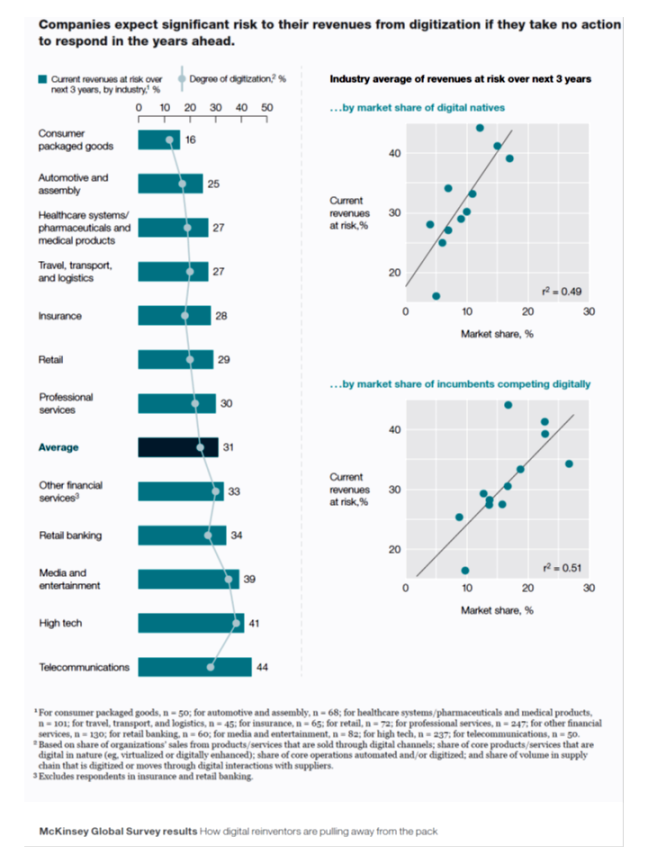
As digitization continues to progress, its expected effects on revenues seem pronounced. When respondents were asked how much of their companies’ revenues would be at risk in the next three years if those companies took no further action to address digital pressures, they estimated that almost one-third could be lost or cannibalized. Consistent with our earlier research showing that increased levels of digitization produce shrinking profit and revenue pools at the industry level, the revenues at risk are even greater in the industries (high tech, as well as media and entertainment) experiencing the highest levels of digitization.

But the level of digitization is only part of the industry picture. Despite a common belief that digital natives are the greatest threat to an industry’s existing market share, the results indicate that incumbents competing in digital ways pose just as great a threat to other companies, if not a greater one.

The correlation between the market share owned by digital natives and revenues at risk is on par with that of incumbents playing digitally. This finding is consistent with other work suggesting that incumbents can have a strong effect on the market and on the pace of digital disruption in a given industry, and this effect is only magnified by the more powerful positioning of these incumbents. Since those competing in digital ways already own a larger market share than digital natives do, on average, they can also make larger shifts in the economics of their respective markets.

To date, the loss of revenues as digitization has expanded is already clear. Nearly 20 percent of all respondents report negative revenue growth in the past three years. But some companies can thrive in a more digitized landscape: specifically, those trying to reinvent themselves by embedding digital technologies in the core of their business models and by launching new digital businesses. Respondents at incumbents playing digitally are twice as likely as traditional incumbents to report exceptional financial growth (that is, an average compound annual growth rate of more than 25 percent) during this same period.
Digital Reinventors

Click here to access McKinsey’s detailed survey analysis


Creating a Data-Driven Enterprise with DataOps

Let’s discuss why data is important, and what a data-driven organization is. First and foremost, a data-driven organization is one that understands the importance of data. It possesses a culture of using data to make all business decisions. Note the word all. In a datadriven organization, no one comes to a meeting armed only with hunches or intuition. The person with the superior title or largest salary doesn’t win the discussion. Facts do. Numbers. Quantitative analyses. Stuff backed up by data.

Why become a data-driven company? Because it pays off. The MIT Center for Digital Business asked 330 companies about their data analytics and business decision-making processes. It found that the more companies characterized themselves as data-driven, the betterthey performed on objective measures of financial and operational success. Specifically, companies in the top third of their industries when it came to making data-driven decisions were, on average, five percent more productive and six percent more profitable than their competitors. This performance difference remained even after accounting for labor, capital, purchased services, and traditional IT investments. It was also statistically significant and reflected in increased stock market prices that could be objectively measured.

Another survey, by The Economist Intelligence Unit, showed a clear connection between how a company uses data, and its financial success. Only 11 percent of companies said that their organization makes “substantially” better use of data than their peers. Yet more than a third of this group fell into the category of “top performing companies.” The reverse also indicates the relationship between data and financial success. Of the 17 percent of companies that said they “lagged” their peers in taking advantage of data, not one was a top-performing business.

But how do you become a data-driven company? According to a Harvard Business Review article written by McKinsey executives, being a data-driven company requires simultaneously undertaking three interdependent initiatives:

Identify, combine, and manage multiple sources of data

You might already have all the data you need. Or you might need to be creative to find other sources for it. Either way, you need to eliminate silos of data while constantly seeking out new sources to inform your decision-making. And it’s critical to remember that when mining data for insights, demanding data from different and independent sources leads to much better decisions. Today, both the sources and the amount of data you can collect has increased by orders of magnitude. It’s a connected world, given all the transactions, interactions, and, increasingly, sensors that are generating data. And the fact is, if you combine multiple independent sources, you get better insight. The companies that do this are in much better shape, financially and operationally.

Build advanced analytics models for predicting and optimizing outcomes

The most effective approach is to identify a business opportunity and determine how the model can achieve it. In other words, you don’t start with the data—at least at first—but with a problem.

Transform the organization and culture of the company so that data actually produces better business decisions

Many big data initiatives fail because they aren’t in sync with a company’s day-to-day processes and decision-making habits. Data professionals must understand what decisions their business users make, and give users the tools they need to make those decisions.

DD Enterprise

Click here to access the ebook Data Driven Organizations

Bank to the future: Finding the right path to digital transformation

Customers are changing the way they buy financial services. That means that firms can’t afford to sit on the sidelines when it comes to their digital capabilities. But a bank shouldn’t think of a digital transformation as only a way to stay ahead of the competition. A bank should make sure its transformation fits its strategy, because transformation is really all about strategy.

  • What makes sense for your bank?
  • Where are you succeeding with customers?
  • What can help you keep going down that road?

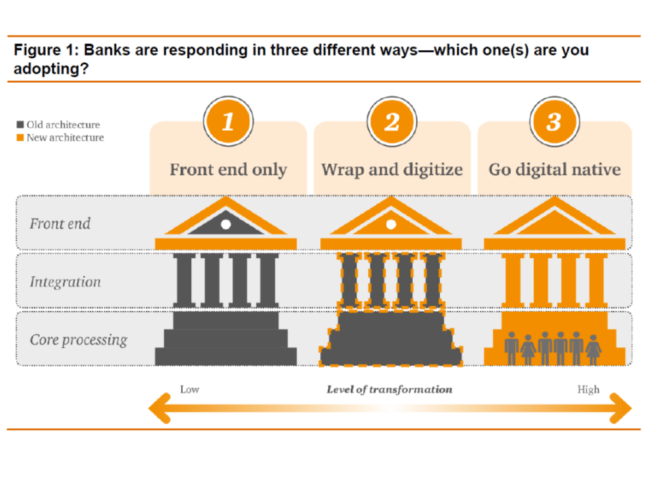
While it’s important to keep up with competitors, your digital transformation should be tailored to your bank’s particular needs. Each institution has its own footprint, legacy infrastructure, customer demographics, and so on. Let’s explore the three most common approaches to digital transformation in more detail (see Figure 1). Each option creates a different customer experience, has a varying effect on profitability, and comes with its own set of challenges. From there, we’ll discuss how you should weave in digital transformation as part of your overall strategy and what you can do to get started now.

The simplest approach is to modify the front end only, focusing on the primary ways a customer interacts with a bank (website, app, etc.). Largely a cosmetic fix, the bank designs an appealing mobile app and web interface but keeps the organization’s workflows, culture, and back-end infrastructure intact. We understand the appeal of this approach. For an organization that needs a quick win, it’s certainly the fastest route. In fact, this approach may be a quick interim step for banks that have real client-facing issues. It’s a solid stop on the road of transformation, but for most banks, it won’t be the destination.

DigitalBank

Click here to access PWC’s report

Insurance Global Trends in 2017

A brief summary of the key regional trends :

  • Analytics, Customer Centricity and Digital Innovation achieve similar scores across all our regions.
    • Customer-Centricity trails marginally in North America.
    • Noteworthy is the perfect score of 60 attained for Digital Innovation in Asia-Pacific, which indicates that this was the number-one priority here in all four measures underlying the priority score (money, time, staffing and training).
  • Underwriting and Risk Management both score considerably higher in North America than they do elsewhere – as we saw in the first priorities table, Underwriting is 3rd in the list of priorities in North America, despite not getting above 7th place in any other regions, and its Risk Management score is more than 80% higher than the runner-up’s (Europe).
  • There is a step-up in focus on Claims in Europe and North America compared to Asia-Pacific.
  • With Distribution Diversification, we have the exact inverse scenario, with Asia-Pacific leading the pack, possibly a reflection of the emerging markets within it necessitating high-scale low-cost distribution, which traditional models cannot provide.
  • Fraud is also a marginally higher priority in Asia-Pacific.
  • Europe and Asia-Pacific lead North America with their focus on Internet of Things.
  • Cybersecurity and Mobile achieve similar (lowish) scores for all regions; Product Development is relatively high across the board.
  • Regulation is the biggest deal in Europe, where respondents quoted in particular Solvency II and the Insurance Distribution Directive (IDD) as being causes for concern.

InsuranceNexus

Click here to access Insurance Nexus detailed survey analysis

The new dynamics of financial globalization

Since the global financial crisis began in 2007, gross cross-border capital flows have fallen by 65 percent in absolute terms and by four times relative to world GDP. Half of that decline has come from a sharp contraction in cross-border lending. But financial globalization is still very much alive—and could prove to be more stable and inclusive in the future.

  • Eurozone banks are at the epicenter of the retreat in cross-border lending, with total foreign loans and other claims down by $7.3 trillion, or by 45 percent, since 2007. Nearly half has occurred in intra-Eurozone borrowing, with interbank lending showing the largest decline. Swiss, UK, and some US banks also reduced their foreign business.
  • The retrenchment of global banks reflects several factors:
    • a reappraisal of country risk;
    • the recognition that foreign business was less profitable than domestic business for many banks;
    • national policies that promote domestic lending;
    • and new regulations on capital and liquidity that create disincentives for the added scale and complexity that foreign operations entail.
  • Some banks from developing and other advanced economies—notably China, Canada, and Japan—are expanding abroad, but it remains to be seen whether their new international business is profitable and sustained.
  • Central banks are also playing a larger role in banking and capital markets.
  • Financial globalization is not dead. The global stock of foreign investment relative to GDP has changed little since 2007, and more countries are participating. Our new Financial Connectedness Ranking shows that advanced economies and international financial centers are the most highly integrated into the global system, but China and other developing countries are becoming more connected. Notably, China’s connectedness is growing, with outward stock of bank lending and foreign direct investment (FDI) tripling since 2007.
  • The new era of financial globalization promises more stability. Less volatile FDI and equity flows now command a much higher share of gross capital flows than before the crisis. Imbalances of current, financial, and capital accounts have shrunk, from 2.5 percent of world GDP in 2007 to 1.7 percent in 2016. Developing countries have become net recipients of global capital again.
  • But potential risks remain. Capital flows—particularly foreign lending—remain volatile. Over 60 percent of countries experience a large decline, surge, or reversal in foreign lending each year, creating volatility in exchange rates and economies. Equity-market valuations have reached new heights. Financial contagion remains a risk. The rise of financial centers, particularly those that lack transparency, is worth watching.
  • Looking forward, new digital platforms, blockchain, and machine learning may create new channels for cross-border capital flows and further broaden participation.
    • Banks need to harness the power of digital and respond to financial technology companies or fintechs, adapt business models to new regulation, improve risk management, and review their global strategies.
    • Regulators will need to continue to monitor old risks and find new tools to cope with volatility, while creating a more resilient risk architecture and keeping pace with rapid technological change.

Financial Globalization

Click here to access McKinsey’s detailed study


Digitizing IT

Digital transformation is the new strategic imperative—no longer just a handy source of competitive differentiation but a must-do for every company, in every industry, and across every geography.

The challenges involved, however, are testing leadership teams to their limits: how can they best

  • wrap digital services around existing products and services,
  • launch new ones that capture customers’ hearts and wallets,
  • and find innovative ways to interact digitally, both internally and externally?

And how can they achieve their goals against a backdrop of stretched budgets and competing priorities ?

In the eye of the storm sit the chief information officer (CIO) and the IT team.

As digital technology becomes embedded in almost every aspect of doing business, IT is increasingly called upon to advise the C-suite

  • on the feasibility of new approaches and to deliver new applications and services,
  • while continuing to perform the day-to-day tasks that keep existing systems up and running.

This report explores both the challenges and the opportunities facing IT in an era of digital transformation. Written by The Economist Intelligence Unit (EIU) and sponsored by SAP, it is based on a survey of more than 800 business and IT leaders across Europe, North America, Latin America and Asia-Pacific, along with desk research and interviews with C-level executives at major international organisations.

The key findings are as follows:

  • Digital transformation lacks strategic co-ordination. Digital transformation is firmly on the agenda for the majority of companies, and they are busy with a variety of digital initiatives. They are investing in a range of technologies and pursuing a wide array of objectives, most commonly improving products and services and boosting the customer experience. But only a minority of organisations have devised and implemented a digital transformation strategy to direct these initiatives. Those that have done so are substantially more likely to see their digital initiatives as being effective (93%) than those that have not (63%).
  • The way in which digital transformation is implemented varies considerably between firms—and even between departments. The CIO is the most likely executive to take ownership of digital transformation (37%), but CEOs (20%) and chief operating officers (15%) are also likely owners—and 16% say that digital transformation is not owned by one individual member of the C-suite. Meanwhile, 29% report that digital initiatives are led by individual business units, 24% say they are led by a dedicated digital unit, and 22% say they are led by IT. Interestingly, respondents from IT are more likely to believe their digital initiatives are centrally coordinated than those in other functions, revealing a distinct lack of “joined-up thinking” on the matter.
  • Both IT and non-IT executives believe that the IT department should take a more active role in digital transformation. Executives both inside and outside the IT function consistently report that IT should ideally play a more active role in key capabilities that support digital transformation than is currently the case. The biggest discrepancy concerns innovation—just 7% of executives say that IT leads their organisation’s attempts to identify opportunities to innovate, while 35% believe that it should. The fact that IT executives agree shows that it is not for want of ambition that they do not currently lead these capabilities. Instead, the data suggest that they are constrained by the obligations of their current role.
  • Digital transformation is a test of the IT department’s ability to collaborate. Digital products and processes require input from multiple departments. As a result, digital transformation is a test of an organisation’s ability to work across departmental lines. The majority of executives of all stripes agree that collaboration between IT and non-IT management will provide the greatest opportunity for success in digital business initiatives. “Everyone has to succeed together,” as one digital executive puts it.
  • IT departments are evolving for the era of digital transformation, but there is much more to be done. IT departments have begun to adapt their working practices to meet the needs of digital transformation—and their peers in other functions are noticing. Almost half (45%) of non-IT executives say the IT department has changed the way it works “completely” or “significantly” to support digital transformation, while 40% report “limited” changes. However, IT executives themselves report limited adoption of key methodologies associated with digital delivery, such as Agile software development (17%) or DevOps (15%). These new ways of working are by no means easy to adopt, but this implies a degree of inertia that few companies can afford.

Digitize IT

Click here to access the Economists Intelligence Unit’s detailed report

The Digital Business Imperative

Don’t Build A Digital Strategy; Digitize Your Business Strategy

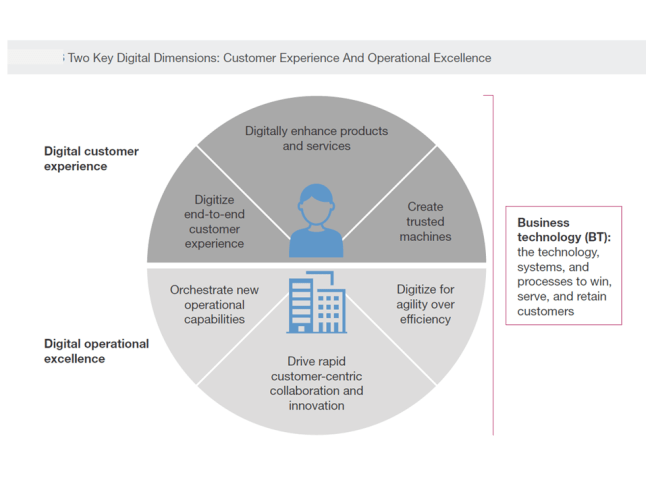
Digital fundamentally changes your relationship with your customers. You can’t address this change with a bolt-on digital strategy that adds an app here or a site there. To remain competitive, you must re-engineer how your business creates value for your customers in the digital age.

Digital Has Changed Your Markets
Your customers aren’t who they used to be — they haven’t been for quite some time now. Digital touchpoints permeate every aspect of your customers’ lives — how they watch TV on Netflix, how they research new products on their smartphone, how they check their balance on PayPal, or how they review their stay on Airbnb. Business buyers expect automated service, tap communities for insights, and want services with apps attached; they’re even more digital than consumers are. Digital has transformed the market context for every business, and the pace of change is accelerating.

Digital Has Changed The Way That You Operate
Digital has transformed more than your channels and customers. It also disrupts you from within, changing the way that you do business. Digital not only accelerates the pace of change but also brings new opportunities for firms that can embrace the technology fast enough. It speeds time-to-market, reduces costs, and unlocks new revenue streams. There’s a reason why manufacturers ABB, Schneider Electric, and Siemens spent a combined €8 billion on acquiring software assets to help clients design, manage, and optimize complex industrial operations like power grids more effectively.

Use Digital To Help Customers Get To The Outcomes That They Desire

Re-envision your business not as a set of products and services but as part of the personal value ecosystems that your customers assemble according to their needs and desires. Learn to increase value by expanding your company’s role in your customers’ personal value ecosystems.

Digital Operational Excellence Increases Business Agility

Digital business isn’t just about customer experience — it’s also a way to drive operational agility. Digital operations can increase speed-to-market, make employees more productive, promote leaner processes, and maximize asset utilization.

Digital Dimensions


Click here to access Forresters’ detailed study

Achieving Digital Maturity Adapting Your Company to a Changing World

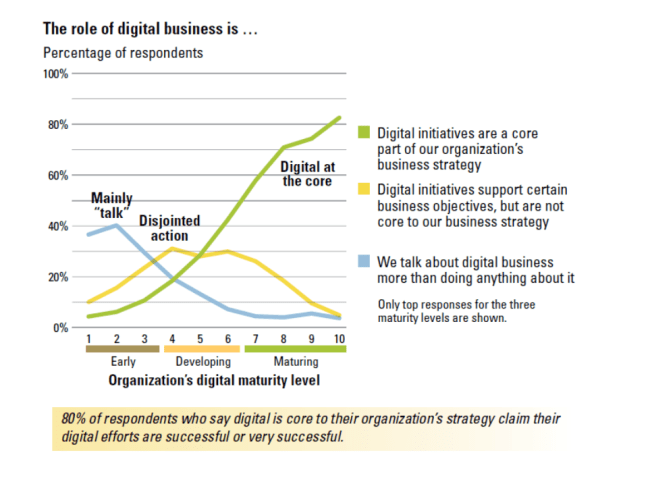
Adapting to increasingly digital market environments and taking advantage of digital technologies to improve operations are important goals for nearly every contemporary business. Yet, few companies appear to be making the fundamental changes their leaders believe are necessary to achieve these goals.

Based on a global survey of more than 3,500 managers and executives and 15 interviews with executives and thought leaders, MIT Sloan Management Review and Deloitte’s third annual study of digital business reveals five key practices of companies that are developing into more mature digital organizations. Their approaches, which may offer valuable lessons for companies that want to improve their own digital efforts, include:

  1. Implementing systemic changes in how they organize and develop workforces, spur workplace innovation, and cultivate digitally minded cultures and experiences. For example, more than 70% of respondents from digitally maturing companies say their organizations are increasingly organized around cross-functional teams versus only 28% of companies at early stages of digital development. We discuss how this fundamental shift in the way work gets done has significant implications for
    • organizational behavior,
    • corporate culture,
    • talent recruitment,
    • and leadership tactics.
  2. Playing the long game. Their strategic planning horizons are consistently longer than those of less digitally mature organizations, with nearly 30% looking out five years or more versus only 13% for the least digitally mature organizations. Their digital strategies focus on both technology and core business capabilities. We discuss how linking digital strategies to the company’s core business and focusing on organizational change and flexibility enables companies to adjust to rapidly changing digital environments.
  3. Scaling small digital experiments into enterprise-wide initiatives that have business impact. At digitally maturing entities, small “i” innovations or experiments typically lead to more big “I” innovations than at other organizations. Digitally maturing organizations are more than twice as likely as companies at the early stages of digital development to drive both small, iterative experiments and enterprise-wide initiatives rather than mainly experiments. Digitally maturing organizations also can be shrewd and disciplined in figuring out how to fund these endeavors and keep them from languishing in the face of more immediate investment needs.
  4. Becoming talent magnets. Employees and executives are highly inclined to jump ship if they feel they don’t have opportunities to develop digital skills. For example, vice president-level executives without sufficient digital opportunities are 15 times more likely to want to leave within a year than are those with satisfying digital challenges. Digitally maturing organizations typically understand the need for and place a premium on attracting and developing digital talent. Their development efforts often go far beyond traditional training. These businesses create compelling environments for achieving career growth ambitions while acquiring digital skills and experience, which make employees want to stay.
  5. Securing leaders with the vision necessary to lead a digital strategy, and a willingness to commit resources to achieve this vision. These leaders are more likely to have articulated a compelling ambition for what their digital businesses can be and define digital initiatives as core components to achieving their business strategy. A larger percentage of digitally maturing companies are also planning to increase their digital investment compared to their less digitally mature counterparts, which threatens to widen an already large gap in the level of digital success.

DigitalMaturity

Click here to access MIT’s detailed survey report

What is the Era of the Intelligent Insurer

The biggest innovations in insurance over the next three years will not be in the technology tools themselves, but in how we design them with employees, customers, intermediaries and other human partners in mind.

Digital technology continues to reshape the insurance industry at an unprecedented and quickening pace. In our Technology Vision 2017 research, 87 percent of insurance respondents agreed that we have entered an era of technology advancement that is no longer marked by linear progression, but by an exponential rate of change.

What sets this new wave of disruption apart from those that preceded it is that humans are firmly in control of how technology reshapes our experiences, our industry and the wider world. It’s no longer people who are adapting to technology—rather, the technology is adapting to us.

We’re putting technology to work to disrupt ourselves, our organizations and entire industries. The technology we use today—compared to that of just a few years ago—is increasingly interactive, as touch displays, mixed reality, and natural language processing make it feel more human.

Advanced technology is now capable of learning, with contextual analysis, image recognition and deep learning algorithms that make it seem to think more like us. And, perhaps best of all, technology can now adapt—by constantly aligning itself to our wants and needs.

The five major trends observed are :

  1. AI is the new UI – The Experience Above All
  2. Ecosystem Power Plays – Unleash the Power of Us
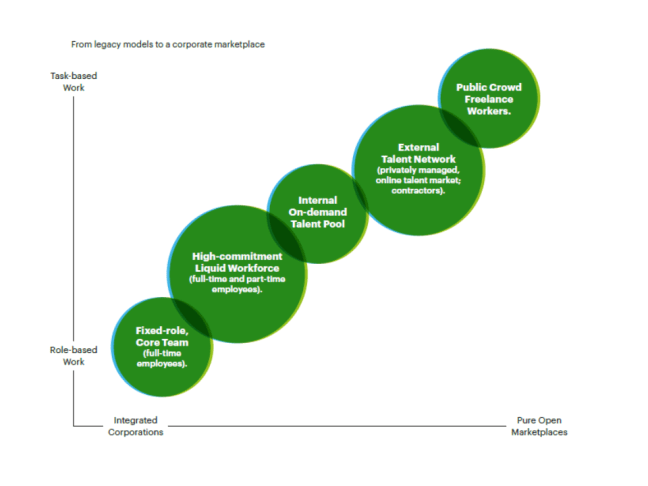
  3. Workforce Marketplace – Invent Your Future
  4. Design for Humans – Inspire New Behaviors
  5. The Uncharted – Invent New Industries, Set New Standards

Marketplaces

Click here to access Accenture’s detailed report

InsurTech Caught on the Radar

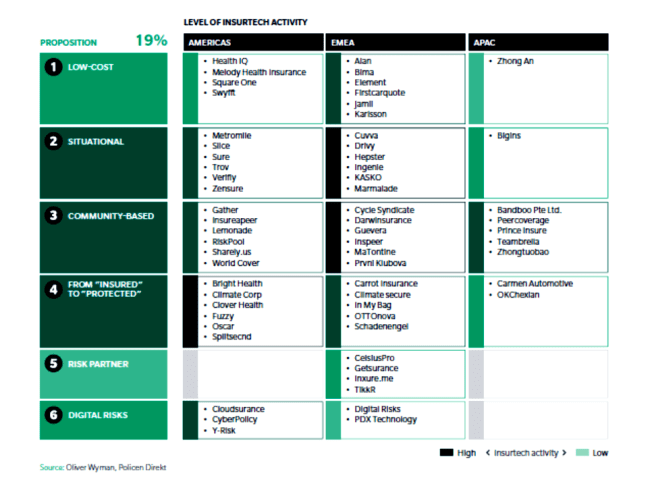
The overall picture that emerges from our InsurTech Radar is, first of all, that different business model categories vary significantly in terms of overall level of economic attractiveness and degree of startup activity. While some see little startup activity, others already appear overcrowded. The number of InsurTechs active in a category is not always in line with its relative attractiveness.

Secondly, even in the most attractive business model categories, it is not clear that InsurTechs will disrupt the industry and make the race. The players most likely to succeed vary by category. InsurTechs will not always be the winners. There are several categories in which either incumbents embracing digital change or firms from outside the insurance industry are most likely to succeed.

Thirdly, a number of underdeveloped categories present attractive opportunities. To be successful in these areas will require innovators to get creative on “demand side” thinking creating models that fundamentally change how risk coverage is presented and sold to customers, models that are not merely digital updates of traditional or slightly altered insurance propositions. Such thinking – substantially different from the “supply side” models of the current, first wave of InsurTechs – is essential for uncovering latent customer demand for risk cover.

Segment 1: Proposition

The proposition segment is less than half the size of the others. It is also the most varied in terms of outlook. The InsurTech Radar shows that there is currently a major mismatch in this segment between the categories with the highest level of startup activity and those with the greatest overall potential. Examples include Situational and Community-Based business model categories which we see as over-emphasized. Nevertheless, the proposition segment includes some of the most attractive categories of any InsurTech segment, as they represent true innovation on how risk coverage is presented and sold to customers – some of these currently see relatively little activity so far (such as the Risk Partner business model category). While the news here is good for established insurers, in that they are likely to be the winners in several of these attractive categories, it is also quite clear that InsurTechs are here to stay. The emergence of newly funded and fully digital insurance carriers might bring forward real breakthroughs. It is very likely that the segment will look quite different in a few years.

Segment 2: Distribution

The InsurTech Radar shows the distribution segment to be much better matched in terms of the level of activity and the categories with the highest likelihood of success. On the down side, all but two of these areas have, comparatively only moderate potential at best, due either to limited premium pools, challenges in sustaining value generation, little opportunity for differentiation, or some combination of these (such as B2C Online Brokers). As in the proposition segment, some of the most crowded categories are also likely to see a shakeout.

Segment 3: Operations

The operations segment is the most consistent of the three: Only one business model category here currently shows limited potential (the “Balance Sheet / Financial Resource
Management” category). Most others are highly attractive. InsurTechs are likely to dominate the segment, albeit sharing honors in the underwriting category with reinsurers.

InsurTech OW

Oliver_Wyman_and_Policen_Direkt_Global_InsurTech_Report_2017