EIOPA proposal for Regulatory Technical Standards (RTS) on management of sustainability risks including sustainability risk plans

Early december 2024 EIOPA has published its consultation paper on management of sustainability risks and the newly created sustainibility risk plans. Very detailed and far reaching standards for the (re)insurance industry that will be added to the ESRS and CSRD framework and significantly enhance existing Solvency II requirements as part of the broader Solvency II reform (Proposal for a Directive of the European Parliament and of the Council amending Directive 2009/138/EC as regards proportionality, quality of supervision, reporting, long-term guarantee measures, macro-prudential tools, sustainability risks, group and cross-border supervision).

This article covers the new requirements for governance (AMSB, Key Functions) and the framework for the sustainability risk plans. An upcoming article will deal with materiality and financial assessments covered by the RTS draft as well as with the new metrics to be integrated in the extended framework.

Background and rationale

The Solvency II Directive requires undertakings to implement specific plans to address the financial risks from sustainability factors and mandates EIOPA to specify the elements of these plans. Article 44 of the amended Solvency II Directive requires undertakings to develop and monitor the implementation of specific plans, quantifiable targets, and processes to monitor and address the financial risks arising in the short, medium, and long-term from sustainability factors. The Directive mandates EIOPA to specify in regulatory technical standards (RTS) the minimum standards and reference methodologies for the

  • identification,
  • measurement,
  • management,
  • and monitoring

of sustainability risks, the elements to be covered in the plans, the supervision and disclosure of relevant elements of the plans.

According to EIOPA, the RTS apply the following approach:

  • First, the proposed RTS build on the existing prudential requirements and integrate the sustainability risk plans into undertakings’ existing risk management practices. The Solvency II Delegated Regulation as amended in 2022 as well as amendments to the Solvency II Directive already require the management of sustainability risks. Existing policy statements and guidance issued by EIOPA set out supervisory expectations on aspects of sustainability risks management. The elements of the sustainability risk plans feed off these requirements and into the own risk and solvency assessment (ORSA) of material financial risks. The sustainability risk plans will be part of undertakings’ regular supervisory reporting.
  • Second, the RTS ensure a read-across between the undertakings’ sustainability and transition plans. While the sustainability risk plans focus on prudential risks for insurers arising from sustainability factors, the undertakings’ actions to mitigate these risks will need to consider their transition efforts.
  • Third, the RTS enable undertakings, including those that are subject to the Corporate Sustainability Reporting Directive (CSRD), to disclose on sustainability risk in a consistent and efficient manner. The RTS specify the minimum standards and methodologies, including selected risk metrics, for performing and disclosing on prudential sustainability risks, as required by the Solvency II Directive. Insurers subject to CSRD can feed the elements identified for public disclosure as part of the Solvency II Solvency and Financial Condition Report (SFCR), into the disclosure required under CSRD.

Own Risk and Solvency Assessment (ORSA)

Insurers shall integrate sustainability risk assessment in their system of governance, risk management
system and ORSA
, as illustrated below:

  • Risk management function and areas: the risk management function shall identify and assess emerging and sustainability risks. The sustainability risks identified by the risk management function shall form part of the own solvency needs assessment in the ORSA. Undertakings shall integrate sustainability risks in their policies. This includes the underwriting and investment policies, but also, where relevant policies on other areas (e.g. ALM, liquidity, concentration, operational, reinsurance and other risk mitigating techniques, deferred taxes risk management). The underwriting and reserving policy shall include actions by the undertaking to assess and manage the risk of loss resulting from inadequate pricing and provisioning assumptions due to internal or external factors, including sustainability risks. The investment risk management policy shall include actions by the insurance or reinsurance undertaking to ensure that sustainability risks relating to the investment portfolio are properly identified, assessed, and managed.
  • Prudent person investment principle: when identifying, measuring, monitoring, managing, controlling, reporting, and assessing risks arising from investments, undertakings shall take into account the potential long-term impact of their investment strategy and decisions on sustainability factors.
  • Actuarial function: regarding the underwriting policy, the opinion to be expressed by the actuarial function shall at least include conclusions on the effect of sustainability risks.
  • Remuneration policy: The remuneration policy shall include information on how it takes into account the integration of sustainability risks in the risk management system.

Sustainability Risk Plans

Considering the relationship with the ORSA, regular supervisory reporting and public disclosure, the figure below sets out the structure of the sustainability risk assessment and key elements of the plan:

The sustainability risk plans should be sufficiently robust to support insurers’ risk management process and the supervisory review of the risk management. Considering the information that is required in the ORSA (for material risks), the sustainability risk plans reported to the National Supervisory Authority should include as a minimum:

a) Governance arrangements and policies to identify, assess, manage, and monitor material sustainability risks.
b) A sustainability risk assessment consisting of:
I. A materiality assessment.
II. A financial risk assessment.
c) Explanation of the key results obtained from the materiality assessment and from the financial risk assessment, where applicable
d) The risk metrics, where relevant, based on different scenarios and time horizons.
e) Quantifiable targets over the short, medium, and long term to address material risks in line with the undertaking’s risk appetite and strategy.
f) Actions by which the undertaking manages the sustainability risks according to the targets set.

Governance

Business model and strategy

Sustainability risks and opportunities can affect the business planning over a short-to-medium term and the strategic planning over a longer term.

The Administrative, Management, and Supervisory Body (AMSB) should set risk exposure limits, targets, and thresholds for the risks that the undertaking is willing to bear with regards to sustainability risks, taking into account:

  • Short-, medium- and long-term time horizon, considering the impact sustainability risks may have soon, but also over the longer term, to be reflected in the business planning over a short-to-medium term and the strategic planning over a longer term.
  • The impact of sustainability risks on the external business environment that will feed into the (re)insurers’ strategic planning.
  • The undertaking’s exposure to material sustainability risk, across sectors and geographies, the transmission channels across risk categories and lines of business.
  • Qualitative and quantitative results from scenario, sensitivity, and stress testing.

Potentially relevant questions which the undertaking can consider when integrating sustainability risk assessment into its governance are:

How does the AMSB expect that sustainability risks might affect its business?

  • Does the AMSB consider sustainability factors as a risk and/or opportunity? If yes, in what ways might environmental, social or governance factors pose risks to the undertaking’s business in economic or financial terms, or create opportunities? If neither risk nor opportunities seem to exist, why not? Has the undertaking elaborated different strategic options to manage the risks and how they have been developed?
  • Has the AMSB implemented or planned any substantive changes to its business strategy in response to current and potential future sustainability impacts? If yes, what are the key risk drivers that it would consider relevant to its strategy? If not, why not?
  • Is the AMSB concerned about secondary effects or indirect impacts of sustainability on the undertaking’s overall strategy and business model (e.g. any systemic repercussions on the industry or the economy)?
  • What is the undertaking’s time horizon for considering environmental, social or governance risks?

Governance

A. The AMSB

Fitness and propriety. The AMSB is responsible for setting undertakings’ risk appetite and making sure that all risks, and therefore also sustainability risks, if material, are effectively identified, managed, and controlled.

For this, the AMSB should collectively possess the appropriate qualification, experience, and knowledge relevant to assess long-term risks and opportunities related to sustainability risks, which may be obtained or improved through appropriate training.

Effectiveness. To ensure the AMSB effectively executes its responsibilities to identify, manage and control sustainability risks, the AMSB should:

  • be aware of their obligations in the context of the long-term impacts of sustainability risks.
  • be capable of identifying sustainability risks as possible key risks for the undertaking.
  • openly discuss within the AMSB sustainability risks and opportunities.
  • effectively communicate on sustainability risks as possible key risks to in the short and long term.
  • interact with the rest of the organisation by putting sustainability risk as a possible key topic in the day-to-day business.
  • plan and deliver results by considering the impact of sustainability risks and opportunities.
  • take sustainability risks into consideration in the decision-making process.

B. Risk Management and other Key Functions

The risk management function has a vital role in:

Risk identification and measurement: The risk management function will need to ensure that the undertaking effectively identifies how sustainability risks could materialise within each area of the risk management system. It also sets the approach used by undertakings to measure and quantify their exposure to sustainability risks, including understanding the limitations of the methods used, and any gaps the undertaking faces in data and methodologies to assess the risks. Undertakings need to apply relevant tools to identify risks in a proportionate way depending on the nature, scale, and complexity of the risks.

Given the forward-looking nature of the risks and the inherent uncertainty associated with sustainability risks, undertakings will need to use appropriate methodologies and tools necessary to capture the size and scale of the risks. This would imply going beyond using only historical data for the purposes of the risk assessment and depending on the materiality of risk at stake, implement forward-looking technique (i.e. stress testing and scenario analysis), for example by considering also future trends in catastrophe modelling or environmental risk assessment. Science, data, or tools may not yet be sufficiently developed to estimate the risks accurately. As undertakings’ expertise and practices develops, the expectation should be that the approach to identifying and measuring the sustainability risks will mature over time. Hence, the risk management function will need to establish the following:

  • clear policies and procedures for identifying, measure, monitor, managing and report sustainability risks, and the review and approval by the AMSB.
  • qualitative, quantitative or a mix of both approaches to appropriately identify and measure the risks, and any limitations to data and tools.
  • forward-looking analysis of underwriting liabilities or investment portfolios under different future (transition) scenarios, setting out the key data inputs and assumptions as well as gaps and barriers (information, data, scenarios) which complicate undertaking’s efforts to undertake scenario analysis.
  • oversight of any activities performed by the external service providers (e.g. ESG rating providers).

Risk monitoring: The risk management function will need to establish the methodologies, tools, metrics and suitable key risk or performance indicators to monitor the sustainability risks and ensure that risks are consistent with internal limit and its risk appetite. These quantitative and qualitative tools and metrics would aim, for example, at monitoring exposures to climate change-related risk factors which could result from changes in the concentration of the investment or underwriting portfolios, or the potential impact of physical risk factors on outsourcing arrangements and supply chains. The tools and metrics need to be updated regularly to ensure that risks underwritten, or investments made remain in line with undertakings’ risk appetite and support decision making by the AMSB. In addition to that, a list of circumstances which would trigger a review of the strategy for addressing the sustainability risks can be considered as a good practice.

Risk management/mitigation: Risk management measures should be proportionate to the outcome of the materiality assessment. Where material potential impacts of the sustainability risks have been identified, undertaking(s) should identify risk management and mitigating measures. The written policies on the investment and underwriting strategy should include such potential measures. Based on the double materiality principle, the investment and underwriting policy will also consider the financial risks to the balance sheet arising from the impact posed by the underwriting and investment strategy and decisions on sustainability factors. Risk management measures can therefore include measures to help reducing risks caused by climate change, through premium incentives, for example.

The actuarial function shall also consider sustainability risks in its tasks. This would include:

  • concluding on the effect of sustainability risks in the opinion on the underwriting policy. For example, considering the increasing expected losses from physical damage due to increasingly severe and frequent natural catastrophes, the choice of underwriting certain perils, but also the pricing of the perils will need to be considered in a forward-looking manner, having regard to the sustainability of the business strategy.
  • an opinion on the adequacy of the reinsurance arrangements of the undertaking taking special account of the sustainability risks of the undertaking, the undertaking’s reinsurance policy and the interrelationship between reinsurance and technical provisions. The undertaking may consider that in times of increasing losses due to climate change, the reinsurance market may ‘harden’ and increase the cost for primary reinsurance.
  • contributing to the effective implementation of the risk management system, providing the necessary support to the risk management function. For example, considering increasing losses for natural catastrophes due to climate change, the actuarial function will need to contribute to the assessment of the risk and opportunity of underwriting certain natural perils. The actuarial pricing of climate change risks can inform the overall risk management strategy and contribute to the underwriting policy by informing on the risks of underwriting certain perils and the opportunity to invest in prevention measures to reduce the losses. The consideration of climate change in an actuarial risk-based manner should allow for the consideration of incentives in the pricing and underwriting of certain natural hazards, with the view to potentially reduce losses over a longer-term perspective.
  • coordinating the calculation of technical provisions and overseeing the calculation of technical provision, including referring to risks to technical provision driven by sustainability factors.
  • assessing the sufficiency and quality of the data used in the calculation of technical provisions including the validation of relevant sustainability risk input data and comparison of best estimates against experience. The assessment may include expressing a view on data limitations as well as considerations on how to implement a forward-looking view on the risks.

The role of the compliance function regarding sustainability risks would imply, as part of establishing and implementing the compliance policy:

  • assessing legal and legal change risks related to sustainability regulation. Especially as regulatory requirements are building up on sustainability risk management, reporting and disclosure, the compliance with new legal requirements will require attention.
  • providing information on the high-risk areas within the undertaking as regards to the transition policy of the company and legal risk attached to implementing (or not) the transition targets, from a prudential and conduct perspective.
  • identifying potential measures to prevent or address non-compliance. This may require addressing the risk of misrepresentation at entity or product level on the sustainable nature of its risk management or of its product offer.

The internal audit function should consider, where relevant sustainability risks in the preparation and maintaining of internal audit plan. This may include:

  • highlighting high-risk areas to requiring special attention. The potentially increased reliance on external parties as data providers on sustainability risks, or for verification of the sustainability of investments regarding environmental or social objectives, may need particular attention to ascertain the quality of the outsourced activity.
  • coping with follow-up actions in particular recommendations in areas, processes, and activities subject to review.

Functions or committees with special responsibility for sustainability risks. The AMSB may decide to delegate the task of addressing sustainability matters to specific committee(s). Such committees discuss and propose matters to the AMSB for it to take appropriate actions and pass resolutions. It is important to highlight that the responsibility about decisions about material sustainability risks remains with the AMSB. If a (re)insurance undertaking has or intends to set up a function with special responsibility for sustainability risks, its integration with existing processes and interface with key and other functions must be clearly defined. A dedicated sustainability unit or function would therefore be involved, in addition to the risk management function, actuarial function and/or compliance function, whenever the insured risk or investment is sensitive to sustainability risk, e.g., by virtue of the economic sector in which the investment was made, or the geographical location of the insured object.

Misunderstandings regarding the role or extent of the assessment to be made by the sustainability function must be avoided. In other words, it needs to be ascertained whether the function has a mere corporate/communication role (e.g. in dealing with corporate responsibility and reputational risks) or is also intended and equipped for sustainability materiality and financial risk analysis.

Remuneration

Remuneration can be used as a tool for the integration of sustainability risks and incentives for
sustainable investment or underwriting decisions
. The Solvency II Delegated Regulation stipulates that the remuneration policy and remuneration practices shall be in line with the undertaking’s business and risk management strategy, its risk profile, objectives, risk management practices and the long-term interests and performance of the undertaking. It further stipulates that the remuneration policy shall include information on how it takes into account the integration of sustainability risks in the risk management system.

Furthermore, undertakings within the scope of the Sustainable Finance Disclosure Regulation shall include in their remuneration policies information on how those policies are consistent with the integration of sustainability risks, and to publish that information on their websites.

Undertakings will need to take into account both financial and non-financial criteria when assessing
an individual’s performance at certain point of time
: the consideration of sustainability factors is an example of non-financial (or increasingly financial) criteria that could be considered when assessing individual performance. For example, increasingly, for investment professionals, the risk framework should include an assessment of sustainability risks.

From a sustainability perspective, the alignment of the remuneration policy with the institution’s
long-term risk management framework and objectives, seems relevant. In addition, a number of studies concluded that, although it is difficult to prove that short-term strategies result in the destruction of long-term values, in some cases the short-term orientations of managers and investors become self-reinforcing. Therefore, incentives to shift the overall business strategy towards more long-term goals (e.g. promoting ‘patient capital’, increasing the long-term commitments of shareholders or tie managers’ remunerations to long-term performances through training and disclosure of long-term oriented metrics) are relevant in view of the long-term horizon of sustainability risks and opportunities.

The impact of the remuneration policies on the achievement of sound and effective long-term risk
management objectives may be especially relevant when it comes to the variable remuneration of
categories of staff whose professional activities have a material impact on the institution’s risk profile
, taking into account their roles and responsibilities in relation to its sustainability strategy.

Among the currently existing practices across the EU, variable remuneration of employees of (re)insurance undertakings is based on performance and mostly on short-term basis – annual bonuses, or bonuses linked to the business strategy over 3-5 years. The performance of employees would therefore need to be aligned with the longer-term horizon of sustainability risks.

For example, long-term strategy goals such as reducing financed emissions in the investment portfolio or limiting losses in the underwriting of natural catastrophes can be aligned with the remuneration goals horizon, as for example through:

  • Medium-to-short term remuneration incentives linked to achieving set targets in reducing CO2 emissions of investments or linked to reduction of losses through risk prevention initiatives for climate adaptation purposes.
  • Longer-term incentives linked to payment with shares in the company, nudging the executive to take decisions in the long-term interest of the company.

Where the remuneration strategy of the undertaking refers to vague discretionary measures of progress such as ‘improving sustainability’ or ‘driving a robust ESG program’, these should be supported by specific goals or commitments and be measurable, meaningful, and auditable.
Where to start on your ESG journey

Where to start on your ESG journey

Initiating your company’s commitment to reporting its environmental, social, and governance (ESG) metrics can prove a daunting task. But keep in mind: It’s a marathon, not a sprint.

“You don’t have to be perfect on Day 1, Your suppliers and stakeholders want to see progress.”

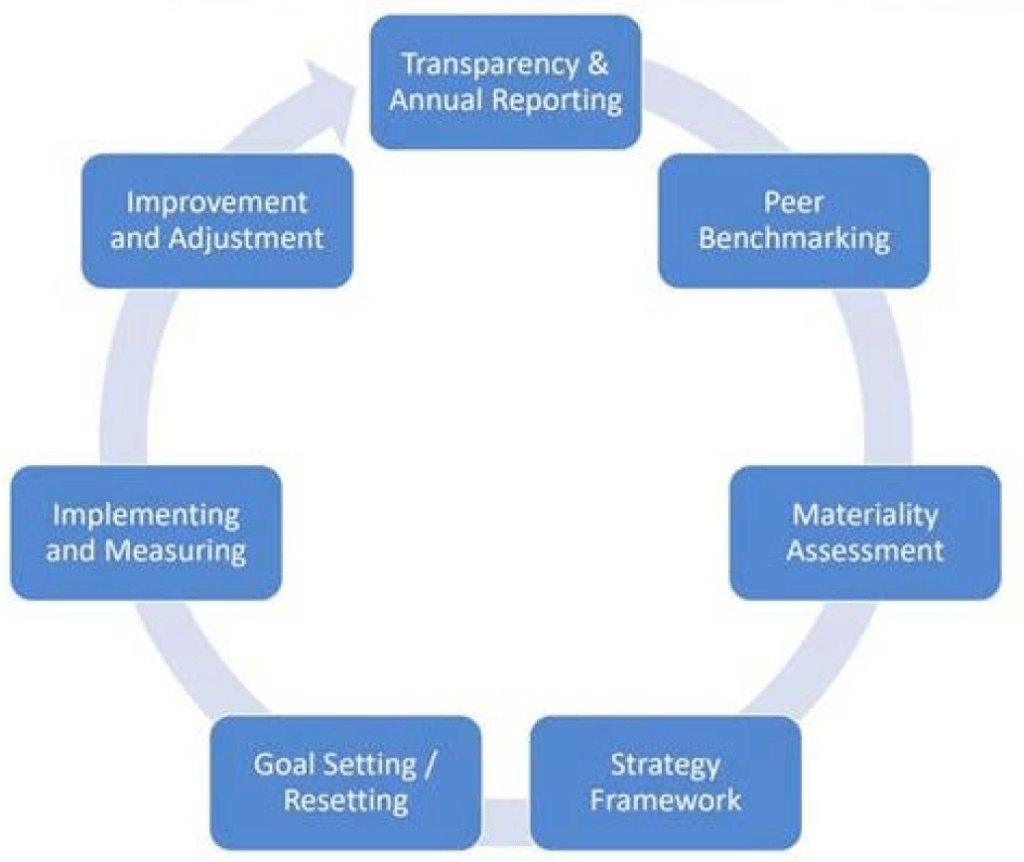
If your company is at this stage—perhaps bracing for the climate-related disclosure rule proposal put forward by the Securities and Exchange Commission (SEC) in March—a roadmap for getting your ESG efforts off the ground could look like this:

Transparency and annual reporting: “Start by identifying all the things your company is doing on ESG and build a baseline, that will give you an indication of how mature your program is today. Most likely you’re doing a lot already.”

Peer benchmarking: Where are your competitors in their ESG journeys? Have any of them experienced public success or failure you can learn from? From this exercise, your company can set realistic expectations of where it wants to be to keep pace with the competitive landscape.

Materiality assessment: “Understanding the materiality drivers for your industry or industries, depending on how your company is structured, is helpful”. The Sustainability Accounting Standards Board (SASB) offers a materiality map that provides guidance for 77 different industries. “Having something at the bottom doesn’t mean it’s not important and you stop doing it, but it helps you focus on the top tier, those are the items you need to set public goals on.” External materiality assessments also add credibility. »

Strategy framework: You know what your peers are doing, you know what’s important to the company and its investors— now is when you build out your strategy. “What does ESG mean for us?” “What are we trying to achieve?” ESG means different things for different companies, but “there’s also some fundamental truths about what ESG is and how and who ESG is serving—the stakeholders involved in your business.” Particularly for compliance professionals, serving shareholders is a natural strategic goal to build around.

Goal setting/resetting: During the peer benchmarking stage, you might note some of the milestones your competitors are striving toward. Their goals can help shape your own. “Do you want to be with the group where you’re just managing expectations, or do you want to compete or lead? It doesn’t happen overnight; you have to go through it step-by-step and build your goals for the long term to move the needle on this. If you’re setting carbon-neutral or net-zero deadlines, be realistic. “Put something out there that is achievable but not too easy”.

Implementing and measuring: This is the most important step because “it’s not in your hands anymore, You have to depend on your cross-functional teams … they will be the ones doing the work and implementing the initiatives.” Legal, human resources, operations, and other departments each have a part to play. You set up a dashboard to track how it was progressing on its key performance indicators on a quarterly basis. “We didn’t wait until the annual report to find out how we did”.

Improvement and adjustment: ESG reporting is a cycle, as evidenced by the arrow in the roadmap image. Going through these steps each year will help ensure a business is tailoring its objectives to continue to serve the most important piece of the puzzle. “This (ESG) is about the people, this is not about the processes, procedures, or requirements. It’s about the people—inspiring the people, collaborating cross-functionally, getting that momentum. That will help you move a lot faster.”

ESG: Adapting businesses should look beyond what is financially material

Environmental, as many would expect, covered climate-related elements, including carbon, energy, water, waste, and circularity. Diversity and inclusion, workplace safety, data privacy and protection, and customers and community fell under social. Governance claimed ethical business practices, board structure, disclosures and reporting, and executive compensation.

While ESG is comprised of just three words, it represents a lot more, encompassing many aspects of how businesses can operate efficiently, ethically, and more financially sound. “Sometimes you have to take out some of the buzzwords that cause people to lock in to certain thinking and open it up. One way to do that is to call it strategic nonfinancial materiality.”

It’s important to think of sustainability initiatives in terms of strategic nonfinancial materiality when it comes to the “tragedy of the commons,” a popular term in environmental science. “When we come across something we can use with no associated cost, we historically 100 percent of the time overuse and mismanage it. If something is common, we manage to mess it up.”

Examples of this include the atmosphere, oceans, and low earth orbit. Prudent corporations can innovate their thinking by getting ahead of an issue and “band[ing] together with industry [or] with other people who use those commons.” One way to think about this, is the term “double materiality,” which is often associated with the European Union’s Nonfinancial Reporting Directive. Double materiality calls for companies to consider their impact on society and the environment in addition to how sustainability issues affect the company.

“In the United States, we’re very well focused on financial materiality.” Also worth considering is “dynamic materiality,” a term utilized by the World Economic Forum that encourages companies to track certain factors year-over-year that might not be material now but could be in the future as the environment changes rapidly.

“These are dynamically material risks. You may still not know anything about them, but it is important to track them potentially as emerging risks, so, innovate how you look at not just what’s a snapshot material now but what are those things that are likely to be material soon.”

Regarding social, it’s suggested to contemplate news stories over the last few years that have changed how we deal with employees as an example. “They didn’t happen in a continuity, one day you weren’t talking about it, the next day it was on the front page and didn’t go off. Those are dynamically material things that drastically change, and you should be able to look for them.”

The Securities and Exchange Commission’s (SEC) proposed climate-related disclosure rule released in March puts forward a similar process, asking companies “to report items that aren’t financially material but are risks nonetheless. This is new, and it’s going to affect the assurance functions,” including

  • internal audit,
  • enterprise risk management,
  • and trade compliance.

“Assurance functions rely on governance and rules, and as we do this, we are going to expand that governance. When you do, you can expand assurance.”

Under the SEC’s proposal, assurance—first limited, then reasonable—is required for Scope 1 and 2 greenhouse gas emissions disclosures outside of the financial statements for accelerated and large accelerated filers. There is no initial attestation requirement for Scope 3 disclosures, which are also subject to a safe harbor provision for affected registrants.

Regarding internal audit, “Maybe we can apply more automation [and] more data analytics to those areas. There is going to be more governance and rigor applied. Maybe more of our creative aspects and our more human and complex audits can go to other places because if greenhouse gas emissions are going to be extremely rigorized, similar to financials, maybe that can be a robotic process automation.”

Hidden Opportunities of Aligning Ethics and Compliance with ESG

ESG is rapidly evolving from grass-roots activism into a top down, board-driven mandate. It’s no mystery why, given that ESG assets make up a third of total global assets under management and are expected to surpass $50 trillion by 2025. ESG investing (also known as “impact investing”) was born of a growing awareness that long-term financial performance of businesses is inextricably intertwined with environmental, social, and governance factors. It has gained considerable traction as research suggests that companies with high ESG ratings tend to outperform their counterparts.

As a result, companies are moving beyond “check the box” ESG disclosures, to instead build out substantive ESG programs, identify appropriate quantitative and qualitative metrics to measure and validate their ESG initiatives, and distinguish themselves with “AAA” ESG ratings. Corporations are devoting significant capital, time, and resources to embedding environmental, social and governance factors into their business strategies and preparing annual ESG disclosures. Because ethics and compliance is so tightly woven into the social and governance elements of ESG, ethics and compliance officers are uniquely poised to support this broader effort in a number of ways.

THE OVERLAP BETWEEN E&C AND ESG

While ESG is strongly associated with environmental initiatives such as lowering carbon footprint, social and governance factors have achieved equal prominence. “Social” and “governance” define a company’s corporate citizen persona—or how it behaves—which is the heart and soul of ethics and compliance and, increasingly, a key factor in market valuation.

Ensuring a company behaves responsibly and ethically is both the mission of a Chief Ethics and Compliance Officer and the purpose of an ESG program. CECOs therefore have oversight of much of the infrastructure that supports social responsibility and prevents corruption, such as

  • internal controls,
  • Code of Conduct and policies,
  • workplace health and safety,
  • data protection and privacy,
  • whistleblower hotlines, workforce training,
  • and prevention of fraud, bribery and money laundering.

Ethics and compliance is mission critical because it is the reputational guardian of the company, the first line of defense against ethical fading. Thanks in large part to the lightning speed of today’s news cycle and the instantaneous impact of social media, corporate malfeasance scandals can have massive immediate impact on reputation and by extension valuation. It’s not unusual for news of bad corporate behavior to be accompanied by an immediate 20-30% drop in market cap. For a $3 billion company, that can equate to a one-day loss of $1 billion.

WHY SHOULD CECOS ALIGN WITH ESG?

It’s early days for ESG, relatively speaking, and best practices for building, quantifying, and disclosing ESG programs are rapidly evolving. As companies move towards transparency and begin walking the talk by aligning corporate culture to the stated ESG values, the historical function of E&C rolls up naturally to support these efforts. Opportunities abound for ethics and compliance leaders who join the challenge to improve their company’s ESG report card:

  1. Board visibility: Boards have come to recognize that robust ESG programs not only attract investors, but also offer a framework to mitigate business risk and future proof the company. Boards are now dedicating agenda time to embedding ESG into company strategy and risk mitigation. As a result, the head or coordinator of a company’s ESG program often reports to the board.
  2. More funding: A traditional ethics and compliance framework is often insufficient to meet the broader mandate of ESG. The top accounting and consulting firms are investing in building capability and capacity for ESG advisory services, and CECOs should be doing likewise internally. By tying ethics and compliance programming to ESG, E&C officers can tap into a bigger budget pool.
  3. Organizational clout: ESG planning and disclosure requires holistic engagement across the organization. By ensuring ethics and compliance is a strong complement of, and contributor to, the high-visibility high-value ESG initiative, CECOs can break organizational silos and increase the intrinsic value of ethics and compliance (and their roles) in the process.

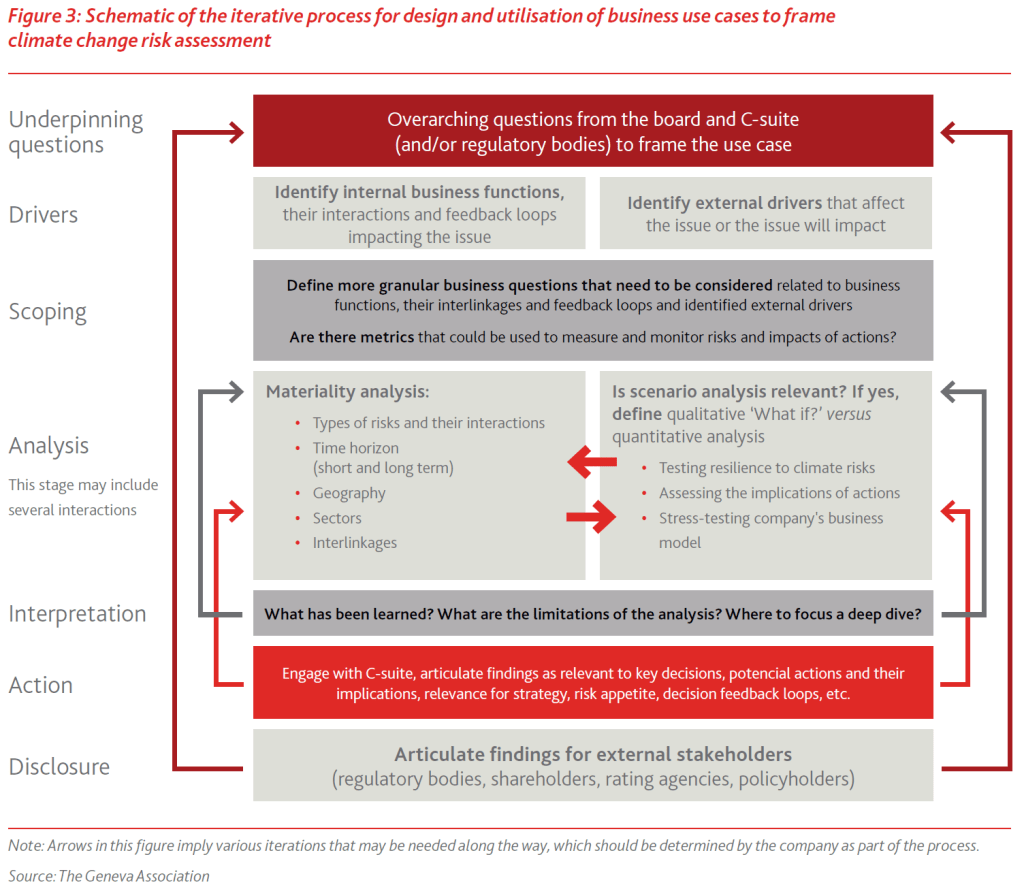
Anchoring Climate Change Risk Assessment in Core Business Decisions in Insurance

Key messages:

  1. The development of decision-relevant climate change risk assessment with a holistic approach requires an exploratory, iterative and adaptive process that will take time. A holistic approach
    considers physical, transition and litigation risks and their interactions at different time horizons in the short and long term. It considers both sides of the balance sheet, as well as interactions across business functions and decision feedback loops to assess the materiality of risks and develop potential actions to address them. Importantly, some re/insurers that have advanced further in this iterative process have found it beneficial to anchor the assessment in overarching decision areas that link both sides of the balance sheet. While re/insurers in all business lines have started exploring the materiality of physical and transition climate change risks on each side of the balance sheet, for life & health re/insurers in particular, more research is required to assess the attributions and materiality of climate change to their underwriting exposures – including longevity, mortality and morbidity –over various time horizons. As research in this field progresses, the ability both to assess life & health re/insurer liability exposures and perform more holistic assessments will improve.
  2. An analysis of regulatory developments since June 2021 and a survey conducted by The Geneva Association reveal that the regulatory and supervisory priorities and approaches are increasingly aligned with earlier GA task force recommendations related to climate change risk assessment and scenario analysis.
  3. Responses from 11 regulatory bodies to a Geneva Association Survey shed light on the regulatory objectives and priorities that can help guide climate change risk assessment exercises within and across jurisdictions. Our analysis has revealed the top four regulatory priorities:
    • policyholder protection,
    • the insurer’s financial health,
    • corporate governance and strategy,
    • the insurability/affordability of insurance solutions,
    • financial stability,
    • raising risk awareness,
    • addressing data/risk assessment services and environmental stewardship.
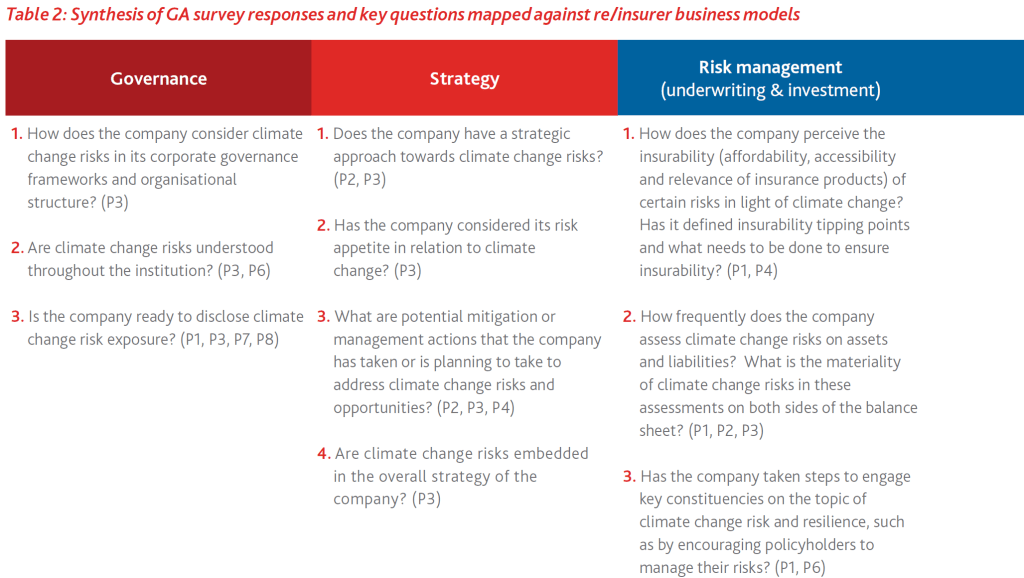
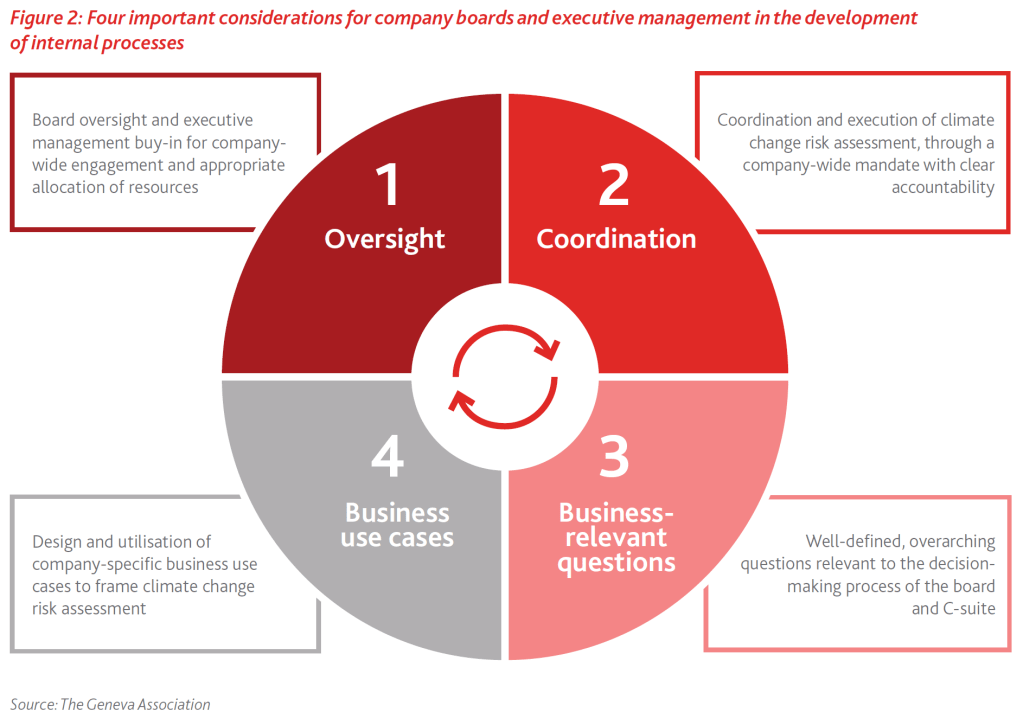
  4. Company boards and executive management need to consider the following four key issues to drive the process towards a more holistic approach that would produce decision-useful information:
    • Board oversight and executive management buy-in for company-wide engagement, along with appropriate resource allocation to build these capabilities, are important;
    • The coordination and execution of climate change risk assessment require an internally established, company-specific mandate with clear accountability;
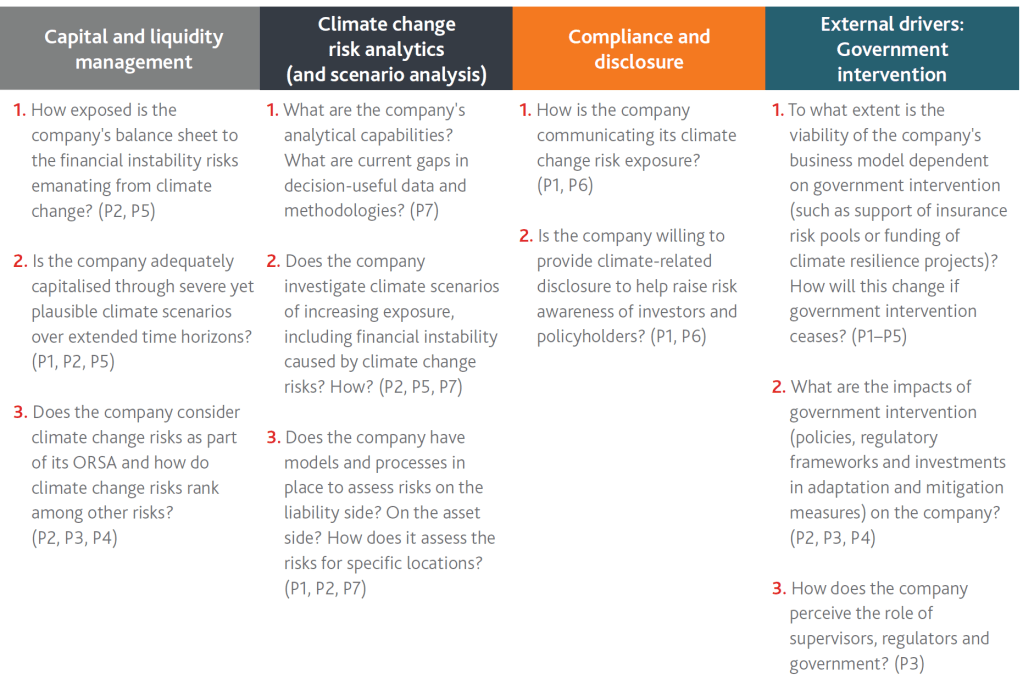
    • Central to this process is the development of overarching decision-relevant questions for the board and the C-suite (a list based on the GA survey of regulatory and standard-setting bodies is included);
    • Company-relevant business use cases should be designed and utilised to guide the iterations of climate change risk assessment.
  5. A 10-step template provided in this report can help companies design business use cases to frame the analysis, engage experts from relevant business functions across the balance sheet, and mine and utilise the same data and tools across the company. It is important to start simple by exploring the impacts of each climate change risk type, on each side of the balance sheet, considering short- and long-term time horizons. With each iteration, companies can build up the level of complexity by assessing the interactions of physical, transition and litigation risks and exploring how these risks are manifested within and across business functions. Of note:
    • This process should consider internal business functions and their interactions as well as external drivers that impact issues relevant to the business use case, by risk type and time horizon;
    • Materiality analysis is at the heart of climate change risk assessment, allowing focus on the
      areas most impacted by climate change risks and identifying priorities for a deeper dive and
      resource allocation;
    • As part of the design and implementation of business use cases, the company should seek to
      identify metrics to measure and monitor the risks and track the impacts of the measures taken to manage them;
    • This resource-intensive process will take time and present challenges that will need to be addressed, ranging from overtime and the availability of data for the given region to internal experience and expertise, and the availability of best practices. In this report, we offer three examples of business use cases to demonstrate these points.
  6. The use of forward-looking scenario analysis needs to be further explored, depending on the issue being considered. Scenario analysis is a tool for conducting a forward-looking assessment of risks and opportunities, where the company can systematically explore individual or combined factors and make strategic decisions in the face of significant uncertainties. Scenario analysis may be used for a range of applications, for example:
    • Testing the resilience of a company’s business model to climate change-related risks;
    • Assessing the implications of possible actions a company can take;
    • Stress-testing the company’s business model under extremely adverse conditions.
  7. Through strong industry collaboration, re/insurers should conduct an analysis of existing data challenges, gaps and needs, and define priority areas and requirements for the future development of tools. More work is required by re/insurers and regulatory bodies to identify gaps in data, to converge on best practices and build a robust toolbox for forward-looking climate change risk analyses. Since 2021, several organisations have offered an assessment of the gaps in climate change risk data and tools in the current landscape, with a focus on certain applications or segments in the financial sector. The journey towards a holistic approach could lead re/insurers to address such gaps over time, not least in emissions data, asset locations and supply chain data. Note that life & health re/insurers still face challenges when it comes to identifying the types of data that would allow the extraction of climate change attribution and liability exposures.
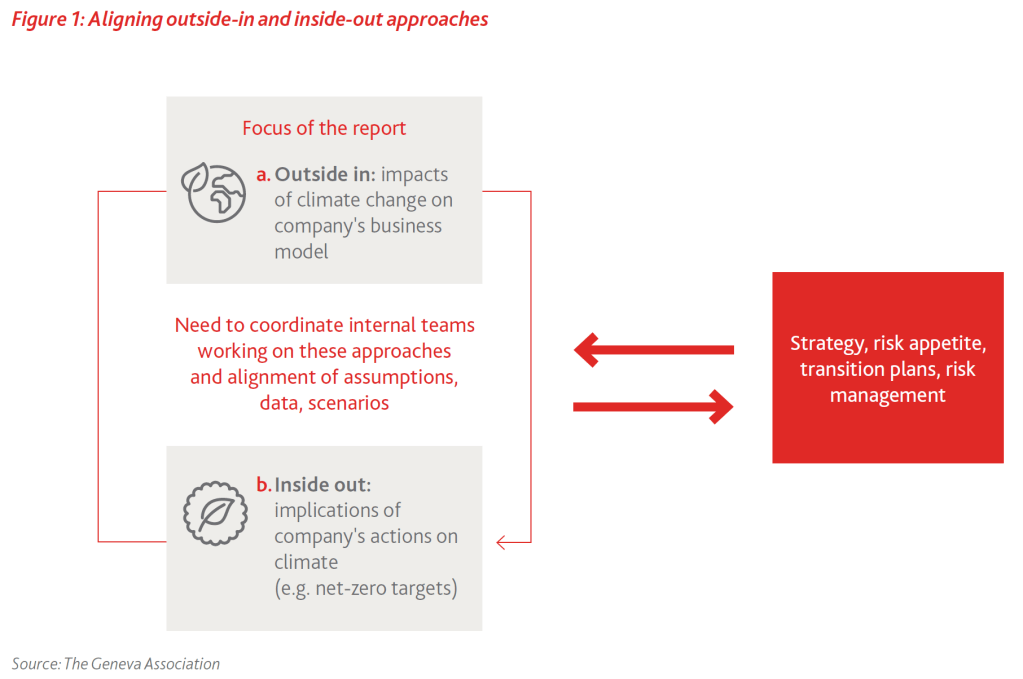
  8. Importantly, company leadership should seek to harmonise and align their net-zero target-setting
    activities using ‘inside-out’ analysis with efforts to assess the resilience of their business model to
    climate change risks using ’outside-in’ approaches for developing viable targets, transition strategy and plans
    . In fact, a growing number of critics are calling out the misalignment of net-zero pledges with what the companies can actually deliver and the possibility of greenwashing, which could lead to potential reputational and climate litigation risks or even regulatory action.
  9. Robust intra- and inter-sectoral collaboration is the only way to expedite the development and convergence of good practices, meaningful baseline requirements for decision-useful climate change risk assessments and disclosures that would allow for cross-company comparisons. To this end, we acknowledge and deeply appreciate the growing proactive collaboration and engagement
    across the insurance industry and with key regulatory and standard-setting bodies in the financial sector.

Context

In 2020, The Geneva Association (GA) launched its task force on climate change risk assessment with the aim of advancing and accelerating the development of holistic methodologies and tools for conducting forward-looking climate change risk assessment. These efforts have intended not only to support primary insurance and reinsurance companies and regulatory bodies with innovation in this area, but also to demonstrate the benefits of industry-level collaboration to help expedite the development and convergence of best practices.

In its first two reports, the GA task force highlighted the complexities associated with the development of forward-looking climate change risk assessment methodologies and tools. It stressed the need to develop methodologies for holistic climate change risk modelling and scenario analysis for both sides of the balance sheet, using a combination of qualitative and quantitative approaches. The GA task force also highlighted the implications of physical and transition risks for the insurance industry, with a focus on the challenges of quantitative scenario analysis approaches. The conclusion was that the prescriptive quantitative regulatory exercises to date, which were conducted to raise awareness, have outlived their
purpose
. More specifically, these resource-intensive exercises do not provide decision-useful information given the significant uncertainties associated with the transition to a carbon-neutral economy (e.g. uncertainties associated with public policy, market and technology risks). Finally, the GA task force called on regulatory bodies to clarify their regulatory objectives and explain how their exercises would deliver decision-useful information. It also stressed the need for convergence on baseline regulatory requirements for analysis and reporting across jurisdictions. To this end, it encouraged stronger collaboration between regulatory bodies within and across jurisdictions, as well as with the insurance industry, to enable the sharing of lessons learned and access to broader expertise, in the aim of expediting the convergence of best practices.

Since June 2021, there have been several developments on the policy, technology, regulatory and scientific fronts, with implications for companies’ climate change risk assessment.

The evolving regulatory landscape for climate change risk assessment

Between June 2021 and May 2022, certain regulators launched new initiatives and published guidelines. A synthesis of these developments reveals the need for regulatory bodies to:

  • Acknowledge the limitations of current tools, models and data for long-term quantitative scenario analysis (as evidence, the 2021 Bank of England Climate Biennial Exploratory Scenarios experiment concluded that projections of climate change losses are uncertain; the view that scenario analysis is still in its infancy, with notable data gaps; and the increasing recognition among some regulatory bodies that quantitative approaches can and should be complemented with qualitative assessments, especially over a longer time horizon);
  • Stress the need to consider multiple scenarios representing different plausible pathways of transition or physical risks, and expand benchmark scenarios (typically NGFS) with sectoral and geographical granularity considerations;
  • Recognise the principle of proportionality, with expectations linked to the size and organisational complexity of the company;
  • Stress the importance of materiality in supervisory expectations for quantitative assessments as well as robust governance of climate change risks, with a need for transparency, particularly in relation to re/insurer investments in carbon-intensive sectors.

As of July 2022, there are still variations in the approaches used by regulators. Regulators agree, however, that this could impede comparisons across companies and jurisdictions as well as the ability to assess broader systemic economic and social impacts. Importantly, the International Association of Insurance Supervisors (IAIS) is working on promoting a globally consistent supervisory response to climate change, with a focus on three areas:

  • standards,
  • data
  • and scenario analysis,

by providing guidance to regulatory bodies. The Financial Stability Board (FSB) is also issuing guidance on supervisory and regulatory approaches across borders and sectors to address market fragmentation and potential sources of systemic risk. Finally, the development of a global baseline for sustainability reporting standards with a focus on climate change, by the ISSB, aims to translate them further into harmonised inter-jurisdictional standards.

Strategic importance of aligning inside-out and outside-in climate risk assessment approaches

Companies are conducting two types of climate risk assessment:

  • Inside-out analysis: This includes assessing the impact of the company’s actions on the climate by setting their climate targets (e.g. net zero targets) based on a variety of science-based approaches, such as those introduced by the UN Net-Zero Asset Owner Alliance (UN NZAOA) and the Science-Based Targets initiative (SBTi). For example, the UN-convened Net-Zero Alliances uses 1.5°C-compatible pathways, which may be far more ambitious than what companies and the real economy can deliver. In fact, the UN NZAOA has warned that the global economy does not move as is required by science, leading to a widening gap between companies’ climate targets and the real economy. Net-zero targets need to take this widening gap into account as this misalignment could lead to other financial and non-financial risks for the company, including reputation risk. This is further exacerbated by the fact that climate science is still evolving.
  • Outside-in analysis: This involves assessing the resilience of the company’s business model to climate change risks, which is the focus of this report. It is important to emphasise that the development of the company’s strategy, transition plan and related actions cannot be done solely using inside-out analysis. Conducting outside-in analysis is critical, enabling the company to assess not only the impacts of climate change risks and their interactions, but also the implications of the possible range of activities under different scenarios on the firm’s business model. Of note, the inside-out view puts greater emphasis on ‘impact’ – which has a clear political component and should be grounded in materiality assumptions, which is the central objective of the outside-in analysis.

In summary, companies should seek to harmonise and align inside-out with outside-in climate change risk assessment efforts (Figure 1). In fact, a growing number of critics are calling out the misalignment of net-zero pledges by the financial sector, in light of their already committed investments in carbon-intensive sectors for the years to come. Critics are also raising the possibility of greenwashing, which could lead to potential climate litigation risk. Regarding the latter, some regulators are developing KPIs to assess and monitor the existence and level of greenwashing as part of their efforts to incorporate climate change factors into their regulatory mandate.

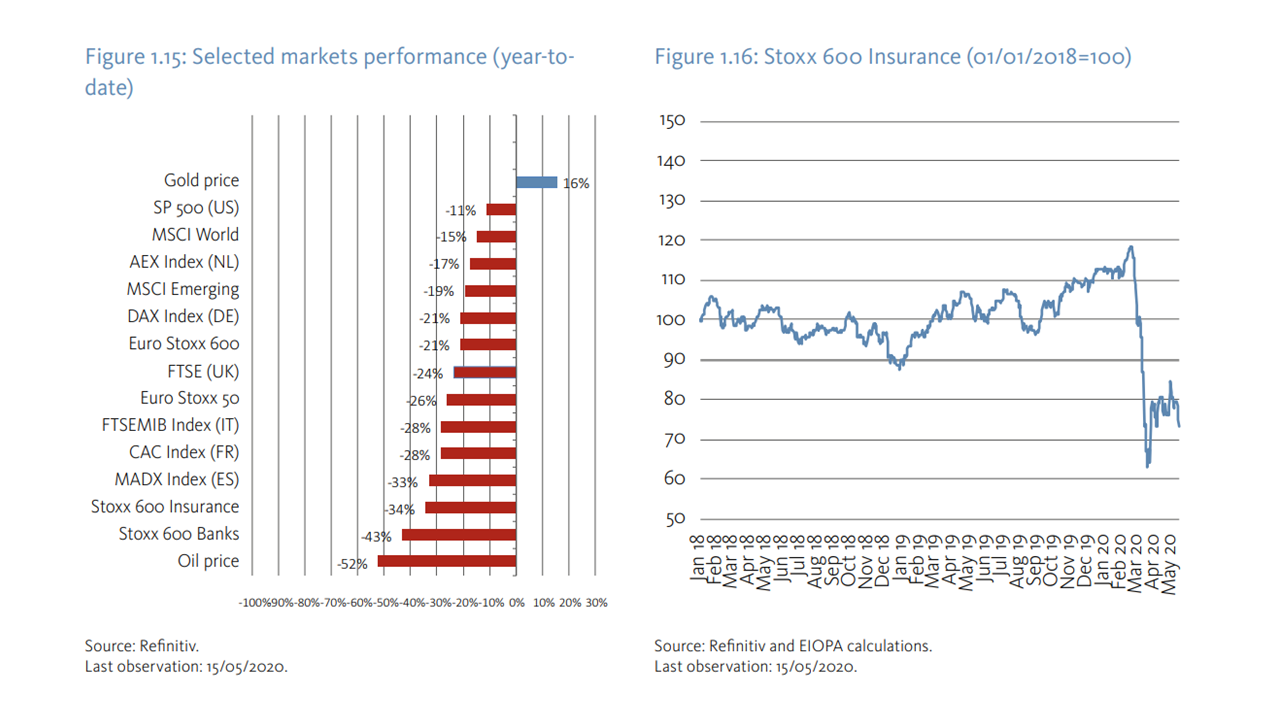
EIOPA Financial Stability Report July 2020

The unexpected COVID-19 virus outbreak led European countries to shut down major part of their economies aiming at containing the outbreak. Financial markets experienced huge losses and flight-to-quality investment behaviour. Governments and central banks committed to the provision of significant emergency packages to support the economy, as the economic shock, caused by demand and supply disruptions accompanied by its reflection to the financial markets, is expected to challenge economic growth, labour market and the consumer sentiment across Europe for an uncertain period of time.

Amid an unprecedented downward shift of interest rate curves during March, reflecting the flight-to-quality behaviour, credit spreads of corporates and sovereigns increased for riskier assets, leading effectively to a double-hit scenario. Equity markets dramatically dropped showing extreme levels of volatility responding to the uncertainties on virus effects and on the status of government and central banks support programs and their effectiveness. Despite the stressed market environment, there were signs of improvement following the announcements of the support packages and during the course of the initiatives of gradually reopening the economies. The virus outbreak also led to extraordinary working conditions, with part of the services sector working from home, which rises the potential of those conditions being preserved after the virus outbreak, which could decrease demand and market value for commercial real estate investments.

Within this challenging environment, insurers are exposed in terms of solvency risk, profitability risk and reinvestment risk. The sudden reassessment of risk premia and the increase of default risk could trigger large-scale rating downgrades and result in decreased investments’ value for insurers and IORPs, especially for exposures to highly indebted corporates and sovereigns. On the other hand, the risk of ultra-low interest rates for long has further increased. Factoring in the knock on effects of the weakening macro economy, future own funds position of the insurers could be further challenged, due to potential lower levels of profitable new business written accompanied by increased volume of profitable in-force policies being surrendered or lapsed.

Finally, liquidity risk has resurfaced, due to the potential of mass lapse type of events and higher than expected virus and litigation related claims accompanied by the decreased inflows of premiums.

EIOPA1

For the European occupational pension sector, the negative impact of COVID-19 on the asset side is mainly driven by deteriorating equity market prices, as, in a number of Member States, IORPs allocate significant proportions of the asset portfolio (up to nearly 60%) in equity investments. However, the investment allocation is highly divergent amongst Member States, so that IORPs in other Member States hold up to 70% of their investments in bonds, mostly sovereign bonds, where the widening of credit spreads impair their market value. The liability side is already pressured due to low interest rates and, where market-consistent valuation is applied, due to low discount rates. The funding and solvency ratios of IORPs are determined by national law and, as could be seen in the 2019 IORP stress test results, have been under pressure and are certainly negatively impacted by this crisis. The current situation may lead to benefit cuts for members and may require sponsoring undertakings to finance funding gaps, which may lead to additional pressure on the real economy and on entities sponsoring an IORP.

EIOPA2

Climate risks remain one of the focal points for the insurance and pension industry, with Environmental, Social and Governance (ESG) factors increasingly shaping investment decisions of insurers and pension funds but also affecting their underwriting. In response to climate related risks, the EU presented in mid-December the European Green Deal, a roadmap for making the EU climate neutral by 2050, providing actions meant to boost the efficient use of resources by

  • moving to a clean, circular economy and stop climate change,
  • revert biodiversity loss
  • and cut pollution.

At the same time, natural catastrophe related losses were milder than previous year, but asymmetrically shifted towards poorer countries lacking relevant insurance coverages.

Cyber risks have become increasingly relevant across the financial system in particular during the virus outbreak due to the new working conditions that the confinement measures imposed. Amid the extraordinary en masse remote working arrangements an increased number of cyber-attacks has been reported on both individuals and healthcare systems. With increasing attention for cyber risks both at national and European level, EIOPA contributed to building a strong, reliable, cyber insurance market by publishing its strategy for cyber underwriting and has also been actively involved in promoting cyber resilience in the insurance and pensions sectors.

Click here to access EIOPA’s detailed Financial Stability Report July 2020

Optimize for both Social and Business Value – Building Resilient Businesses, Industries, and Societies

Why Is Corporate Capitalism at a Tipping Point?

Stakeholders are beginning to pressure companies and investors to go beyond financial returns and take a more holistic view of their impact on society. This should not surprise us. After all, we have lived through two decades of hyper-transformation, during which rapidly evolving digital technologies, globalization, and massive investment flows have stressed and reshaped every aspect of business and society.

As in previous transformations, the winners created new dimensions of competition and built innovative business models that increased returns for shareholders. Many others found their businesses at risk of being disrupted, with familiar formulas no longer working. To meet the unwavering demands of Wall Street, many companies relentlessly optimized operating models, streamlined and concentrated supply chains, and specialized their assets and teams — leaving them less resilient and less adaptable to shifting markets and trade flows. The resulting waves of corporate restructuring, consolidation, and repositioning have fractured companies’ cultures and undermined their social contracts.

Furthermore, this hyper-transformation cascaded beyond individual companies and created socio-economic dynamics that left many people and communities economically disadvantaged and politically polarized. Combined with the increasing shared anxiety that the earth’s climate is changing faster than the planet can adapt, a global zeitgeist of risk and insecurity has emerged. We will enter the 2020s with more citizens, investors, and leaders convinced that the way business, capital, and government work must change — and change quickly.

We now must rethink the sustainability of the whole system in the face of extreme externalities — or risk losing social and political permission for further progress. The 2030 UN Sustainable Development Goals (SDGs) identify the moral and existential threats that we must meet head-on. While some question the SDGs’ breadth and timeline, most agree that, if achieved, they would create a more just, inclusive, and sustainable world.

Goal 17 calls for new engagement by companies and capital in partnership for collective action across the public, social, and private sectors. Five years into the SDG agenda, there is ample evidence that governments, investors, and companies are beginning to exercise their capacity to create much-needed change.

Change Is Underway but Is Hardly Sufficient

Many institutional investors are racing to integrate ESG (environmental, social, and governance) assessments into their decision making, and they are expecting companies to report on how they deliver on those metrics. New efforts promote radical disclosure, like the Bloomberg/Carney TCFD (Task Force on Climate-Related Financial Disclosures), which encourages signatories to report on the climate risks of their financial holdings.

New standards initiatives are creating a foundation for nonfinancial performance accounting, and the prospect of widespread “integrated reporting” seems realistic. Companies are investing in “purpose” and defining their contributions to society against material ESG factors and SDG goals. Corporate sustainability and CSR (Corporate Social Responsibility) functions, historically on the sidelines, are now being integrated into line business activity, with progressive companies expanding the scope of competition to include differentiation on environmental and societal dimensions. And through industry consortia, many companies are taking collective action on issues that both threaten their right to operate and open up new opportunities for their industries.

Such examples are important early signals that the context for business is changing. However, for all the progress on commitments, agreements, metrics, and policies, there has been little aggregate progress against top-level goals, like

  • reducing CO2 emissions,
  • cutting plastics waste,
  • or narrowing social and economic inequality within nations.

Without demonstrable impact and collective progress, social and political pressure will only build, further threatening the legitimacy of corporate capitalism.

A New Societal Context for Business

Companies will face escalating social activism by investors, stakeholders, social mission organizations, and policymakers on issues of

  • climate risk,
  • economic inequality,
  • and societal well-being.

Governments and local communities will set a higher bar for a company’s right to operate, and in a connected world a company’s local performance will quickly affect its global reputation and trigger social and regulatory consequences. Stakeholders will expect radical transparency on ESG performance.

This will shift investors’ perceptions of a company’s risk and opportunity, skewing capital toward those that deliver both financial returns and positive societal impact. To satisfy a growing demographic of socially minded consumers and businesses, companies will need to demonstrate “good products doing good” and anchor their brands and identity around a credible purpose.

Talent will gravitate toward companies that give employees a line-of-sight to making the world better while also providing a fulfilling career. To win, companies will need to define competition more broadly, adding new dimensions of value through

  • environmental sustainability,
  • holistic well-being,
  • economic inclusion,
  • and ethical content.

This will require radical business model innovation

  • to enable circular economies for precious resources;
  • to provide assets that are shared rather than owned;
  • to broaden access and inclusion;
  • and to multiply positive societal impact.

At this critical moment for corporate capitalism, business is more trusted than government, according to the Edelman Trust Barometer. Farsighted corporate leaders will see the opportunity for their industries to

  • mitigate environmental and societal threats,
  • catalyze collective action to discover new solutions,
  • shape wider ecosystems,
  • and expand trust with stakeholders.

Such actions will be indispensable to strengthen social permission for corporate capitalism before it is further undermined.

CEOs Need an Agenda for Value and the Common Good

We frame the journey to new corporate value and the common good around six imperatives.

It begins with reimagining corporate strategy, then

  • involves transforming the business model,
  • reframing performance and scorekeeping,
  • leading a purpose-filled organization,
  • practicing corporate statesmanship,
  • and elevating governance.

BCG 1

While challenging to execute, we argue that this agenda will be essential to create a great company, a great stock, a great impact, and a great legacy.

Reimagine Corporate Strategy

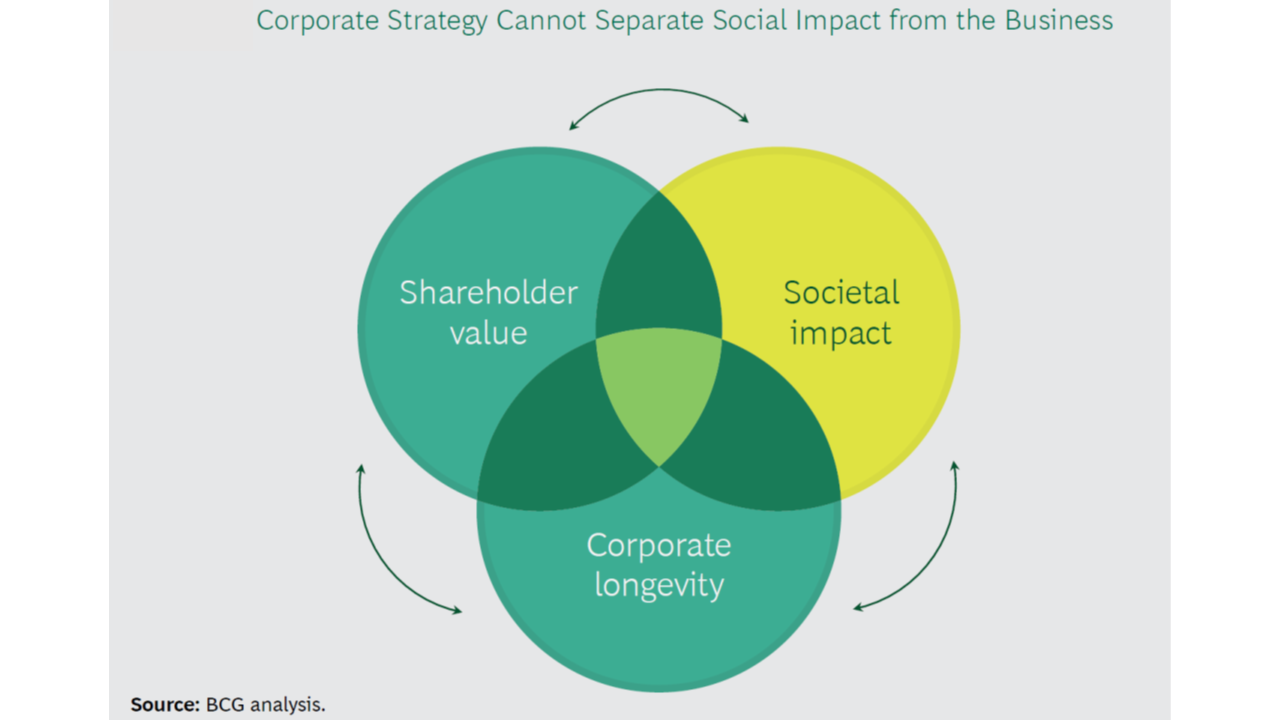
We believe few companies have strategies for this new era of business. The following exhibit illustrates the ambition of such a strategy, which establishes competitive advantage at the intersection of

  • shareholder value,
  • corporate longevity,
  • and societal impact.

The “quality” of the strategy is thus judged by how it delivers both total shareholder returns and total societal impact.

BCG 2

Consequently, it widens the scope of competition to encompass creating rich differentiation and relative advantage in multiple areas of societal value. It embeds “social value” into new business constructs, shared value chains, and reconstructed ecosystems.

It also opens, broadens, and deepens markets to enable access and inclusion. And it expands the scope of business by calling for coalitions for collective action that address existential risks to environmental and societal ecosystems.

This new type of strategy flips leadership’s perspective from “company-out” to “societal needs-in,” by asking how a specific SDG target could be met by extending the company’s capabilities, assets, products, services, and ecosystem—and those of its industry. The following exhibit lists ten questions that strategists should incorporate into their strategy processes to ensure that they embrace the opportunity to create both shareholder returns and societal impact.

BCG 3

However, these new strategies cannot simply be grafted onto existing business models. Business models themselves will need to be transformed. Sustainable business model innovation (S-BMI) takes a much wider perspective than traditional business model innovation by considering

  • a broader set of stakeholders;
  • the system dynamics of the socio-environmental context;
  • longer time horizons for sustaining adaptable advantage;
  • the limits of business model scale, viability, and resilience;
  • the cradle-to-grave production and consumption cycle;
  • and the points of leverage for profitable and sustainable transformation.

Transform Business Models

We can already observe seven topologies for sustainable business model innovation, sometimes in combination, all with the potential to increase both financial returns and societal benefits.

  • Own the origins. Compete on capturing and differentiating the “social value” of inputs to production processes, products, or services. For example,
    • pursue cleaner energy,
    • sustainable practices,
    • preserved biodiversity,
    • recycled content,
    • inclusive and empowering work practices,
    • minimized waste,
    • digitized traceability,
    • fair trade, and so on.

Performance here will require differentially advancing the societal performance of the supplier base and its stewardship of resources, communities, and trade flows. Achieving this may require backward integration to ensure fast and complete upstream transformation and then holding and using these new capabilities for competitive advantage and differentiation.

  • Own the whole cycle. Compete by creating societal impact through the whole product usage cycle, from creation through end of life. This competitive typology puts a wide aperture on the business and requires systems analysis to uncover business models that offer the richest competitive and financial options. For example,
    • designing for circularity, recyclability, and waste to value;
    • creating offerings that enable sharing rather than owning to ensure high utilization of resources and end-of-life value;
    • constructing infrastructure to facilitate circularity and repurposing;
    • integrating into other value chains to capture societal value;
    • educating and enabling consumers to choose whole-cycle propositions on the basis of value to people and planet.

To achieve these ends, expect to reposition operations, reinvent supply chains and distribution networks, pursue new backward or forward integration, acquire business adjacencies, or undertake unconventional strategic partnering.

  • Expand “social value.” Compete by expanding the value of products or services on six dimensions:
    • economic gains,
    • environmental sustainability,
    • customer well-being,
    • ethical content,
    • societal enablement,
    • and access and inclusion.

Then advocate new standards, increase transparency and traceability, tune marketing and segmentation, engage customers on the product’s wider value and their involvement in bigger change, and seek premium pricing. In business-to-business offerings, help customers integrate the full social value of your products, services, and business model into their own differentiation and ESG ambitions.

  • Expand the chains. Compete by extending the company’s value chain, layering onto other industries’ value chains to extend the reach of your products and services and the societal impact for both parties, while changing the economics and risks of doing so. For example,
    • use the reach of a consumer products distribution system to extend payments and financial services to small merchants;
    • layer one company’s health services onto another company’s physical supply chain to benefit its workers and their families while expanding markets for health services;
    • or use the byproducts of one company’s operations as feedstock in other companies’ value chains.
  • Energize the brand. Compete by digitally encoding, promoting, and monetizing the full accumulated social value that is embedded in products and services, along the whole value chain— from origins to customer, from cradle to grave. Use such data to rethink differentiation, the brand experience, customer engagement, pricing for value, ESG reporting, investor engagement, and even potential new businesses. For example,
    • strengthen the brand with promotions that showcase the business’s performance on the open, clean, green, renewable, and inclusive attributes of its operations;
    • and increase customer engagement and loyalty by using data on the product’s environmental and societal footprint to empower customers in choosing how their lifestyle affects the planet and its people.
  • Relocalize and regionalize. Compete by contracting and reconnecting global value chains to bring societal benefits closer to home markets in ways stakeholders value. For example,
    • build local and regional brands that better express local tastes and values;
    • source from smaller local producers to minimize logistics emissions and strengthen local economies;
    • reimagine production networks against total environmental and societal costs;
    • capture local waste streams as feedstocks for other activities;
    • or reconstitute jobs for microwork to use local talent.
  • Build across sectors. Compete by creating models that include the public and social sectors to improve the company’s business and societal proposition, particularly in emerging and rapidly developing economies. For example,
    • work alongside governmental bilateral aid institutions and NGO development organizations to improve the agricultural capacity of small farmers so they become reliable sources of agricultural inputs to the agro-processing value chain;
    • partner with global environmental organizations and governments to promote the reuse of ocean plastics as feedstocks to production systems;
    • partner with governments to strengthen social safety nets and prevent corruption through digitization and electronic payments;
    • or partner across sectors to restructure recycling systems to enable higher penetration of waste-to-value business models.

Extend this into industry coalitions for collective action that reshape broader rights to operate and generate new opportunities.

All seven types of S-BMI create new sources of differentiation, operating advantage, network dynamics, and societal value — enabling more durable and resilient businesses that benefit shareholders and society. But to assess and improve the performance of these business models and communicate their value, we need to expand today’s scorecards.

Click her to access BCG’s full article