
Change management in AI adoption is not just about technology; it’s about people, data and processes.
The rise of Artificial Intelligence (AI) to solve challenges across business sectors has made it an indispensable tool for finance departments that aim to be more efficient, precise, and insightful. Modern businesses require AI, boards are demanding it, and competitors are implementing it. However, the adoption of AI can be daunting; it necessitates transformational changes within the organization.
Successful change starts with transformational leadership who drive a culture of change within their organization and understand the importance of linking the change initiative with
- defined business objectives,
- stakeholder engagement,
- and strong project management.
Understanding your business objectives
Before you even start to consider which AI technology to adopt, understanding the specific business objectives, and how they support the overall direction of the company, department, or initiative, is critical. Whether becoming more data-driven when it comes to risk assessment, or improving efficiency by streamlining internal audits, having clearly defined objectives will help your organization focus.
Three pillars of change management for AI adoption
People
A comprehensive change program for AI will contain several core people readiness elements to support stakeholders through the journey from awareness of AI to becoming AI advocates. Examples of core people elements include:
- Early and active engagement from key stakeholders, including both senior management and end users.
- A strong communications plan that provides relevant and timely information and resources to stakeholders. The communication plan should also include critical initial steps of raising stakeholder awareness and understanding of the AI being applied and its benefits to the end user (what’s in it for me).
- A comprehensive training program that includes both the understanding of AI and its benefits, and specific training around new processes and technology.
Process
The alignment of business objectives when updating existing processes to incorporate AI is crucial. Mapping your current as-is and future to-be state is a critical exercise to incorporate as part of your implementation and deployment.
Data
To support your AI initiative, understanding your data needs and building a strategy for seamless data integration and transformation is a critical step in implementing and deploying your AI solution.
Questions to ask AI vendors to help establish trust within your firm
Establishing trust in AI algorithms can increase resistance to change. Asking the right questions to AI vendors can support and deepen the awareness and understanding of AI practices within your organization to strengthen your trust of the application. Some key questions include:
- What certifications or processes do they have in place?
- Is a third-party algorithm audit possible?
- Do they have a human-centric principle in their design?
Developing AI advocates within your organization requires several initial steps including
- building awareness of AI practices,
- providing a clear understanding of what the technology is doing,
- and articulating the benefits for the end users (the what’s in it for me).
Overcoming change management obstacles
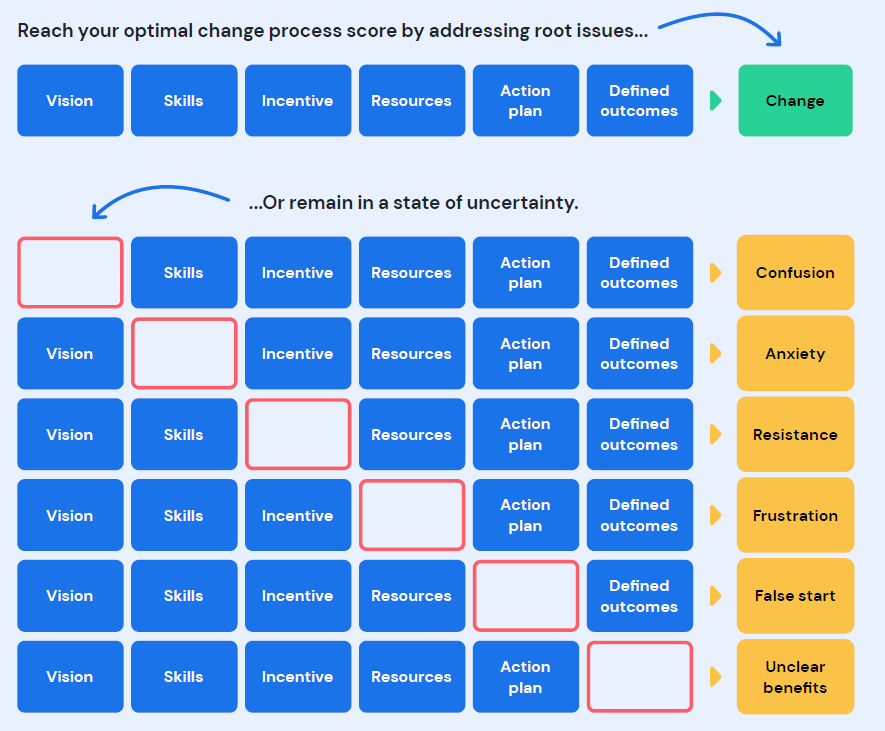
Address roadblocks with the Change Scorecard
The Change Scorecard provides a diagnostic view of how the change process is going. It links
observed symptoms like frustration or disengagement back to root issues such as lack of
incentives or skills. Once identified, these can be addressed strategically to bring the change
process back on track.
The Change Scorecard
Build a compelling change vision with a clear understanding of “what’s in
it for me.”
Organizations can lessen its resistance to change by providing a clear understanding of
the change vision, its benefits and success criteria. Leverage this short template to craft
impact statements that articulate
- what we’re doing,
- why we’re doing it,
- and how we know we’ve done it well.

Communications and the rule of 7
One of the biggest problems with communication is the assumption that it has taken place, this is why it’s important to follow the “Rule of 7” when communicating: 7 times, 7 ways, 7 different days!
Don’t forget to include the top questions from stakeholders, including:
- What is changing?
- Why are we changing?
- What is staying the same?
- What is expected of me?
People readiness and training
In order to enact change, the team responsible for making the change must be both willing (understand the benefits and willing to change) and able (have the skills, processes and systems in place to change).
A robust change management program will ensure that there are both people readiness strategies and training enablement programs to ensure users have what they need to succeed.
Change champion network and pulse checks
Establishing a change champion network of super users, especially for teams spread across locations and time zones, is an excellent mechanism to increase support networks and disseminate of information both from the project team to the end users, and from the end users back to the core team. Additionally, Pulse Checks are excellent tools for gauging user sentiment during the transition. Regular check-ins can identify specific pain points and offer opportunities to correct the course. These are not just about gathering data but also serve as moments to clarify misconceptions and provide needed information.

 bleu-azur-consulting.eu