The Global Risks Report 2018

Last year’s Global Risks Report was published at a time of heightened global uncertainty and strengthening popular discontent with the existing political and economic order. The report called for “fundamental reforms to market capitalism” and a rebuilding of solidarity within and between countries.

One year on, a global economic recovery is under way, offering new opportunities for progress that should not be squandered: the urgency of facing up to systemic challenges has, if anything, intensified amid proliferating indications of uncertainty, instability and fragility. Humanity has become remarkably adept at understanding how to mitigate conventional risks that can be relatively easily isolated and managed with standard riskmanagement approaches. But we are much less competent when it comes to dealing with complex risks in the interconnected systems that underpin our world, such as organizations, economies, societies and the environment. There are signs of strain in many of these systems: our accelerating pace of change is testing the absorptive capacities of institutions, communities and individuals. When risk cascades through a complex system, the danger is not of incremental damage but of “runaway collapse” or an abrupt transition to a new, suboptimal status quo.

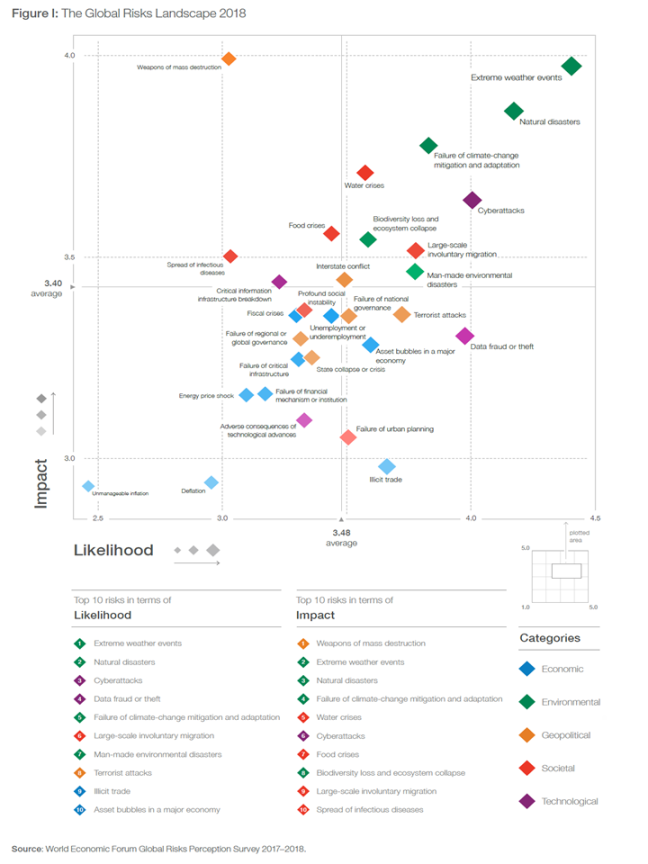
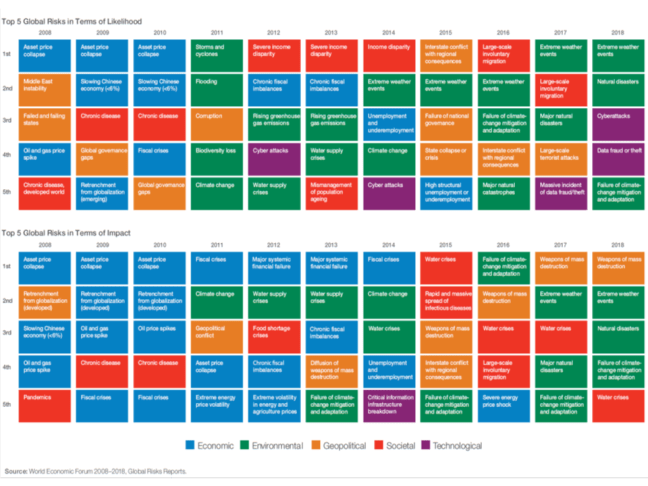
In our annual Global Risks Perception Survey, environmental risks have grown in prominence in recent years. This trend has continued this year, with all five risks in the environmental category being ranked higher than average for both likelihood and impact over a 10-year horizon. This follows a year characterized by high-impact hurricanes, extreme temperatures and the first rise in CO2 emissions for four years. We have been pushing our planet to the brink and the damage is becoming increasingly clear. Biodiversity is being lost at mass-extinction rates, agricultural systems are under strain and pollution of the air and sea has become an increasingly pressing threat to human health. A trend towards nation-state unilateralism may make it more difficult to sustain the long-term, multilateral responses that are required to counter global warming and the degradation of the global environment.

Cybersecurity risks are also growing, both in their prevalence and in their disruptive potential. Attacks against businesses have almost doubled in five years, and incidents that would once have been considered extraordinary are becoming more and more commonplace. The financial impact of cybersecurity breaches is rising, and some of the largest costs in 2017 related to ransomware attacks, which accounted for 64% of all malicious emails. Notable examples included the WannaCry attack—which affected 300,000 computers across 150 countries—and NotPetya, which caused quarterly losses of US$300 million for a number of affected businesses. Another growing trend is the use of cyberattacks to target critical infrastructure and strategic industrial sectors, raising fears that, in a worst-case scenario, attackers could trigger a breakdown in the systems that keep societies functioning.

Headline economic indicators suggest the world is finally getting back on track after the global crisis that erupted 10 years ago, but this upbeat picture masks continuing underlying concerns. The global economy faces a mix of long-standing vulnerabilities and newer threats that have emerged or evolved in the years since the crisis. The familiar risks include potentially unsustainable asset prices, with the world now eight years into a bull run; elevated indebtedness, particularly in China; and continuing strains in the global financial system. Among the newer challenges are limited policy firepower in the event of a new crisis; disruptions caused by intensifying patterns of automation and digitalization; and a build-up of mercantilist and protectionist pressures against a backdrop of rising nationalist and populist politics.

The world has moved into a new and unsettling geopolitical phase. Multilateral rules-based approaches have been fraying. Re-establishing the state as the primary locus of power and legitimacy has become an increasingly attractive strategy for many countries, but one that leaves many smaller states squeezed as the geopolitical sands shift. There is currently no sign that norms and institutions exist towards which the world’s major powers might converge. This creates new risks and uncertainties: rising military tensions, economic and commercial disruptions, and destabilizing feedback loops between changing global conditions and countries’ domestic political conditions. International relations now play out in increasingly diverse ways. Beyond conventional military buildups, these include new cyber sources of hard and soft power, reconfigured trade and investment links, proxy conflicts, changing alliance dynamics, and potential flashpoints related to the global commons. Assessing and mitigating risks across all these theatres of potential conflict will require careful horizon scanning and crisis anticipation by both state and nonstate actors.

This year’s Global Risks Report introduces three new series:

  1. Future Shocks,
  2. Hindsight,
  3. Risk Reassessment.

Our aim is to broaden the report’s analytical reach: each of these elements provides a new lens through which to view the increasingly complex world of global risks.

Future Shocks is a warning against complacency and a reminder that risks can crystallize with disorientating speed. In a world of complex and interconnected systems, feedback loops, threshold effects and cascading disruptions can lead to sudden and dramatic breakdowns. We present 10 such potential breakdowns—from democratic collapses to spiralling cyber conflicts—not as predictions, but as food for thought: what are the shocks that could fundamentally upend your world?

In Hindsight we look back at risks we have analysed in previous editions of the Global Risks Report, tracing the evolution of the risks themselves and the global responses to them. Revisiting our past reports in this way allows us to gauge risk-mitigation efforts and highlight lingering risks that might warrant increased attention. This year we focus on antimicrobial resistance, youth unemployment, and “digital wildfires”, which is how we referred in 2013 to phenomena that bear a close resemblance to what is now known as “fake news”.

In Risk Reassessment, selected risk experts share their insights about the implications for decisionmakers in businesses, governments and civil society of developments in our understanding of risk. In this year’s report, Roland Kupers writes about fostering resilience in complex systems, while Michele Wucker calls for organizations to pay more attention to cognitive bias in their risk management processes.
GRR2018 1

GRR2018 2

Click here to access WEF – Marsh’s detailed Global Risk Report 2018
Mastering Risk with “Data-Driven GRC”

Overview

The world is changing. The emerging risk landscape in almost every industry vertical has changed. Effective methodologies for managing risk have changed (whatever your perspective:

  • internal audit,
  • external audit/consulting,
  • compliance,
  • enterprise risk management,

or otherwise).

Finally, technology itself has changed, and technology consumers expect to realize more value, from technology that is more approachable, at lower cost.

How are these factors driving change in organizations?:

Emerging Risk Landscapes

Risk has the attention of top executives. Risk shifts quickly in an economy where “speed of change” is the true currency of business, and it emerges in entirely new forms in a world where globalization and automation are forcing shifts in the core values and initiatives of global enterprises.

Evolving Governance, Risk, and Compliance Methodologies

Across risk and control oriented functions spanning a variety of

  • audit functions,
  • fraud,
  • compliance,
  • quality management,
  • enterprise risk management,
  • financial control,

and many more, global organizations are acknowledging a need to provide more risk coverage at lower cost (measured in both time and currency), which is driving reinventions of methodology and automation.

Empowerment Through Technology

Gartner, the leading analyst firm in the enterprise IT space, is very clear that the convergence of four forces,

  • Cloud,
  • Mobile,
  • Data,
  • and Social

is driving the empowerment of individuals as they interact with each other and their information through well-designed technology. In most organizations, there is no coordinated effort to leverage organizational changes emerging from these three factors in order to develop an integrated approach to mastering risk management. The emerging opportunity is to leverage the change that is occurring, to develop new programs; not just for technology, of course, but also for the critical people, methodology, and process issues. The goal is to provide senior management with a comprehensive and dynamic view of the effectiveness of how an organization is managing risk and embracing change, set in the context of overall strategic and operational objectives.

Where are organizations heading?

“Data Driven GRC” represents a consolidation of methodologies, both functional and technological, that dramatically enhance the opportunity to address emerging risk landscapes and, in turn, maximizing the reliability of organizational performance. This paper examines the key opportunities to leverage change—both from a risk and an organizational performance management perspective—to build integrated, data-driven GRC processes that optimize the value of audit and risk management activities, as well as the investments in supporting tools and techniques.

Data Driven GRC

Click here to access ACL’s detailed White Paper

The Imperative to Raise Enterprise Risk Intelligence

How to raise enterprise risk intelligence

  • Break down silos and collaborate. To ensure all risks are addressed, finance, operations, compliance, legal and IT functions should work together in managing enterprise risks. According to 53 percent of respondents, there is little, if any, collaboration among these functions to achieve a clearly defined enterprise risk management strategy.
  • Focus on accomplishments that will make a difference. The findings reveal a significant gap between the most important features of a risk intelligence platform and what features are actually accomplished. The features considered most important but rarely accomplished are:
    • Business continuity response (produces plans, runs business impact analyses, resiliency controls and engages stakeholders in crisis drills and recovery)
    • Incident/issue risk response (coordination of classification, collaboration, evidence, policies and reporting across the organization for all operational and security risk events)
    • Operational risk & compliance (creates risk registers and runs Risk and Compliance Self-Assessments (RCSAs) against critical business processes to report key risk indicators (KRIs), findings and loss events)
    • Threat and vulnerability mitigation (automates continuous risk correlation, prioritization and remediation of assets and operation criticality, threat reachability, control and vulnerabilities)
  • Establish a formal budget for enterprise risk management. It is critical to allocate resources specifically designated to achieving a well-executed enterprise risk management program. Fiftyeight percent of respondents say their organizations do not have a formal budget.
  • Engage management and the board of directors in the organization’s risk strategy. The inability to get started was one of the top three barriers to achieving risk management objectives. Senior leadership’s involvement will incentivize and motivate collaboration and a formal process for achieving the objectives of a risk management program.
  • Achieve clarity of your IT assets and infrastructure. A clear map of the infrastructure and categorization of assets, especially high value and knowledge assets, is key to ensuring appropriate risk measures are in place. Only 24 percent of respondents say they have categorized assets based on their business criticality.
  • Assign accountability for the achievement of specific risk management objectives. According to the findings, either no one person has overall responsibility or it is dispersed throughout the organization.
  • Measure effectiveness in risk intelligence efforts. Only 31 percent of respondents say their organizations have specific metrics to determine how well risks are being managed. Many organizations represented in this study are not measuring such key objectives as time to contain threats and attacks, time to identify and pinpoint high-risk areas and time to remediate after containment of the attack.
  • Consolidated risk reporting is essential. Sixty-three percent of respondents say it is essential or very important to have a centralized or consolidated risk reporting (one set of metrics) in order to achieve a strong security posture.
  • Replace complexity with ease of use. The number one barrier to achieving risk management objectives is the complexity of technologies that support risk management objectives. Understandably, the number one feature of a risk management solution is ease of use (53 percent of respondents). Investments in risk management technologies that end up on the shelf because of complexity and the lack of in-house expertise will frustrate any attempts to achieve an enterprise risk management program.

ERM Survey

2017_Report_on_ERM

How GRC Strategy & Integration Affects Confidence

Every organization does GRC whether they use the acronym or not. All have some approach to governing the organization, managing risk, and addressing compliance. It could be scattered in silos and disconnected, or it could be highly collaborated and integrated. Organizations should not be asking if they should do GRC but are to ask how mature their organization’s approach to GRC is and how it can be improved.

The formal definition for GRC found in the OCEG GRC Capability Model is that “GRC is a capability to reliably achieve objectives [governance] while addressing uncertainty [risk
management] and acting with integrity [compliance].” In the ideal world there is a natural flow through to GRC.

  • Governance sets objectives and directs and steers the organization setting the context for risk management.
  • Risk management aims to understand and minimize uncertainty in those objectives and reduce exposure to loss while maximizing performance.
  • Compliance assures that the organization operates with integrity to the boundaries established inorganization values, policies, regulatory and legal requirements, as well as boundaries set by risk limits and thresholds.

However, within many organizations there are often many GRC functions operating in isolation producing redundancy and gaps while remaining ignorant of the interrelationship of risk across silos. This has a measurable cost to the organization in
inefficiency, ineffectiveness, and lack of agility. Other organizations have mature and structured processes and reporting on GRC that brings together an integrated and
orchestrated view of GRC processes and information.

The goal of this 2017 OCEG GRC Maturity Survey report is to help organizations:

  • Understand the level of integration of GRC within organizations;
  • Differentiate the degree of confidence in performance with the ability to identify and manage risks and requirements;
  • Examine the benefits of an integrated GRC capability and the negative effects of siloed operations.

Integrated GRCClick here to access OCEG’s detailed analysis.