The General Data Protection Regulation (GDPR) Primer – What The Insurance Industry Needs To Know, And How To Overcome Cyber Risk Liability As A Result.

SCOPE

The regulation applies if the

  • data controller (organization that collects data from EU residents)
  • or processor (organization that processes data on behalf of data controller e.g. cloud service providers)
  • or the data subject (person)

is based in the EU. Furthermore, the Regulation also applies to organizations based outside the European Union if they collect or process personal data of EU residents. Per the European Commission, “personal data is any information relating to an individual, whether it relates to his or her private, professional or public life. It can be anything from

  • a name,
  • a home address,
  • a photo,
  • an email address,
  • bank details,
  • posts on social networking websites,
  • medical information,
  • or a computer’s IP address.”

The regulation does not apply to the processing of personal data for national security activities or law enforcement; however, the data protection reform package includes a separate Data Protection Directive for the police and criminal justice sector that provides robust rules on personal data exchanges at national, European and international level.

SINGLE SET OF RULES AND ONE-STOP SHOP

A single set of rules will apply to all EU member states. Each member state will establish an independent Supervisory Authority (SA) to hear and investigate complaints, sanction administrative breaches, etc. SA’s in each member state will cooperate with other SA’s, providing mutual assistance and organizing joint operations. Where a business has multiple establishments in the EU, it will have a single SA as its “lead authority”, based on the location of its “main establishment” (i.e., the place where the main processing activities take place). The lead authority will act as a “one-stop shop” to supervise all the processing activities of that business throughout the EU. A European Data Protection Board (EDPB) will coordinate the SAs.

There are exceptions for data processed in an employment context and data processed security, that still might be subject to individual country regulations.

RESPONSIBILITY AND ACCOUNTABILITY

The notice requirements remain and are expanded. They must include the retention time for personal data and contact information for data controller and data protection officer must be provided.

Automated individual decision-making, including profiling (Article 22) is made disputable. Citizens now have the right to question and fight decisions that affect them that have been made on a purely computer generated basis.

To be able to demonstrate compliance with the GDPR, the data controller should implement measures which meet the principles of data protection by design and data protection by default. Privacy by Design and by Default require that data protection measures are designed into the development of business processes for products and services. Such measures include pseudonymizing personal data, by the controller, as soon as possible.

It is the responsibility and liability of the data controller to implement effective measures and can demonstrate the compliance of processing activities even if the processing is carried out by a data processor on behalf of the controller.

Data Protection Impact Assessments must be conducted when specific risks occur to the rights and freedoms of data subjects. Risk assessment and mitigation is required and prior approval of the Data Protection Authorities (DPA) is required for high risks. Data Protection Officers (DPO) are to ensure compliance within organizations.

DPO must be appointed:

  • for all public authorities, except for courts acting in their judicial capacity
  • if the core activities of the controller or the processor consist of
  • by their nature, their scope and/or their purposes, require regular and systematic
    monitoring of data subjects on a large scale
  • processing on a large scale of special categories of data pursuant to Article 9 and
    personal data relating to criminal convictions and offences referred to in Article 10
    processing operations which, for the purposes of national
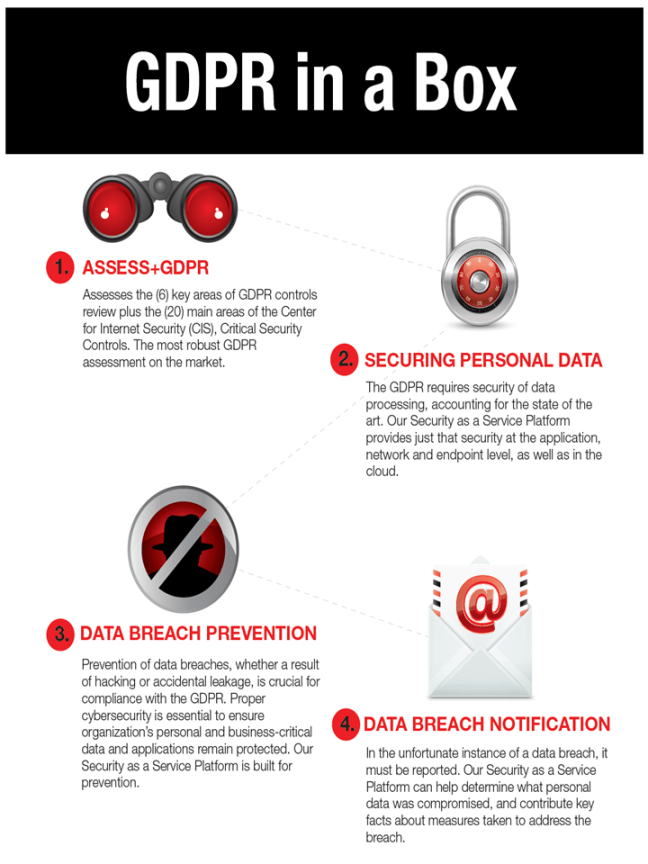
GDPR in a Box


Click here to access Clarium’s detailed paper

Mastering Risk with “Data-Driven GRC”

Overview

The world is changing. The emerging risk landscape in almost every industry vertical has changed. Effective methodologies for managing risk have changed (whatever your perspective:

  • internal audit,
  • external audit/consulting,
  • compliance,
  • enterprise risk management,

or otherwise).

Finally, technology itself has changed, and technology consumers expect to realize more value, from technology that is more approachable, at lower cost.

How are these factors driving change in organizations?:

Emerging Risk Landscapes

Risk has the attention of top executives. Risk shifts quickly in an economy where “speed of change” is the true currency of business, and it emerges in entirely new forms in a world where globalization and automation are forcing shifts in the core values and initiatives of global enterprises.

Evolving Governance, Risk, and Compliance Methodologies

Across risk and control oriented functions spanning a variety of

  • audit functions,
  • fraud,
  • compliance,
  • quality management,
  • enterprise risk management,
  • financial control,

and many more, global organizations are acknowledging a need to provide more risk coverage at lower cost (measured in both time and currency), which is driving reinventions of methodology and automation.

Empowerment Through Technology

Gartner, the leading analyst firm in the enterprise IT space, is very clear that the convergence of four forces,

  • Cloud,
  • Mobile,
  • Data,
  • and Social

is driving the empowerment of individuals as they interact with each other and their information through well-designed technology. In most organizations, there is no coordinated effort to leverage organizational changes emerging from these three factors in order to develop an integrated approach to mastering risk management. The emerging opportunity is to leverage the change that is occurring, to develop new programs; not just for technology, of course, but also for the critical people, methodology, and process issues. The goal is to provide senior management with a comprehensive and dynamic view of the effectiveness of how an organization is managing risk and embracing change, set in the context of overall strategic and operational objectives.

Where are organizations heading?

“Data Driven GRC” represents a consolidation of methodologies, both functional and technological, that dramatically enhance the opportunity to address emerging risk landscapes and, in turn, maximizing the reliability of organizational performance. This paper examines the key opportunities to leverage change—both from a risk and an organizational performance management perspective—to build integrated, data-driven GRC processes that optimize the value of audit and risk management activities, as well as the investments in supporting tools and techniques.

Data Driven GRC

Click here to access ACL’s detailed White Paper

State of Digital Analytics: The Persistent Challenge of Data Access & Governance

Disjointed, inaccessible data is a major productivity inhibitor for analytics teams, diverting skilled resources from contributing to valuable business intelligence.

Analytics teams struggle with data access. In addition to listing data silos and data access among both their top data and analytics challenges, above, nearly three in five said it takes days or weeks to access all the data needed for their work or the work of the teams they manage. Only a third were able to access all their data in a day or less.

AMOUNT OF TIME FOR ANALYSTS AND ANALYTICS TEAMS TO ACCESS DATA

Nearly two in five analytics professionals are spending more than half of their work week on tasks unrelated to actual analysis. Forty-four percent of managers reported that more than half of their team’s work week is spent accessing, blending, and preparing data rather than analyzing it, while 31 percent of analysts said they spend more than half of their work week on data housekeeping.

TIME SPENT PREPPING DATA, RATHER THAN ANALYZING IT

As a result, the majority of analysts have found it necessary to learn programming languages specifically to help them access and/or prepare data for analysis. Outside of mandates from their employers, a full 70 percent of analysts reported taking it upon themselves to learn to code for this reason, and more than a quarter of those analysts have spent 80 or more hours learning to program.

ANALYSTS LEARNING PROGRAMMING SKILLS TO OVERCOME DATA ISSUES

It should go without saying that data professionals tasked with analyzing organizational information meaningfully and actionably cannot adequately perform their core job function without accurate data. Yet in addition to raising the data access challenges above, the industry is also split in terms of confidence in data accuracy. Nearly half reported that they question the accuracy of the data they or the teams they manage use regularly, while a little more than half said they are confident about their data.

Data Analysis

Click here to access TMMData’s detailed Survey Results