Greenwashing in Insurance – How Regulators Design a Framework

In 2023, EIOPA has published several recommandations and progress reports, the most insightful being:

  • Advice to the European Commission on Greenwashing – EIOPA-BoS-23/157 – 01 June 2023
  • Consultation Paper on the Opinion on sustainability claims and greenwashing in the insurance and pensions sectors – EIOPA-BoS-23/450 – 17 November 2023

Both documents contain highly important information and guidelines towards a future framework for the industry, a framework probably to be applicable no later than 2025.

As outlined in both papers, EIOPA addresses these guidelines in close cooperation with the two other ESA in charge of financial services supervision, EBA and ESMA. It’s advice summarizes this interconnectedness with a « Sustainable Finance Investment Value Chain » chart:

The Advice to the EC defines the meaning of « Sustainibility Claims« , the critical item to be addressed to analyse any kind of greenwashing activity within this value chain.

‘Sustainability claims’ are claims that state or imply that an entity or product ‘benefits’ the environment or society. The type of ‘benefit’ is varied and includes:

  • positively impacting sustainability factors;
  • not impacting sustainability factors;
  • minimizing negative impacts on sustainability factors;
  • minimizing the impact of climate change on society (this includes climate adaptation measures).

This understanding of ‘sustainability claims’ is consistent with the definition of “environmental claims” as defined in the EC proposed Directive as regards empowering consumers for the green transition which would amend the Unfair Commercial Practices Directive (UCPD): “‘environmental claim’ means any message or representation […], which states or implies that a product or trader has a positive or no impact on the environment or is less damaging to the environment than other products or traders, respectively, or has improved their impact over time”. ‘Sustainability claims’ as understood by EIOPA extends it to also cover social aspects.

Misleading sustainability claims can deceive consumers into buying products that are not aligned with their preferences, or into buying products from a pension or insurance provider that misleadingly portrays itself an entity with sustainability credentials. In such cases, consumers’ investments or premiums are re-routed away from sustainability factors.

Further, greenwashing occurrences erode consumers’ trust in providers’ ability to positively impact environmental or social factors. While EIOPA has not identified to date any major greenwashing cases in the insurance and pension sectors, because cases emerged in other sectors there may be already a general mistrust from consumers in relation to sustainability claims which can be made by providers. The EU-wide Eurobarometer survey carried out by EIOPA in June 2022 shows that 62% of EU consumers do not trust the sustainability claims made by insurance undertakings or distributors, while a similar percentage (63%) says that sustainability claims about insurance products are often misleading. Consumer representatives in their response to the ESA Joint CfE in January 2023 also reported limited trust in insurers and pension providers sustainability claims.

Additionally, misleading sustainability claims do not allow consumers as well as broader society to hold providers accountable for their environmental and social impact. This unaccountability might embolden providers to make misleading sustainability claims to gain a competitive advantage over other providers, after which these other providers might follow suit to close the competitive advantage, leading to more greenwashing occurrences.

Where and How Greenwashing Occurs in the Insurance and Pension Sectors

EIOPA differentiates seven major fields (three specific stages for insurers, three for IORPs and one common stage for both types of organizations) within the insurance and pensions lifecycle chart:

The major difference among insurers and IORPs are the reference to « products » and « schemes », taking into account the still highly heterogenous pension market and pension scheme providers within the EU.

In relation to the stages of the insurance and pensions lifecycle, respondents to the ESA Joint CfE provided views on the likelihood of the occurrence of greenwashing:

Declared likelihood shows that Marketing and Sales a clearly fingerpointed as they are considered « highly likely » to be subject to greenwashing. Without neglecting the other stages and especially the entity model and management clearly in the drivers’ seat of the other stages’ behaviour, let’s focus on the product delivery issues:

  • Marketing: main fields of potential greenwashing have their origins in the risks related to terminology and non-textual imagery.
  • Sales: information asymmetry or misleading information/disclosure as well as risks related to unsuitable product due to poor advice, incentives and distributors’ training are cited as potentially important and critical

Tackling Greenwashing

EIOPA regularly conducts surveys with the NCA to evaluate maturity and action plans as long as the framework is not in place.

Results are for the time being relatively mitigated as the large majority of NCA (21) didn’t identify greenwashing issues yet due to missing criteria to be applied and inexisting client related investigations. However, NCA reporting first actions are using several techniques EIOPA will probably evaluate and adopt for the future framework:

Very interesting also the survey results on the potential use of Suptech to deal with the enormous need to analyze data on products, sales and marketing practices:

Next Steps

Based on additional analyses, discussions and evidence that emerges by the delivery of the final report (May 2024), EIOPA will further refine its view on the definition of greenwashing, its impacts and risks (particularly on potential financial stability risk implications), as well as on how greenwashing can occur in the insurance and pensions lifecycle. To further exemplify the latter, EIOPA might develop case studies showing how greenwashing can emerge in practice.

EIOPA will also provide further considerations on the supervision of greenwashing, particularly in relation to any new greenwashing-related supervisory experiences and practices, as well as in relation to greenwashing-related supervisory and enforcement measures, if any.

Finally, EIOPA will further develop the list of issues it has already identified in the regulatory framework and based on those issues it will propose improvements – by way of recommendations – to the regulatory framework relevant to the insurance and pension sectors, including to Level 1 legislation. However as requested by the CfA, EIOPA will not make any proposals that would imply modifications of the Corporate Sustainability Reporting Directive (CSRD).

Digital Skills, Mindset, and Divide

Digital transformation doesn’t stop creating surprise, admiration, innovation … but also deception and divide. In 2023, Gen AI has taken the lead regarding use, high speed engagement, discovery, and implementation.

How Tech Executives Rank Other C-suite Leaders’ Digital Skills and Mindset

They give the highest marks for proficiency and mindset (the ability to imagine digital solutions)
to chief marketing, strategy and operations officers and CEOs among non-tech roles – and rank legal
and HR leaders lowest
, on average. Several potential reasons could explain this « gap »:

  • one of it probably being the traditionally less developed business partnership among CTO/CIO functions and HR and especially Legal departments as these functions either work with robust legacy or with low or no IT solutions to produce their output;
  • another root cause of underestimated « mindset » and « proficiency » might be stronger compliance requirements usually existing for HR and Legal functions, requirements natively less open for technical disruption;
  • finally, both functions are frequently « (dis)qualified » by IT management as being too « open to shadow IT » solutions.

Three-Quarters of CEOs Have Tried ChatGPT Since Its Launch

A third of chief executives who have used the tool for work used it for writing and communication. More than 20% have employed it for general research, followed by market research and presentations (13% each).

Definitely a great start compared to significantly lower C-level adoption of previous IT innovations and disruptions. However, given the extremely broad potential among all other functions within an organization, from front lines to back office and all support functions, it’s critical to involve executives and boards in all inititiatives identified or to be identified as critical and potentially disruptive and/or transformative for the organizations future.

Otherwise, the risk to underestimate value and underallocate investments could be huge (e.g. past experience with social network, IoT, data science … too often considered being « for their kids or for freaks » than for their organizations and business).

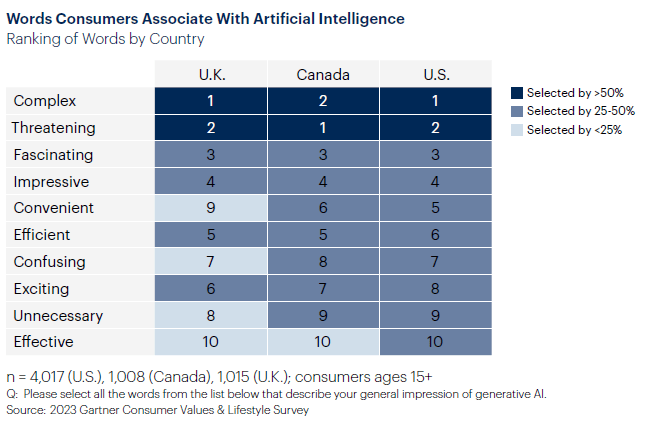
As Executives Laud AI, Consumers in the U.K., Canada and U.S. Express Fear

More than half of consumers in all three countries chose “complex” and “threatening” to describe AI, while “effective” was the least-selected word.

Not really a surprise as Big Tech is considered being a cunsumer unfriendly « oligopoly » after the skyrocketing of their market capitalization since Covid.

Fastly growing data privacy issues and cyber security incidents naturally add concerns regarding this technological disruption mainly built on Big Data and AI usage most consumers didn’t imagine prior to ChatGPT going mainstream.

How to Cope With Global Digital Divides

At least four digital infrastructures are emerging as ideology splits the world — in China, the U.S., the EU, and Russia. After three decades of global consistency for multinational companies, this shift has radical implications for business.

The number of national policies restricting data flows or access more than doubled from 2017 to 2021. With AI regulation following the same path, hoping this divided world will “return to normal” is futile. And a purely tactical C-suite response to one digital policy at a time is too costly.

To reduce risks to growth, executive leaders should instead view geopolitical and digital tensions strategically while reacting to measures in specific jurisdictions. That means:

  • Adjusting local enterprise technology architectures, operating models and corporate structures as needed
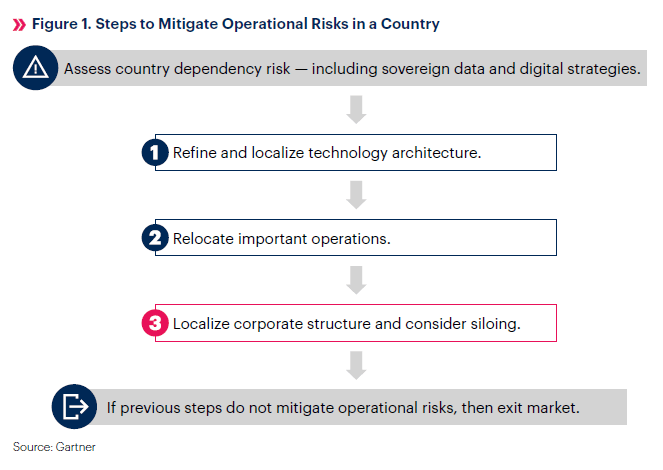
  • Exiting the market as the final resort if following the steps outlined in Figure 1 does not sufficiently mitigate operational risks

Assess Country Dependency Risk — Including Sovereign Data and Digital Strategies

Executive leaders should first determine the business impact of geopolitical and digital risks in a country — including regulations — and consider appropriate mitigating steps. For example, some
multinational enterprises that continued to operate in Russia after February 2022 had to adjust their technology stack when one or more of their technology suppliers left the country.

Many multinational organizations are assessing the potential for a similar problem to arise in other regions of high tension. They also now need to manage China’s Personal Information Protection Law (PIPL) and India’s new Digital Personal Data Protection Act (passed in August 2023 but not yet effective) while remaining compliant with the EU’s general data protection regulation (GDPR).

Because digital technology is central to business, digital regulations affect almost everything a company does (as well as nearly all consumers and public-sector activities). Executive leaders must, therefore, take a broad view of how their enterprise uses data (see Figure 2).

Evaluate your digital risk in a country using Figure 2 as a guide. Take each element as a potential risk area you need to gauge due to one or more sovereign data and digital regulations. While this process will depend on where and how your company operates, a standardized assessment across all elements will help you make consistent, actionable changes faster at a strategic level.

Executive leaders addressing the enterprisewide impact of increasing digital regulations should:

  • Identify the business scenarios and outcomes that are hardest to govern because of, for example,
    geographic and organizational diversity, complexity and autonomy.
  • Consider establishing a virtual team to govern data and analytics throughout business functions and across geographies to address one of these situations. Using this connected governance framework will involve creating a proof of concept to test the benefits, risks and impacts associated with the scenario.

What’s now and next in Analytics, AI, and Automation

Over the past few years, rapid technological advances in digitization and data and analytics have been

  • reshaping the business landscape,
  • supercharging performance
  • and enabling the emergence of new business innovations
  • and new forms of competition
  • and business disruption.

Yet progress has been uneven. While many companies struggle to harness the power of these technologies, companies that are fully leveraging the capabilities are capturing disproportionate benefits, transforming their businesses and outpacing—and occasionally disrupting—the rest.

At the same time the technology itself continues to evolve rapidly, bringing new waves of advances in

  • robotics,
  • analytics,
  • and artificial intelligence (AI),
  • and especially machine learning.

Together they amount to a step change in technical capabilities that could have profound implications for business, for the economy, and more broadly for society as a whole. Machines today increasingly match or outperform human performance in a range of work activities, including ones that require cognitive capabilities, learning, making tacit judgments, sensing emotion, and even driving—activities that used to be considered safe from automation. Adoption of these technologies could bring significant new performance and transformational benefits to companies that go beyond simply substituting labor and lead to previously unimagined breakthrough performance and outcomes. Moreover, they have the potential to boost the productivity of the global economy at a time when it is sorely needed for growth and the share of the working-age population is declining.

Yet their advent raises difficult questions about how companies can best prepare for and harness these technologies, the skills and organizational reinvention that will be required to make the most of them, and how the leaders in the private and public sector as well as workers will adapt to the impact on jobs, capability-building and the nature of work itself.

Disruption

MGI-Briefing-Note-Automation-final